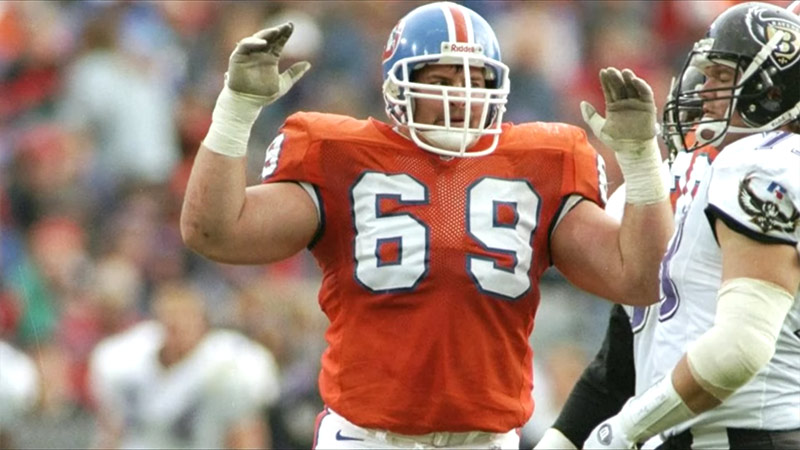
In the high-stakes world of professional football, nicknames are often forged in the fires of rookie training camps or earned through legendary feats on the field.
Most players hope for a moniker that evokes power, speed, or precision. Yet, one of the most respected offensive linemen in the history of the game, a man with three Super Bowl rings and a decorated career in broadcasting, carries a name that suggests something entirely different.
Mark Schlereth, known to millions of fans simply as “Stink,” possesses a nickname that is as legendary as it is visceral.
While many fans recognize the name from his time with the Washington Redskins and Denver Broncos, or his ubiquitous presence as an analyst, the true story behind the name is a masterclass in the grit, obsession, and sometimes grotesque realities of life in the NFL trenches.
The Cultural Catalyst: The Alaskan “Stinkhead”
To understand how a three-time champion became synonymous with an unpleasant odor, one must look back to Schlereth’s roots in Anchorage, Alaska.
When he entered the league as a rookie, his teammates were naturally curious about his background in the “Last Frontier.” Schlereth, always an open book, shared stories of traditional Alaskan delicacies, specifically a dish known as “stinkheads”.
“Stinkheads,” or tepa, are a traditional Alaskan Native dish consisting of fermented king salmon heads that have been buried in the ground for weeks.
It is a dish characterized by an incredibly pungent, unmistakable aroma. For his teammates in Washington, this was the perfect ammunition for locker room ribbing.
They initially began calling him variations of “Stinkhead” as a lighthearted jab at his Alaskan heritage. However, at this stage, the name was merely a joke about fish—it had not yet become the defining, career-long moniker that would stick for decades.
The 1990 Preseason: A Choice Between Relief and a Roster Spot
The nickname “Stink” was truly cemented during a preseason game in 1990, a moment that perfectly illustrates the precarious nature of life as an NFL substitute.
In the professional ranks, there is an unspoken but absolute rule: never leave the field. If you are a primary substitute or a fringe starter, leaving the game for even a few minutes to use the restroom provides an opportunity for the “next man up” to shine.
For Schlereth, the fear of losing his place on the depth chart outweighed any sense of personal decorum.
During this particular preseason contest, Schlereth found himself in a desperate situation. He needed to use the restroom urgently, but as a primary substitute, he was required to be ready at a moment’s notice.
Fearing that a trip to the locker room would result in him missing his chance to play, he made a radical decision. While sitting on the steel bench on the sidelines, Schlereth opted to relieve himself right then and there.
The act itself was a testament to his dedication to the game, but the physical reality of the situation was about to collide with the high-speed requirements of an NFL offense.
The “Splash” That Defined a Legacy
Moments after he had relieved himself on the sideline bench, the coaching staff called Schlereth into the game.
There was no time to change, no time to clean up, and certainly no time to explain. He trotted onto the field, his uniform soaked.
The incident reached its peak of notoriety during a practice snap or a specific play involving backup quarterback Stan Humphries.
In the standard mechanics of an NFL snap, the quarterback must place his hands directly under the center or, in some blocking schemes, maintain close physical proximity to the offensive line.
As Humphries moved into position to take the snap, he placed his hands against Schlereth’s lower back.
The physical pressure of the exchange caused a “splash” that reportedly hit Humphries in the eye. The reaction in the locker room and on the field was instantaneous. The story spread like wildfire through the organization.
The name “Stinkhead” was immediately shortened to “Stink,” and it transitioned from a joke about Alaskan fish to a description of Schlereth’s actual, on-field habit.
A 12-Year Commitment to “The Habit”
While many would view the 1990 incident as an embarrassing one-off mistake, Schlereth viewed it as a functional strategy for career longevity.
In interviews and memoirs, he has been remarkably candid about the fact that he continued this practice for the remainder of his 12-year career.
For Schlereth, “Stink” became a badge of honor that represented his “whatever it takes” mentality. He was a player who underwent 29 different surgeries—20 of those on his knees—to stay on the field.
In his mind, if he was willing to go under the knife dozens of times to protect his job, urinating in his pants during a game was a minor inconvenience.
He openly admitted that instead of running to the locker room and risking a missed snap, he simply continued the practice of relieving himself in his uniform.
This level of commitment is what separated the elite grinders from the average players of that era.
His teammates eventually stopped teasing him and started respecting the sheer insanity of his dedication. The moniker was no longer an insult; it was a testament to his obsession with availability.
The Philosophical Weight of a Name
In today’s NFL, with its heightened focus on hygiene, branding, and player comfort, the story of Mark Schlereth might seem like a relic of a more primitive age.
However, the story of “Stink” captures the essence of what it meant to play offensive line in the 1990s. It was a position defined by anonymity, physical suffering, and a desperate, almost paranoid need to remain indispensable.
Mark Schlereth didn’t become a three-time Super Bowl champion because he was the fastest or the strongest; he became a champion because he refused to leave the field for any reason. Whether it was a torn ligament or a full bladder, Schlereth remained at the line of scrimmage.
The nickname “Stink” serves as a permanent reminder that professional excellence often requires a willingness to endure things that most people would find unthinkable.
While the origin of the name might be stomach-turning, the legacy it represents is one of absolute, unyielding professional reliability.
In the end, Mark Schlereth proved that in the pursuit of greatness, it’s okay to have a name that stinks—as long as your game doesn’t.