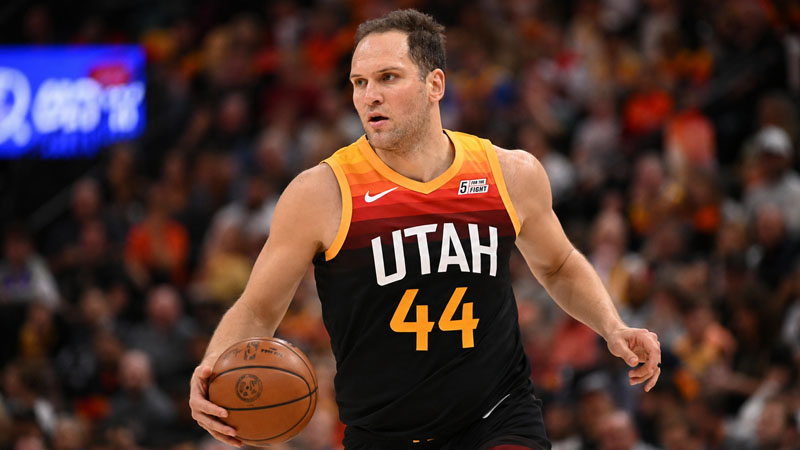
Bojan Bogdanović is generally not considered a good defender by modern NBA standards. Throughout his ten-year career, he has been classified as a below-average individual defender or a defensive liability, primarily valued for his elite floor spacing and scoring.
Statistically, he ranks among the lowest in the league for defensive playmaking, averaging just 0.6 steals and 0.1 blocks per game.
While he possesses a sturdy 6’7” frame and demonstrates high competitive effort—notably in his 2018 playoff battle with LeBron James—his lack of lateral quickness and verticality often requires defensive schemes to mask his limitations.
The Statistical Reality of Bogdanović’s Defensive Impact
When analyzing the defensive profile of a veteran like Bojan Bogdanović, the numbers provide a stark contrast to his offensive efficiency. Over 719 career games, his box-score metrics suggest a player who rarely disrupts the flow of an opposing offense.
His career Defensive Box Plus-Minus (DBPM) of -1.3 indicates that a league-average substitute would typically provide better defensive value.
This lack of impact is further evidenced by his career Defensive Rating of 113.9, which highlights a consistent trend of high points allowed while he is on the floor.
| Defensive Metric | Career Average / Value | Context & Meaning |
|---|---|---|
| Steals Per Game (SPG) | 0.6 | Extremely low for a perimeter wing player. |
| Blocks Per Game (BPG) | 0.1 | Indicates almost zero rim protection or weak-side help. |
| Defensive Rebounds (DREB) | 3.1 | Below average for a 6’7″ small/power forward. |
| Defensive Rating (DRtg) | 113.9 | Points allowed per 100 possessions (lower is better). |
| Defensive Box Plus-Minus | -1.3 | Performance relative to a league-average player. |
| Defensive Win Shares | 10.3 | Total wins contributed by defensive play over 719 games. |
Despite these low averages, there was a notable outlier in his career. During the 2018-19 season with the Indiana Pacers, Bogdanović recorded a career-best defensive rating of 109.8.
However, analysts attribute this peak less to individual improvement and more to Indiana’s elite team-defensive infrastructure at the time.
For the majority of his career, his “stocks” (combined steals and blocks) have hovered at a meager 0.7 per game, proving he is not a disruptive force in passing lanes.
Physical Limitations and the Scouting Report
Understanding why a player with standard positional size struggles defensively requires a look at his physical scouting report.
Standing 6’7” and weighing 226 pounds, Bogdanović has the build of a versatile forward, yet he often fails to leverage this size into defensive stops. His primary obstacles are rooted in his athletic profile rather than a lack of knowledge or desire.
The Challenge of Lateral Quickness and Agility
The most significant hurdle in Bogdanović’s defensive game is a severe lack of lateral foot speed. In the modern NBA, where “hunting” mismatches is a primary offensive strategy, Bogdanović frequently becomes the target for explosive guards and dynamic wings.
When caught in pick-and-roll switches, he often struggles to recover his position after navigating screens, allowing ball-handlers easy paths to the basket.
This lack of agility makes it difficult for him to stay in front of the league’s quicker perimeter threats, leading to a reliance on help defense.
Verticality and the Absence of Rim Protection
Beyond his perimeter struggles, Bogdanović offers virtually no secondary rim protection. His verticality is limited, which explains his historically low block totals—averaging just 0.1 per game.
Throughout his career, he has rarely been seen contesting shots at the summit or providing weak-side help to deter drives.
This lack of “explosion” means that once a player beats him on the perimeter, he has little chance of recovering for a meaningful contest at the rim.
Leveraging Strength in Post Situations
It is not all negative, as his physical strength remains his most reliable defensive tool. Because he weighs 226 pounds, he can hold his ground reasonably well as a situational post defender against slower, physical wing players.
He uses his frame to deny easy positioning in the paint, preventing opponents from simply overpowering him. This strength allows him to transition to the power forward position in certain lineups, though he is often viewed as an “offensively inclined” player in that role.
Scheme Dependency: The Utah Jazz and Rudy Gobert Factor
A critical component of evaluating Bogdanović’s defense is the environment in which he played, specifically during his tenure with the Utah Jazz.
In Utah, the defensive scheme was meticulously crafted to maximize the strengths of three-time Defensive Player of the Year Rudy Gobert, which had a unique effect on Bogdanović’s statistical output.
- The “Hiding” Strategy: Coaches frequently “stashed” Bogdanović on the opponent’s weakest offensive threat to minimize his exposure on the perimeter.
- Funneling toward the Rim: The Jazz defensive principle involved perimeter players staying attached to three-point shooters while funneling drivers toward Gobert in the paint.
- Discouraging Help Defense: Because the team trusted Gobert to defend the rim 2-on-1, perimeter players like Bogdanović were discouraged from leaving their assignments to help, which further suppressed their block and steal numbers.
- The Block Anomaly: In the 2021-22 season, Bogdanović famously recorded only one block in over 2,000 minutes of play, a statistic often cited as proof of his extreme reliance on the team’s rim protector.
- Scheme vs. Skill: While the system suppressed his numbers, critics argue that his career-long lack of blocks—even outside of Utah—proves he simply does not have the intuition for shot-blocking.
The 2018 Playoff Peak: A Case Study in Effort
If the metrics suggest a defensive liability, the 2018 Eastern Conference Quarterfinals offered a counter-narrative built on pure competitive will.
While playing for the Indiana Pacers, Bogdanović was tasked with the daunting assignment of guarding LeBron James. This series became the defining defensive moment of his career, showcasing how effort can sometimes mitigate physical shortcomings.
Aggressive Physicality as a Neutralizer
Knowing he lacked the speed to stay in front of James, Bogdanović utilized a high-energy, physical approach. He stayed low in his defensive stance, leaned into James to deny comfortable positioning, and used his 226-pound frame to disrupt rhythm.
By being “physical” and “aggressively challenging” every movement, he earned widespread praise for making James work for every basket, despite the obvious talent gap.
Maximum Effort and Competitive Drive
The series highlighted Bogdanović’s high competitive drive, proving that he was not a “turnstile” defender due to laziness. Coaches have long noted that while he lacks the athletic tools to be elite, he plays hard and follows the game plan.
This “ramp up” ability shows that in a playoff setting, he can provide value through sheer grit, even if the advanced metrics over an 82-game season suggest otherwise.
Comparing the “Stock” Deficit to NBA Peers
To fully grasp how unusual Bogdanović’s defensive statistics are, one must compare him to other players in the league, including those much smaller than him. His lack of “stocks” (steals and blocks) is statistically anomalous for a 6’7″ forward.
The Block Per Game Comparison
For much of his career, Bogdanović has recorded fewer blocks than some of the shortest players in the NBA.
For instance, in the 2020-21 season, players like Steph Curry and Facundo Campazzo recorded significantly more blocks than Bogdanović, despite being several inches shorter.
Even Isaiah Thomas has had seasons with more blocks than the Croatian forward. This lack of activity at the rim is often cited by fans and analysts as a sign of low defensive engagement or poor intuition regarding timing and verticality.
Activity Levels and Defensive Intuition
Critics point out that 6’7″ is generally considered a “good blocking height” for a wing, making his average of 0.1 blocks per game particularly glaring.
Some argue that this isn’t just a result of playing with a dominant rim protector like Rudy Gobert, as his low block totals persisted throughout his time with other franchises.
The consensus among many observers is that he simply does not possess the natural defensive “nose for the ball” required to generate turnovers or deflections.
Frequently Asked Questions About Bogdanović’s Defense
Is Bojan Bogdanović considered a liability in the playoffs?
While he is a target in isolation, he is not always a liability because of his effort and the ability of coaches to hide him in a team scheme.
His scoring often outweighs his defensive flaws, but in high-stakes series, teams will frequently “hunt” him in pick-and-roll switches to exploit his lack of lateral speed.
Why are his defensive stats so low?
His low stats are a combination of two factors: a lack of natural athletic explosion (lateral quickness and verticality) and the defensive systems he played in, which often prioritized him staying on shooters rather than helping in the paint.
Can a team win a championship with him as a starter?
Yes, provided he is surrounded by elite defensive talent. His time in Utah showed that a team can have a top-tier defense with him on the floor if they have a generational rim protector like Rudy Gobert to erase his perimeter mistakes.
What was his best defensive season?
His best statistical season was 2018-19 with the Indiana Pacers, where he posted a defensive rating of 109.8. This was largely credited to Indiana’s cohesive team defense rather than a significant leap in his individual defensive skills.
Final Assessment: A Specialist in a Team Context
In conclusion, Bojan Bogdanović’s defensive profile is that of a classic offensive specialist. While he is not a “good” individual defender by any metric, his career demonstrates that a player can remain highly valuable through elite scoring and a high competitive motor.
He is a player who requires a specific defensive infrastructure to be successful on that end of the floor—specifically, a scheme that limits his time guarding primary ball-handlers and provides strong help behind him.
Ultimately, while his “one block per season” statistics may be a point of mockery, his ability to compete physically in high-pressure moments like the 2018 playoffs proves he is more than just a bystander on the defensive end.
For a team looking to balance its floor spacing, the defensive trade-off that comes with Bogdanović has historically been one coaches are willing to make.