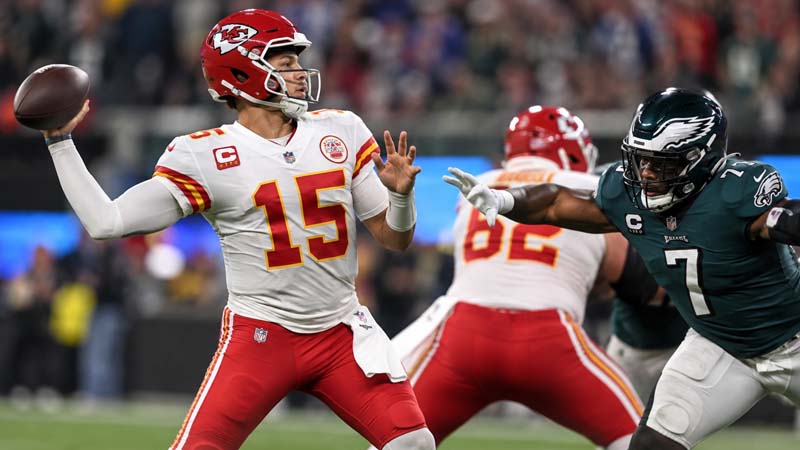
The forward pass is the single most transformative element in the history of gridiron football.
When the play was first introduced over a century ago, it completely altered the physical landscape of the sport, turning a congested, run-heavy game into a high-flying spectacle of athleticism and strategic depth.
However, the freedom to throw the ball downfield is not unlimited. To maintain fair play, structure, and competitive balance, football rulebooks enforce strict limitations on how, when, and where a forward pass may be executed.
When an offensive player violates these rules, officials throw a yellow flag for an illegal forward pass. While the penalty itself is simple, the mechanics governing what makes a pass legal versus illegal are among the most misunderstood aspects of the game.
The Three Foundations of a Legal Forward Pass
To understand why a pass is flagged as illegal, one must first understand what makes a forward pass legal in modern football.
Every offensive play is broadly classified as either a run or a pass. Running plays involve a player carrying the football upfield after a handoff, snap, or lateral, while passing plays involve throwing the ball forward to a receiver.
Under professional, collegiate, and high school rules, a forward pass is considered legal only when it meets three specific criteria:
- It is released from behind the line of scrimmage.
- It is the only forward pass attempted during that specific down.
- It is thrown before a change of team possession occurs during the play.
If a player attempts a forward pass that fails to meet any one of these three conditions, they have committed an infraction, and the play is dead or penalized.
The Three Primary Violations Explained
There are three distinct scenarios where a forward throw is designated as an illegal forward pass under the official rules of the game.
| Violation Type | Detailed Rule Description | Common Game Scenario |
|---|---|---|
| Beyond the Line of Scrimmage | The pass is thrown when the passer’s entire body and the football have completely crossed the neutral line of scrimmage. | A scrambling quarterback is flushed from the pocket, runs toward the line, and throws a desperation pass just as they cross the line. |
| Multiple Forward Passes | Offenses are strictly limited to one forward pass per play. Throwing a second forward pass on the same down is illegal, even if both passes occur behind the line. | A trick play where a short forward pass is thrown to a receiver, who then attempts to throw another forward pass further downfield. |
| After a Change of Possession | Once a turnover occurs (such as an interception or fumble recovery), the team that gained the ball cannot throw a forward pass during their return. | A defensive back intercepts a pass and, while being tackled during the return, attempts to throw the ball forward to a teammate to keep the play alive. |
The Battle of the Line of Scrimmage
The most frequent illegal forward pass penalty occurs when a quarterback or ball carrier throws the ball after crossing the line of scrimmage. In fast-paced games, quarterbacks are routinely forced to escape the passing pocket due to heavy defensive pressure.
As they scramble to the left or right, they must divide their attention between oncoming defenders and downfield receivers. In these split-second moments, a quarterback may release a pass without realizing how far they have traveled downfield.
The “Toeing the Line” Debate: Body vs. Ball
There is significant confusion among casual observers, and even some players, regarding the exact boundary line for a legal pass. Part of this confusion stems from simplified or poorly worded passages in standard rule summaries.
For example, certain guides suggest that if the football itself crosses the line of scrimmage, a forward pass is no longer permissible.
However, official rulebooks (such as NFL Rule 8-2-1-a) offer a much more precise and player-friendly definition:
- The Rule of Entirety: A forward pass is only ruled illegal if both the ball and the passer’s entire body are completely past the line of scrimmage at the exact moment the ball is released.
- The Trailing Foot: If even a small portion of the passer’s body (such as a heel, toe, or trailing foot) remains on or behind the line of scrimmage when they let go of the ball, the pass is completely legal.
- The Airborne Rule: This standard applies whether the passer is touching the turf or is airborne. If a quarterback jumps forward across the line of scrimmage and releases the ball while their entire body is in the air beyond the line, it is an illegal pass. If any part of their body was over or behind the line when they leaped, the pass remains legal.
This specific mechanical distinction is why elite modern scrambling quarterbacks are able to execute highly dramatic throws right on the edge of the line of scrimmage.
By keeping a heel planted on the white line while leaning their entire upper body and throwing arm forward over the line, they can legally deliver a pass downfield.
For defenders, this rule is incredibly challenging because they must respect the quarterback’s threat to run while knowing the quarterback can legally throw until every inch of their body has crossed into the secondary.
The Strategy and Physics of the Double Pass
The rule prohibiting multiple forward passes is designed to prevent offenses from completely overwhelming defensive coverage schemes.
If teams could legally throw consecutive forward passes on a single play, they could easily bypass coverage by throwing a series of short, vertical passes to move the defense out of position.
To bypass this restriction while still executing dynamic passing plays, coaches rely on a legal trick play known as the double pass.
[Quarterback (QB)]
       |
       |  (Passes backward or sideways)
       v
[Wide Receiver / Running Back]
       |
       |  (Passes forward downfield)
       v
[Eligible Receiver]
The double pass depends entirely on the legal distinction between a forward pass and a lateral pass. Under football rules, a throw is only classified as a forward pass if the ball travels forward from the exact coordinate where the passer releases it.
It does not matter where on the field the receiving player catches it; the initial trajectory of the ball determines its legal status.
- The Setup: If a quarterback takes the snap and throws the ball backward or parallel to the line of scrimmage to a teammate, that throw is legally a lateral (or backward pass), not a forward pass.
- The Execution: Because the first throw was a lateral, the receiving teammate is still legally allowed to throw one forward pass downfield to an open receiver.
- The Trap: If the quarterback’s initial throw travels even a fraction of an inch forward from the point of release, that throw is legally recorded as the offense’s single permitted forward pass. If the receiver catches that ball and attempts to throw it downfield, officials will immediately blow the whistle and penalize the offense for an illegal second forward pass.
Historical Evolution: How the Passing Rules Developed
The forward pass was not always the wide-open, tactical weapon it is today. Its implementation was a slow, highly regulated process designed to make a dangerous sport safer without destroying the traditional running game.
- 1906: The Original 5-Yard Rule: When the forward pass was first legalized in 1906, it came with massive structural limitations to prevent teams from using it constantly. The most restrictive of these was that a passer had to stand at least five yards behind the line of scrimmage to throw the ball forward. This meant that quarterbacks could not throw on the move near the line; they had to drop deep into the backfield to establish their passing position.
- 1933: The Modern Scrambler’s Charter: In 1933, the NFL completely overhauled its passing rules to increase offensive output and fan engagement. The league removed the five-yard buffer, making the forward pass legal from anywhere behind the line of scrimmage. This single change birthed the modern quarterback position, allowing players to run, roll out, and make decisions right up to the line of scrimmage.
The Penalty: Cost, Enforcement, and Official Signals
When an illegal forward pass is committed, the consequences are severe enough to stall an offensive drive. Unlike minor technical infractions, this penalty carries a double punishment that directly impacts both yardage and play frequency.
Penalty Metrics
- Yardage Loss: The offense is penalized 5 yards.
- Enforcement Spot: Unlike many pre-snap penalties that are enforced from the original line of scrimmage, the 5-yard penalty for an illegal forward pass is enforced directly from the spot of the foul (the exact location where the illegal pass was thrown).
- Loss of Down: The offense automatically loses the down. For example, if the infraction occurs on 2nd down, the next play will be 3rd down, and the offense will be moved 5 yards backward from where the illegal throw was released.
The Referee’s Signal
When an illegal forward pass is called, the referee will communicate the infraction to the stadium and television audience using a specific physical signal.
- The official will place one arm behind their lower back with an open hand.
- Keeping the arm in this position, the referee will move their hand and forearm up and down in a gentle patting motion against their lower back.
This signal is distinct from other passing penalties (such as intentional grounding or ineligible receiver downfield) and immediately tells coaches, players, and spectators that a pass was thrown from beyond the line or after a change of possession.
Detailed Rule Comparison: NFL vs. College (NCAA)
While the basic definition of an illegal forward pass is consistent across all levels of American football, there are minor differences in how the penalty is enforced and how the play is handled during live action.
- The Live Ball Status: In the NFL, an illegal forward pass does not immediately cause the play to be whistled dead. If a quarterback throws an illegal forward pass and it is intercepted by the defense, the defense can return the interception. The defense can then choose to decline the penalty and keep the results of the play. In some lower levels of football, the play may be blown dead immediately upon the release of an illegal pass to protect players from unnecessary contact.
- Enforcement Nuances: In both NFL and college football, the 5-yard penalty and loss of down are standard. However, the spot of enforcement can vary depending on whether the pass was thrown after a change of possession, in which case the yardage is enforced from the spot of the throw, but the loss of down does not apply to the returning team.
Interactive Knowledge Check: Legal vs. Illegal Play Scenarios
To test your understanding of the illegal forward pass rule, read through the following common game scenarios and determine whether the officials should throw a flag or let play continue.
The Flea Flicker
- The Play: The quarterback takes the snap, turns, and hands the ball off to the running back. The running back runs toward the line of scrimmage, then stops and tosses the ball backward to the quarterback, who has remained behind the line. The quarterback then throws a deep pass downfield to a wide receiver.
- The Ruling: LEGAL. Because the handoff was a running play and the toss back to the quarterback was a backward lateral, only one forward pass was thrown during the play.
The Desperation Flips
- The Play: On 3rd and 10, the quarterback scrambles past the line of scrimmage. Realizing they are about to be tackled short of the first down marker, they toss the ball forward to a running back who is running alongside them.
- The Ruling: ILLEGAL. The quarterback threw a forward pass after their entire body and the ball had crossed the line of scrimmage. The offense will be penalized 5 yards from the spot of that throw and lose the down, making it 4th down.
The Scrambler’s Leap
- The Play: A quarterback scrambles toward the line of scrimmage. Right at the line, they jump into the air. While airborne, they throw the ball forward to a receiver. At the moment of release, the quarterback’s feet are in the air over the line of scrimmage, but their shoulders and arm are leaning back behind the line of scrimmage.
- The Ruling: LEGAL. Because a portion of the passer’s body (their shoulders and upper torso) was still over or behind the line of scrimmage when the ball was released, the pass is legal.
Quick Rule Guide
| Rule Element | Professional (NFL) | Collegiate (NCAA) |
|---|---|---|
| Penalty Distance | 5 Yards | 5 Yards |
| Enforcement Spot | Spot of the Foul | Spot of the Foul |
| Loss of Down? | Yes | Yes |
| “Legal” Boundary | Any part of body behind the line | Any part of body behind line |
| Interception Status | Live ball, returnable | Live ball, returnable |
Understanding the intricacies of the illegal forward pass rule helps fans appreciate the strategic chess match taking place on the field.
The next time you watch a game and see a quarterback scrambling near the line of scrimmage, pay close attention to their feet—those few inches of turf make the difference between a spectacular play and a costly penalty flag.