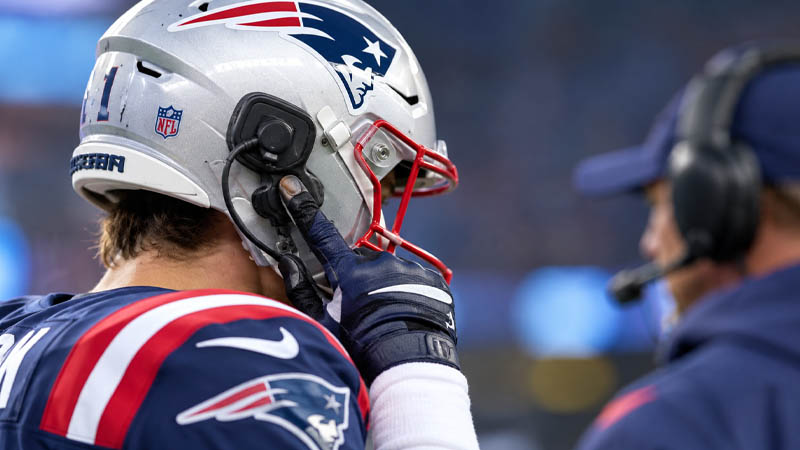
The modern National Football League is a masterclass in operational efficiency. Beneath the spectacular physical feats, the collisions, and the tactical chess matches lies a complex web of technology designed to coordinate 11 players in high-noise, high-pressure environments.
At the center of this technological infrastructure is a small, wireless receiver embedded inside a plastic shell: the helmet radio.
To the casual observer, the green sticker on the back of a quarterback’s helmet is a minor detail. In reality, it represents the vital node of a communications system that has fundamentally transformed professional football.
This technology bridges the gap between elite coaching staffs perched in high-stadium booths or standing on the sideline and the players executing split-second decisions on the grass.
Understanding why and how NFL teams use this system reveals the delicate balance between technological innovation, competitive fairness, and the preservation of human athletic instinct.
I. The Operational Core: Tempo, Precision, and Game Flow
The primary reason for introducing electronic communication in football was to improve efficiency. Football is a game of inches, but it is also a game of seconds.
With a 40-second play clock, delays in communicating instructions can lead to confusion, wasted timeouts, or costly delay-of-game penalties.
Streamlining the Play-Calling Pipeline
Before wireless communication became common, coaches depended on hand signals, flashcards, and player substitutions to communicate plays.
These methods were often slow and could easily be observed by opponents. Helmet radios transformed this process by allowing coaches to communicate directly with the quarterback.
Faster communication gives offenses more time to reach the line, study defensive formations, and make adjustments before the snap.
Eliminating the Vulnerability of Hand Signals
Hand signals are highly visible and can be studied by opposing teams. Helmet communication provides a more secure and direct method of delivering instructions. As a result, sideline signals are now mainly used as a backup when communication technology fails.
Empowering the On-Field General
The helmet radio gives the quarterback or defensive leader immediate access to the coaching plan. This helps organize teammates, establish assignments, adjust protections, and ensure everyone understands the strategy before the play begins.
II. The Technical Architecture: Inside the One-Way Audio Feed
The design of the NFL’s helmet communication system is defined as much by what it cannot do as by what it can.
The league operates under strict technical parameters to prevent technology from completely overshadowing the raw human elements of the sport.
+------------------+         Encrypted RF Signal         +--------------------+
|  Coaching Staff  | ----------------------------------> | On-Field Receiver  |
|  (Sideline/Box)  |                                     |  (Helmet Speaker)  |
+------------------+                                     +--------------------+
                                                                    |
                                                                    v
                                                         [ One-Way Feed Only ]
                                                         [  No Return Mic    ]
                                                                    |
                                                                    v
                                                         +--------------------+
                                                         | On-Field Leader    |
                                                         |  (QB/Linebacker)   |
                                                         +--------------------+
                                                                    |
                                                          Verbal Translation
                                                                    v
                                                         +--------------------+
                                                         |  Remaining Ten     |
                                                         |    Teammates       |
                                                         +--------------------+
The Mechanism of the One-Way Feed
Many fans assume helmet communication works like a phone or walkie-talkie. In reality, it is strictly one-way. Coaches can speak directly to players, but players cannot respond through the helmet.
A small, durable speaker is built into the helmet padding near the ears, with no microphone or two-way communication system. Quarterbacks who want to discuss a play or defensive formation must communicate verbally with teammates or wait until they reach the sideline.
Acoustic Engineering in High-Noise Environments
NFL stadiums can become extremely loud, sometimes exceeding 100 decibels. Helmet speakers are engineered to provide clear coaching instructions despite intense crowd noise.
Their placement and controlled audio frequencies help focus sound toward the player’s ears while limiting outside interference.
Encryption and Signal Security
Wireless play calls must remain secure from opposing teams. The NFL uses protected digital radio systems and encrypted transmissions to prevent unauthorized interception. These systems are also designed to resist radio interference and congestion during games.
III. The Regulatory Framework: The Green Dot and the 15-Second Cutoff
To preserve competitive integrity, the NFL imposes strict rules governing who may use helmet communication, when the system operates, and how the equipment is identified.
The Green Dot Identifier
Every helmet equipped with an active communication receiver must display a league-issued green dot on the back.
This visible marker allows officials to quickly identify players using the system and enforce roster limits. Only one player per team may have an active communication receiver on the field at a time.
This prevents teams from giving multiple players, such as a quarterback and wide receiver, simultaneous access to coaching instructions.
The 15-Second Cutoff
The communication system is also governed by a strict timing rule. The coach-to-player audio feed automatically shuts off when the play clock reaches 15 seconds, or immediately when the ball is snapped—whichever happens first.
This restriction ensures coaches cannot continuously direct players through the final moments before a play.
Once communication ends, the quarterback or designated defensive player must independently read the formation, identify potential blitzes or coverage changes, and make adjustments.
The rule preserves football’s strategic challenge by ensuring that players, rather than coaches, make the final on-field decisions.
IV. Strategic Implications: The On-Field Translation and Mental Battle
The technical limits of NFL helmet communication—especially the one-way feed and 15-second cutoff—create important strategic challenges for both offense and defense.
The Translation Bottleneck
Because only one player can hear the coach, that player carries a major cognitive responsibility. Offensive coordinators may transmit complex calls covering formations, blocking assignments, routes, and snap counts.
The quarterback must quickly understand the instructions and relay them to the other ten players. Crowd noise, confusion, or misunderstandings can make this difficult, and the quarterback cannot ask the coach to repeat the call. This makes communication a crucial part of offensive execution.
The 40-Second Play Clock
- 40s–15s: The coach communicates the play to the quarterback or defensive signal-caller, who relays the instructions to teammates.
- 15s: The communication feed automatically shuts off.
- 15s–0s: Players must operate independently, analyzing the formation and making final adjustments before the snap.
The Defensive Response: Levelling the Playing Field
To balance the advantage once enjoyed by offenses, the NFL allows one defensive player—usually a linebacker or safety—to receive coaching communication.
This player communicates alignments, coverage changes, and adjustments to teammates, creating a strategic battle between both sides.
The Post-Cutoff Chess Match
After the 15-second cutoff, players must rely on instinct and preparation. Defenses can disguise their intentions and shift coverage late, forcing quarterbacks to recognize changes and adjust protections or audibles without further coaching input. This makes the final seconds before the snap a critical tactical battle.
V. Historical Evolution: From Renegade Experiments to Standardized Technology
The NFL’s modern wireless communication system is the product of decades of experimentation, controversy, and regulatory changes. Its history began with an unusual experiment in 1956.
The Paul Brown Experiment
Cleveland Browns coach Paul Brown secretly worked with inventors John Campbell and George Sarles to create a short-range radio receiver for quarterback George Ratterman’s helmet. During a preseason game, however, the device suffered interference, picking up police and taxi transmissions.
Once the NFL discovered the experiment, Commissioner Bert Bell banned helmet communication over concerns about competitive fairness and technological advantages.
The Modern Return
Nearly four decades later, the NFL reconsidered the technology. In 1994, the league approved helmet communication for quarterbacks as part of efforts to improve game efficiency and support faster offenses. Unlike the earlier experiment, the modern system was carefully regulated and made available equally to both teams.
Defensive Communication
Initially, only offensive players could use helmet communication. That changed in 2008, when the NFL allowed one designated defensive player to use a communication helmet. Identified by the familiar green dot, this innovation helped defenses coordinate adjustments and better respond to increasingly complex, fast-paced offenses.
How Football Communication Differs Across Leagues
To truly appreciate the design of the NFL’s communication protocol, it is helpful to compare it to other leagues and sports, which have taken wildly different approaches to integrating technology into play-calling.
| Feature / League | National Football League (NFL) | College Football (NCAA) | Formula 1 (F1) | Major League Baseball (MLB) |
|---|---|---|---|---|
| Direction of Feed | One-Way (Coach to Player) | One-Way (Coach to Player) | Two-Way (Driver to Pit Wall) | One-Way (Catcher/Pitcher) |
| Active Microphones | No (Listen Only) | No (Listen Only) | Yes (Full Two-Way Chat) | No (Button-Press Input) |
| Timing Restrictions | 15-Second Cutoff / Snap | 15-Second Cutoff / Snap | None (Continuous Feed) | None (Between Pitches) |
| Visual Indicators | Green Dot Sticker on Helmet | Green Dot Sticker on Helmet | None (Integrated Telemetry) | None (Discreet Receivers) |
| Number of Receivers | One per team on the field | Up to three per team on the field | All drivers equipped | Multiple players equipped |
The Human Element in a Tech-Driven Era
The success of the NFL’s helmet communication system comes from its ability to enhance football without replacing the human element. Instead of making players dependent on technology, the system improves communication, speeds up play-calling, and allows coaches to deliver instructions more efficiently while leaving critical decisions to the athletes on the field.
The green dot helmet represents more than electronic communication—it represents leadership. The player wearing it must absorb complex instructions, process them quickly despite crowd noise and pressure, and communicate the essential information to teammates.
Once the communication system shuts off after 15 seconds, that player must rely on preparation, judgment, and composure to guide the team.
This balance between technology and human ability is a major part of what makes the NFL compelling. Modern communication systems improve efficiency and safety, but the outcome still depends on preparation, strategy, teamwork, quick thinking, and athletic execution when it matters most.