In the world of professional sports retail, the baseball bat is more than just equipment—it is a symbol of a national pastime and a high-demand commodity in the global marketplace.
In 2020 alone, baseball bats emerged as one of the top-selling sports items in the United States, signaling a massive opportunity for e-commerce merchants to capitalize on this evergreen niche.
However, for many growing brands, the primary barrier to entry isn’t sourcing the product, but the logistics of fulfillment.
The unique, elongated dimensions of a bat often intimidate shippers, leading to concerns over “oversized” fees, transit damage, and high international costs.
Yet, when approached with a professional logistics strategy, shipping a baseball bat is one of the most straightforward processes in your fulfillment chain.
Analyzing the Economics of Bat Shipping
Before a single label is printed, a world-class strategist must understand the variables that dictate profit margins. Shipping costs are never arbitrary; they are the result of a complex interplay between several key factors:
- Courier Service Selection: The choice between postal (USPS) and private (UPS/FedEx) carriers.
- Delivery Velocity: The premium paid for expedited versus ground services.
- Package Mass: While an average bat weighs approximately 3 pounds, packaging adds weight; most shipments are calculated at a 4-pound billable weight.
- Zonal Distance: The geographical span between the origin and the final destination.
- Dimensional Accuracy: The length and girth of the package, which can trigger “Oversized Shipping Fees” if not optimized.
Domestic Benchmarking: The New York to Chicago Corridor
To understand domestic scalability, consider a standard 4-pound package traveling from a logistics hub like New York to a central market like Chicago.
For eCommerce merchants, these rates represent the “baseline” of their domestic operations. Utilizing major couriers allows for a balance between speed and cost-efficiency.
International Market Penetration: Reaching the Global Fanbase
Scaling a brand requires looking beyond domestic borders. However, international logistics introduces variables like lead times and drastically different price points.
For example, shipping a 4-pound bat package from New York to London, UK, yields a wide variance in service levels:
| Courier Service | Lead Time | Estimated Price |
|---|---|---|
| FedEx International Connect Plus | 2 – 5 working days | $25.14 |
| FedEx International Priority | 6 – 7 business days | $39.24 |
| UPS Worldwide Expedited® | 4 – 5 business days | $45.52 |
| USPS Priority Mail International | 6 – 10 business days | $80.35 |
The Engineering of Protection – Precision Packaging
In eCommerce, your packaging is the first physical touchpoint of your brand. Damage in transit doesn’t just cost you the price of the item—it erodes customer trust and brand credibility. Follow this professional three-step protocol to ensure every bat arrives in “game-ready” condition.
Step 1: Primary Shielding with Bubble Wrap
The first line of defense is preventing cosmetic damage. Modern composite and wood bats are susceptible to scratches that can diminish their resale value.
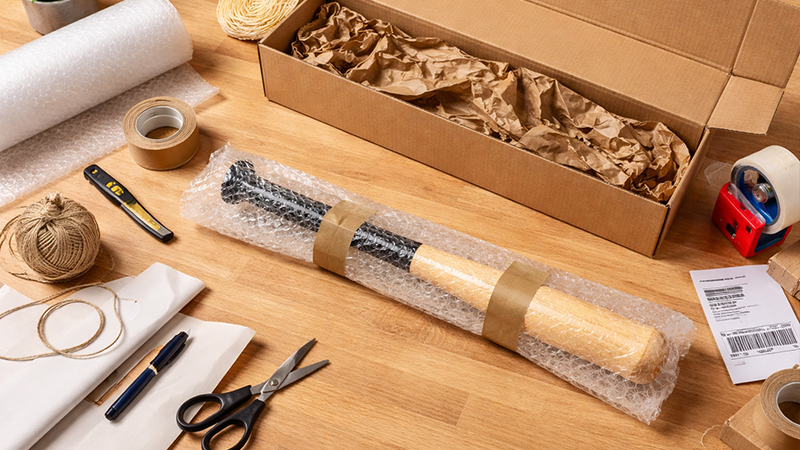
Wrap the bat entirely in bubble wrap, ensuring the material is taut and secured with high-grade packaging tape. This minimizes movement within the secondary container and provides a shock-absorbent layer.
Step 2: End-Cap Reinforcement and Internal Stabilization
The “ends” of the bat (the knob and the barrel) are the highest impact points during transit. Professional shippers must add cushioning materials—such as crumpled newspaper, tissue, or foam inserts—to both ends of the container.
This “stuffed” environment keeps the bat centered and prevents it from sliding, which is the leading cause of “punctured” boxes.
Step 3: Selecting the Optimized Container
Standard square boxes are inefficient for bats. The industry “gold standard” for a single bat is the USPS 38″ x 6″ x 5″ medium tube.
- Why this works: It is specifically engineered for elongated items and provides enough internal volume for the necessary cushioning.
- Strategic Tip: Merchants can often source these mailing tubes for free at the post office or online via USPS, significantly lowering overhead costs.
Advanced Risk Management and Best Practices
The Insurance Imperative
For high-value equipment—such as custom-engineered carbon fiber bats—relying on standard carrier liability is insufficient.
Utilizing comprehensive shipping insurance is a mandatory best practice. It guarantees protection against loss, theft, and damage, ensuring your bottom line remains intact even when a shipment goes awry.
Most major carriers (USPS, UPS, FedEx, DHL) offer international insurance options, providing peace of mind for global transactions.
Handling Multi-Bat Shipments
Efficiency dictates that bulk orders should be consolidated. When shipping multiple bats in a single package, each bat must be wrapped individually.
Use a reinforced, appropriately sized box or heavy-duty tube, and place ample padding between the bats to prevent them from colliding with each other.
Airline and TSA Compliance
For merchants traveling to trade shows or athletes moving gear, remember that bats are classified as security risks. They cannot be part of carry-on luggage and must be checked into the aircraft’s hold.
Claim Management
In the event of damage, speed is of the essence. Merchants should instruct customers to take immediate photos of the damaged packaging and the product. Filing a claim with the carrier promptly is the only way to recover costs.
Strategic Advantage through Logistics Technology
The difference between a struggling merchant and a market leader is often the technology they use to manage their supply chain. Easyship provides the infrastructure required to turn logistics into a competitive advantage.
1. Aggregated Courier Power
High-volume sellers can unlock exclusive discounts of up to 91% off retail shipping rates. By comparing over 550+ courier services in a single dashboard, you ensure you never overpay for a label.
2. Global Compliance and Tax Automation
Cross-border shipping is fraught with hidden costs. Utilizing an Import Tax & Duty Calculator allows you to provide transparent “landed costs” to your international customers, preventing “package refusal” at customs.
Furthermore, integrated HS Code lookup tools ensure your documentation is compliant with global regulations.
3. The Branded Post-Purchase Experience
A customer’s journey doesn’t end at checkout. Use a Branded Tracking Suite to provide custom tracking pages, logo-embedded emails, and personalized packing slips. This creates a high-end, professional feel that encourages repeat business.
4. Operational Efficiency Tools
- Shipping Policy Generator: Clearly communicate your returns and insurance policies to build trust.
- Automation Rules: Set triggers to automatically choose the “Cheapest” or “Fastest” shipping method based on the destination.
Enhanced FAQ: Professional Logistics Insights
Q: What is the most cost-effective packaging for a single bat?
A: The USPS 38″ x 6″ x 5″ medium tube is highly recommended. It balances structural integrity with a size that avoids the most aggressive oversized surcharges, while still allowing room for protective foam or bubble wrap.
Q: How long should I tell my customers to wait for their delivery?
A: Domestic shipments typically range from 1 to 5 business days. International shipments vary by service tier; economy services take 6-10 business days, while premium services like UPS Worldwide Expedited® can arrive in 4-5 days.
Q: Is international shipping worth the hassle for sports gear?
A: Absolutely. With tools like the Tax & Duty Calculator, the complexity of global trade is automated. International fans are often willing to pay a premium for authentic American baseball gear, provided the shipping cost is transparent and the tracking is reliable.
Q: Can I ship multiple bats in one tube?
A: Only if the tube is wide enough to prevent the bats from pressing against the sides. It is usually better to use a dedicated box for multi-bat shipments, ensuring each is individually wrapped to prevent clashing.
Conclusion: Step Up to the Plate
Mastering the logistics of shipping a baseball bat is a vital step in scaling your sports eCommerce business.
By moving from “standard” shipping to a data-driven, automated strategy, you protect your products, your profits, and your brand reputation.
Stop overpaying for retail labels and start shipping like a pro. Join the community of 100,000+ merchants who use Easyship to streamline their fulfillment.