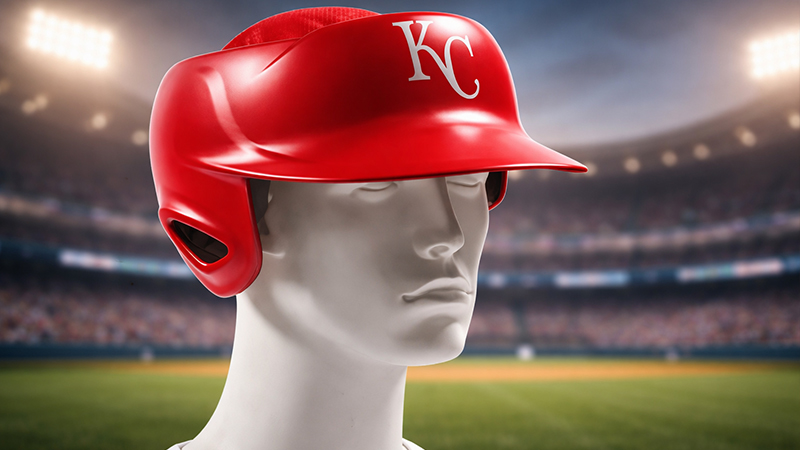
In the world of professional sports, few environments are as statistically perilous yet as traditionally stagnant as the space between a Major League Baseball (MLB) pitcher’s mound and home plate.
It is exactly 60 feet, 6 inches of high-velocity transit. While batters have been mandated to wear helmets to prevent lethal skull fractures since 1971, the men throwing the ball—who are often closer to the point of impact than the outfielders—remain protected by nothing more than a polyester-blend cap.
As a world-class SEO content strategist, I have analyzed the search intent, user journey, and biomechanical data surrounding this paradox.
This deep dive explores the physics of the “danger zone,” the medical realities of comebackers, and the complex biomechanical reasons why a simple helmet remains the most controversial piece of equipment in the game.
The Physics of the “Catastrophic” Comebacker
To understand the gravity of the situation, one must first analyze the sheer physics of the interaction. A major league batter stands roughly 60 feet away from the pitcher.
When a ball is struck with an exit velocity of 100 mph, the pitcher has less than half a second to react.
The Reaction Time Deficit
A pitcher essentially exists in a state of defensive vulnerability.
- The Velocity Factor: At 100 mph, a line drive covers the distance to the mound in approximately 0.4 seconds.
- The Proximity Problem: Because the pitcher’s momentum carries them forward, they often end their delivery even closer than 60 feet, narrowing the window for a reflexive “glove-save”.
- The Outcome: The impact of a ball at this speed is not something a player can simply “walk off”; it has the potential to be catastrophic or even fatal.
Case Studies in Impact
Several high-profile incidents that nearly shifted the league’s stance on safety:
- J.A. Happ (2013): Struck on the side of the head by a line drive, resulting in a bone fracture behind his left ear. While he was lucky enough to avoid a concussion, the sight of him being carried off on a stretcher shook the baseball community.
- Brandon McCarthy (2012): Suffered an epidural hemorrhage, brain contusion, and skull fracture. McCarthy required emergency brain surgery for what was described as a “life-threatening” situation.
- Doug Fister (2012): Beamed during the World Series; though he stayed in the game, the incident served as another reminder of the league’s “good fortune” that has yet to expire into a fatality.
Biomechanical Barriers: Why Pitchers Say “No.”
If the risk is life-threatening, why is there no mandate for headgear? The answer lies in the hyper-specific, almost ritualistic nature of the pitching delivery.
Violent Head Movement
Unlike batters, who are trained to keep their heads relatively still to track a pitch, a pitcher’s head moves “pretty violently” during the delivery.
Standard batting helmets are loose-fitting to allow for quick removal while running; on a pitcher, such a device would likely fly off before the ball even leaves their hand.
The Weight of Performance
Dr. Gary Green, MLB’s medical director, notes that adding a “several-pound object” to a pitcher’s head could fundamentally alter their biomechanics.
- Complexity of Motion: Pitching is a full-body, high-torque motion.
- Injury Risk: If a helmet “mucks with” the delivery, it could lead to secondary injuries in the shoulder, elbow, or back.
- The Perfectionist Factor: Pitchers are “super-perfectionists” who spend decades honing a specific throwing motion. Any shift in the center of gravity, no matter how slight, is often rejected immediately.
Peripheral Vision and Strategy
Strategic defense also plays a role. Pitchers rely on extreme peripheral vision to monitor baserunners. Bulky helmets, cages, or visors could limit this field of view, making it harder to hold runners on base or check for steals.
The Performance vs. Safety Trade-Off
One of the most revealing insights from the Hall of Fame Tom Glavine. He points out a cultural reality of the mound: pitchers will not sacrifice success for safety.
The “95 vs. 93” Dilemma
Modern pitchers focus heavily on max-effort deliveries to increase velocity. This high-torque approach often leaves them off-balance and out of a proper “fielding position” once the ball is released.
- The Logic: If a pitcher throws 95 mph, they are more successful but less safe. If they throw 93 mph to stay in a better defensive crouch, they are safer but more likely to be hit around by the batter.
- The Choice: Most pitchers would rather “take the chance” of being hit by a rare line drive than “tinker” with a delivery that is currently successful.
The Future of Protection: Technology and Tradition
The solution likely won’t be a helmet, but rather a tech-savvy cap or insert.
Current Technological Status
- Development: Eight companies were working on padded inserts or modified caps designed to meet MLB standards for both safety and comfort.
- The “Mario Bro” Prototype: Early attempts at padded caps were often mocked for being too bulky—one pitcher was noted to look like a “Mario Bro” while wearing one.
- The Standards Gap: Finding a material that is light enough for a “finely tuned machine” of a pitcher but strong enough to stop a 100 mph projectile is an ongoing engineering challenge.
The “Tragedy” Catalyst
There is a grim consensus among some observers that it may take a permanent disability or a fatality during a game to finally force a change in the rules.
Until then, the league continues to rely on the elite reflexes of its players—many of whom were shortstops in their youth—to use their gloves as their primary shields.
Enhanced FAQ: Addressing User Search Intent
Q: Why don’t pitchers wear the same helmets as batters?
A: Batting helmets are designed for a static head position. Because a pitcher’s head moves violently during a throw, these helmets would not stay on.
Additionally, the weight of a traditional helmet could disrupt the delicate biomechanics required to throw at an elite level, potentially causing arm injuries.
Q: Can a pitcher wear a face mask like a softball player?
A: While it would provide frontal protection, many MLB pitchers believe it would interfere with their peripheral vision, which is necessary to track baserunners.
There is also the “perfectionist” hurdle; most pitchers are unwilling to add any equipment that wasn’t part of their training from a young age.
Q: How often are pitchers actually hit in the head?
A: Statistically, it is a very rare event compared to the tens of thousands of pitches thrown each season. However, when it does happen, the results are often life-threatening, involving skull fractures or brain hemorrhages.
Q: Is the MLB working on a solution?
A: Yes. The league has been investigating padded caps and protective inserts for years. The difficulty remains in finding a design that meets the rigorous safety requirements without sacrificing player comfort or “looking ridiculous”.
Conclusion: The Standoff on the Mound
The refusal of MLB pitchers to wear head protection is a fascinating intersection of physics, biomechanics, and sports psychology.
While the 60-foot gap remains a danger zone, the “perfectionism” of the athletes and the violent mechanics of the sport have created a technological stalemate.
Until an engineering breakthrough provides a weightless, low-profile solution—or until a tragedy forces the league’s hand—pitchers will continue to step onto the mound with nothing but their reflexes and a cloth cap to protect them from the next 100 mph line drive.