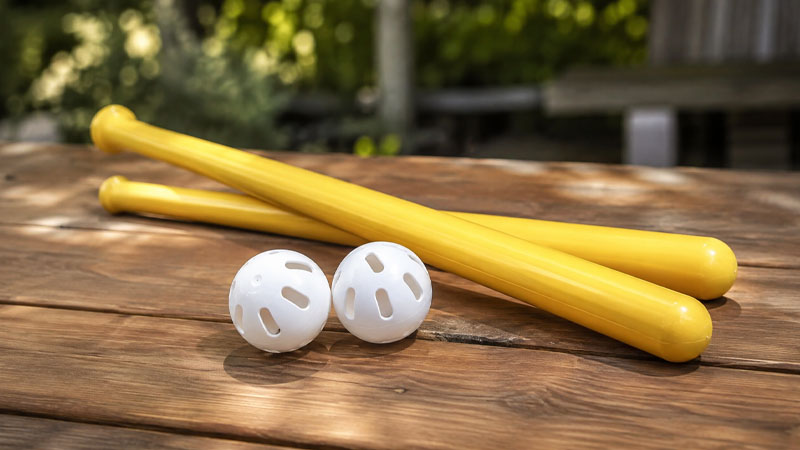
Hitting a Wiffle ball is widely considered one of the hardest tasks in casual sports. A plastic ball weighing under an ounce, perforated with eight slotted holes on one side, can curve up to 48 inches, sink like a stone, or rise unexpectedly above your hands.
Standard baseball hitting mechanics often lead to empty swings and frustration when applied to a Wiffle ball.
Mastering the strike zone requires a dedicated approach tailored to aerodynamics, pitcher mechanics, and specialized equipment.
This guide breaks down the science of pitch recognition, stance adjustments, and swing path control to help you consistently make solid contact and drive the ball.
Understanding Wiffle Aerodynamics & Pitch Recognition
To hit a pitch consistently, you must first understand why it moves. The signature movement of a Wiffle ball is governed by airflow differential: air passes quickly through the smooth side while creating drag and high pressure on the side with the slotted holes. The ball always breaks away from the holes.
Reading these physical traits before and during the pitch gives you a massive advantage at the plate.
The Four Primary Pitches to Master
The Classic Curveball
- How It Moves: Tails sharply away from a right-handed hitter when thrown by a right-handed pitcher.
- Visual Cue: The pitcher releases the ball over the top with the holes facing outward (away from your body).
- Hitting Adjustment: Shift your focal point to the outside edge of the plate. Let the ball travel deeper into the hitting zone before triggering your swing.
The Screwball (In-Curve)
- How It Moves: Breaks aggressively inward toward the batter’s hands.
- Visual Cue: The pitcher uses an over-the-top or three-quarters delivery with the holes facing inward (toward your body).
- Hitting Adjustment: Open your front hip slightly earlier or clear your hands to avoid getting jammed inside.
The Sinker (Drop Ball)
- How It Moves: Plummets vertically right as it reaches the plate.
- Visual Cue: Thrown with a sidearm or low three-quarters release with the holes oriented toward the ground.
- Hitting Adjustment: Avoid matching the plane of the pitch with an upper-cut swing. Keep your bat angle flat and hit the top half of the ball.
The Riser (High Fastball)
- How It Moves: Fights gravity, climbing above your hands late in its flight path.
- Visual Cue: Delivered sidearm or submarine style with the holes facing straight up to the sky.
- Hitting Adjustment: Resist the urge to chase high heat. If forced to swing, stay on top of the ball and match the upward trajectory with a firm top hand.
Adjusting Your Stance & Plate Coverage
Standard baseball hitting wisdom tells batters to stay centered in the box and maintain a classic posture. In competitive Wiffle ball, rigid adherence to traditional form can leave you vulnerable to sharp movement.
Step 1: Crowd the Plate
Pitchers rely on wide, sweeping movement to catch the outer edges of the strike zone or target plastic backstops. By standing closer to the plate, you accomplish two critical goals:
- You eliminate the inner third of the strike zone for the pitcher, forcing them to throw further out.
- You catch breaking pitches before they reach their maximum point of break.
Step 2: Use a Compact, Balanced Base
Wide, aggressive strides create head movement. When a ball is darting unpredictable distances, keeping your eyes level is mandatory.
- Keep your feet slightly wider than shoulder-width apart.
- Limit your stride to a simple toe-tap or soft weight shift onto your back hip.
- Maintain flex in your knees to absorb sudden changes in pitch elevation.
Step 3: Positioning Your Grip & Hands
Where you hold the bat alters your barrel control:
- Standard Yellow Thin Bat: Choke up 1 to 2 inches. This shortens the lever, allowing faster wrist rotation and better barrel control.
- Big Barrel / Plastic Enclosed Bats: Hold lower near the knob to maximize momentum, but maintain soft tension in your fingers to react to late breaks.
The Swing Mechanics: Precision Over Force
The lightweight nature of plastic bats leads many players to swing as hard as possible. However, maximum effort degrades barrel control and leads to excessive pop-ups or whiffs.
The Ideal Attack Angle
Keep your swing path flat to slightly down. Plastic balls compressed by heavy uppercut swings generate massive backspin, causing high, lazy pop-fly outs. A flat or slightly downward palm-up/palm-down contact angle creates sharp line drives that cut through wind and clear infield defenses.
Bat Speed vs. Contact Quality
Because a plastic bat weighs very little, you naturally generate high bat speed without exerting maximum physical effort. Focus on:
- Smooth Acceleration: Accelerate the bat through the hitting zone rather than snatching at the ball.
- Top-Hand Dominance: Guide the bat path with your top hand to keep the barrel from dipping below the plane of the pitch.
- Restrained Follow-Through: Finish your swing high and balanced, ensuring your body doesn’t pull off the pitch before contact.
Game Strategy: Plate Discipline & Pitcher Profiling
Successful hitting is 50% physical execution and 50% tactical awareness. Pitchers cannot throw every pitch for a strike, especially when factoring in wind and ball wear.
| Pitcher Strategy | Hitter Counter-Strategy | Objective |
| Heavy Curve Reliance | Move forward in the box; look for outside release points. | Intercept the pitch before peak lateral break. |
| Frequent Submarine Risers | Lay off high pitches; force ball down into the zone. | Draw walks or force pitches into a flat plane. |
| Targeting Backstop Edge | Shift plate position laterally; take away outside corner. | Narrow the pitcher’s viable target area. |
| Unpredictable Wind Usage | Shorten stride; choke up 1 inch on the bat handle. | Prioritize pure contact over raw power output. |
Recognizing Pitch Patterns
Most pitchers rely on a primary setup pitch. A pitcher who opens with a rising fastball will often follow with a drop ball to exploit your eye level changes. Track their patterns across multiple innings:
- Do they throw the slider when behind in the count?
- Do they switch hole orientation strictly for off-speed pitches?
- How does the wind affect their favorite break angle?
Equipment Considerations
Your hitting strategy must adapt to the specific gear being used in your game or league.
Thin Yellow Classic Bat
- Characteristics: Extremely light, narrow hitting surface, minimal weight in the barrel.
- Tactical Approach: Choke up, emphasize center-of-barrel contact, and use wrist control to guide line drives. Avoid pulling outside pitches.
Heavy-Barrel / Modified Bats
- Characteristics: Wider sweet spot, heavier overall weight, higher exit velocity.
- Tactical Approach: You can afford a slightly wider swing arc. Focus on driving pitches into gaps while using the extra surface area to make contact on late-breaking balls.
Frequently Asked Questions
Why do I keep popping up when I swing hard?
Popping up occurs when the bat barrel strikes the lower third of the ball with an upward trajectory. Because plastic balls are light, an upward swing accentuates backspin, launching the ball straight into the air. Flatten your swing plane and focus on hitting the top half of the ball.
How do I adjust to strong wind conditions?
Wind accentuates the movement caused by the ball’s holes. Headwinds cause pitches to rise or break more dramatically, while tailwinds flatten pitch movement. Choke up on the bat, reduce your stride, and wait half a second longer to ensure the ball finishes its movement before you swing.
Should I pull the ball or hit to the opposite field?
It depends entirely on pitch movement. Trying to pull a sharp away-curve leads to weak end-of-the-bat contact. As a rule, hit breaking pitches in the direction they are moving: push away-curves to the opposite field, and pull inside screwballs.