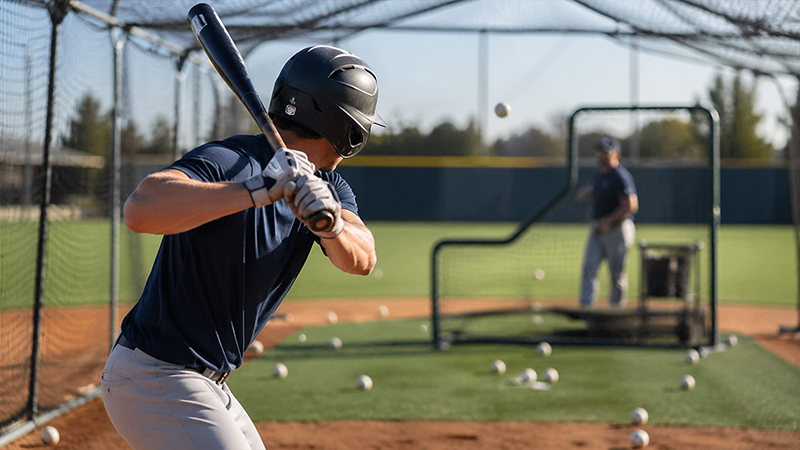
In the high-stakes world of diamond sports—whether you are anchoring a slowpitch team or climbing the ranks of collegiate baseball—the delta between a “good” hitter and a “dominant” one often boils down to a single variable: the precision of their practice schedule.
The debate over batting practice (BP) frequency is as old as the game itself. Some athletes fear that over-practicing leads to mechanical “over-thinking” or fatigue that “messes up” their game-day swing.
Conversely, the architectural framework of elite performance suggests that repetition is the cornerstone of mastery.
To achieve what we call the “Diamond Standard,” one must move beyond the casual “show up and swing” mentality and adopt a data-driven, frequency-optimized training regimen.
This comprehensive guide analyzes the optimal frequency, quality, and structure of batting practice, drawing on professional training standards and real-world athlete experiences to help you dominate your next season.
The Foundation: Why Frequency Matters (The Science of Muscle Memory)
At its core, hitting a ball is a feat of neurological and physical synchronicity. Diamond sports are more repetition-based than almost any other athletic endeavor.
If an athlete only swings six to ten times a week during a game, they will never approach their full potential.
The Fallacy of the “Practice Messes Me Up” Myth
There is a persistent myth that practicing can actually degrade performance. However, elite players and coaches suggest this is often an excuse for poor results or “mentally weak” preparation. The truth is more nuanced: practice only hurts if you are practicing bad habits.
The “Diamond Standard” dictates that practice does not make perfect; only perfect practice makes perfect. When you engage in high-frequency BP, you are not just burning calories; you are building muscle memory.
This neurological blueprint allows your body to react to a 90-mph fastball or a high-arc 12-foot pitch with subconscious precision, freeing your mind to focus on situational strategy rather than hand placement.
The Frequency Matrix: Tailoring Your Routine
Optimal frequency is not a one-size-fits-all metric. It must be calibrated based on your competitive level, the time of year, and your specific mechanical needs.
1. The Elite/Advanced Player (High School, College, Semi-Pro)
For those seeking to maintain a competitive edge at the highest levels, the frequency requirements are rigorous.
- Recommended Frequency: 5–7 days per week.
- Volume: 100–150 focused swings per session.
- Focus: Daily repetitions are essential to refine swing perfection and ensure the “barrel control” necessary for elite-level play.
2. The Recreational/League Player
Even for those playing in local “rec” leagues, a lack of practice is the quickest path to a losing season. Teams that practice hitting at least once a week often see a dramatic shift in performance—moving from a winless record to championship contenders within a single year.
- Recommended Frequency: 1–3 times per week.
- The “Powerhouse” Effect: Teams that skip practice often lose 70–80% of their games to more disciplined opponents. Even thirty minutes at a batting cage once a week can produce a “huge difference” in game-day results.
3. The Youth Player (9u–12u)
For younger athletes, the goal is to build a foundation without inducing burnout or physical strain.
- Recommended Frequency: 2 team practices plus 1–2 individual sessions per week.
- The Goal: Development over domination. At this stage, frequency should prioritize “intentionality” over raw volume to prevent the development of “bad habits” like throwing hands at every pitch.
Seasonal Calibration: Off-Season vs. In-Season
A “Global View” of the calendar year. Your frequency must shift according to the proximity of your competitive games.
The Off-Season: The “Mechanical Workshop”
The off-season is the time for high-volume, technical work. This is when you build the “engine” of your swing.
- Frequency: 3–5 days per week.
- Objective: Refine mechanics and build strength without the immediate pressure of game-day performance.
- Strategy: Many athletes begin with monthly BP in the early off-season (November/December), ramping up to weekly sessions by January/February. This “ramp-up” period ensures that the body is conditioned for the high-intensity demands of the spring season.
The In-Season: The “Maintenance Phase”
Once the season begins, the priority shifts from building to maintenance and recovery.
- Frequency: 2–3 times per week.
- Objective: Keeping mechanics sharp while avoiding fatigue.
- Strategy: Combining team practices with short, individual tee-work sessions is often sufficient to maintain a competitive swing.
Quality Over Quantity: The Anatomy of an Effective Session
A common mistake is equating “time spent” with “improvement.” Hitting for an hour without a plan is often less effective than a 20-minute focused session.
The Power of Tee Work
The humble batting tee is perhaps the most undervalued tool in a hitter’s arsenal. Elite players “bleed tee work until it’s dry”.
- Benefits: It builds muscle memory, improves barrel control, and allows you to work on hitting different zones (inside, outside, deep) without the variability of a pitcher.
- Efficiency: Just 10–15 “air swings” or a few dozen tee hits a day can significantly improve mechanics. One effective routine involves 80 balls off a tee or 40 off a “pop toss,” which can be completed in under an hour.
Live Pitching vs. Machines
While machines offer consistency, they can be “linear and usually wrong” regarding actual game timing.
- The Timing Gap: Timing is the key to hitting, and machines cannot replicate the arc, spin, or “tricks” of a live pitcher.
- The “Game Swing” Round: A high-level BP session should include rounds of “free swinging” followed by rounds focused on specific needs, such as hitting to the backside or managing pitches that usually “jam” the hitter.
The “Ball-on-a-String” and Advanced Drills
For athletes with limited space, a ball-on-a-string or a dangling attachment for a tee allows for high-frequency mechanics work in a backyard setting. Additionally, using weighted bats or weighted balls before a game can help “prime” the muscles for peak velocity.
The Mental Game and Avoiding Burnout
To maintain the “Diamond Standard,” practice must remain sustainable. If BP becomes a “chore,” mental engagement drops, and mechanics suffer.
Monitor the Load
Overtraining is a real risk, particularly for young players. Fatigue leads to “lazy” swings, which in turn develop those dreaded bad habits.
- Recovery Rule: If you experience significant soreness, avoid heavy practice sessions at least 24 hours before a game to ensure you are fresh for the first pitch.
- Pitch Selection Awareness: During BP, there is a temptation to swing at everything. This is a trap. Practice your pitch selection just as much as your swing; don’t get used to “throwing your hands out” at bad pitches just because it’s a practice session.
Enhanced FAQ: Optimizing Your Batting Strategy
Q: Can I get better just by playing games?
A: Unlikely. With only a handful of swings per game, you lack the volume required to build lasting muscle memory. Practice provides the 50–60 touches that a game simply cannot.
Q: Is hitting in a cage better than hitting off a tee?
A: Not necessarily. While cages help with reaction time, the “linear” nature of many cage machines doesn’t mimic the arc of slowpitch or the variety of a live pitcher. A tee is often superior for fixing mechanical flaws.
Q: How many swings should I take in a single session?
A: Aim for 50–100 purposeful swings for a standard session, or up to 150 for elite-level daily training. Quality must always trump quantity.
Q: Should I practice fielding as often as hitting?
A: Yes. Fielding is often where players need the most work. Dedicated fielding sessions of 45–60 minutes per week can drastically improve team performance.
Conclusion: Implementing Your “Diamond Standard”
Mastering batting practice frequency is about more than just showing up; it’s about strategic intentionality.
By aligning your frequency with your competitive level—prioritizing tee work for mechanics and live pitching for timing—you transform the batting box from a place of uncertainty into a place of dominance.
Key Takeaways for Your Next Session:
- Commit to a Minimum: At least 1–3 sessions per week to maintain a competitive swing.
- Focus on the Tee: Use it to “dry out” mechanical flaws and build muscle memory.
- Audit Your Intent: Ensure every swing has a purpose (e.g., hitting backside, improving barrel control).
- Embrace the Off-Season: Use the winter months to build the strength that will win games in July.
The best hitters in the game don’t just have talent; they have a process. It’s time to build yours.