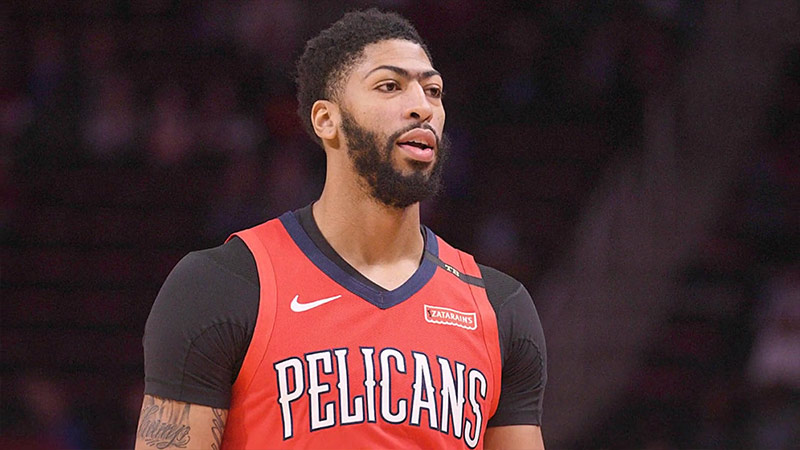
Anthony Davis stands as one of the most gifted and versatile big men in the history of professional basketball.
Combining fluid perimeter mobility with rim-protecting defense and interior power, his ability to dominate games offensively has produced memorable statistical performances throughout his career.
When evaluating his offensive peak, scoring 40 or more points in a single contest serves as a primary benchmark of individual dominance.
Anthony Davis has accumulated 45 career regular-season games with 40 or more points, reaching a total of 49 games when including playoff performances.
The Core Numbers: Regular Season vs. Postseason Breakdown
To fully understand the magnitude of his scoring impact, it is essential to distinguish between standard league competition and high-stakes playoff basketball.
- Regular-Season 40-Point Games: 45 Games
- Postseason 40-Point Games: 4 Games
- Total Combined 40-Point Outings: 49 Games
Achieving 45 regular-season games with at least 40 points places Davis in rarefied air among frontcourt players in modern league history.
Scoring at this level requires sustained physical endurance, high offensive usage, and exceptional shooting efficiency across field goal attempts, perimeter shots, and free throws.
His four 40-point postseason games highlight his ability to elevate his performance under maximum defensive pressure.
Playoff defense typically features targeted game planning, physical coverage, and scheme adjustments designed specifically to neutralize top options.
Maintaining a 40-point ceiling in these environments underscores his elite offensive capability when championships are on the line.
Franchise Breakdown: New Orleans vs. Los Angeles
The story of Anthony Davis’s career is divided into two distinct chapters, each defined by different offensive responsibilities and team structures. His 40-point games reflect this evolution cleanly.
The New Orleans Era: High-Usage Offensive Focal Point
During his seven seasons with the New Orleans franchise (initially the Hornets, later renamed the Pelicans), Davis developed from a high-upside defensive prospect into an unstoppable focal point on offense.
- 40-Point Games in New Orleans: 30 Games
In New Orleans, the offensive scheme ran almost exclusively through Davis. Operating without a secondary superstar for large stretches, he was tasked with generating offense from every area of the floor. His 30 games of 40+ points during this period were characterized by:
- Relentless Transition Play: Running the floor faster than opposing centers to convert easy interior buckets.
- Mid-Range Face-Up Isolation: Using a quick first step and high release point to shoot over perimeter defenders.
- Offensive Glass Dominance: Securing second-chance opportunities through sheer athleticism and timing.
- Heavy Free Throw Volume: Drawing contact inside to accumulate points while opposing frontcourts picked up fouls.
His scoring outbursts in New Orleans were frequently necessary to keep his team competitive, resulting in massive statistical lines where he often paired 40 points with 15+ rebounds and multiple blocks.
The Los Angeles Era: High-Efficiency Impact and Championship Context
Upon joining the Los Angeles Lakers, Davis transitioned into a refined structure alongside elite playmakers, allowing his scoring efficiency to reach new heights.
- 40-Point Games in Los Angeles: 15 Games
While his total count of 40-point games in Los Angeles is lower than in New Orleans, the context of these games shifted significantly. Operating within a balanced roster, Davis no longer needed to force high-volume shot attempts every night. Instead, his 40-point outings with the Lakers have been marked by remarkable field-goal efficiency:
- Elite Pick-and-Roll Execution: Capitalizing on high-level passing to finish lob opportunities and short-roll floaters.
- Targeted Interior Mismatches: Exploiting smaller defenders when opposing teams attempted to switch defensively.
- Clutch Big-Game Scoring: Delivering massive individual totals in key national television matchups and high-stakes conference battles.
Tactical Elements Behind Davis’s Scoring Explosions
Scoring 40 points as a frontcourt player requires a vastly different skill set than scoring 40 as a guard.
Guards often rely on heavy three-point shooting volume and long-distance pull-ups, whereas a big man must navigate congested paint defense, double teams, and physical contact.
Several tactical factors consistently enable Davis to reach the 40-point mark:
- Versatile Shot Profile: Davis is not restricted to paint touches. His ability to hit mid-range jumpers prevents defenses from simply walling off the key.
- Free Throw Production: In nearly all of his 40-point outings, Davis generates a significant portion of his scoring from the charity stripe, frequently attempting 10 to 15 free throws per game.
- Pace and Mobility: Unlike traditional heavy centers, Davis thrives when the game accelerates. His ability to score before defenses set up allows him to earn easy baskets in transition.
- Second-Chance Points: His length and vertical leap allow him to convert offensive rebounds into immediate putbacks or fouls, adding non-scripted points to his tally.
Historical Context and Legacy Among Great Power Forwards
When contextualizing 49 total 40-point games (regular season and playoffs combined), Davis sits in an exclusive tier among power forwards and centers over the last several decades.
Throughout league history, primary frontcourt players who routinely eclipse 40 points are rare. Legendary names like Karl Malone, Charles Barkley, Dirk Nowitzki, Tim Duncan, and Kevin Garnett established gold standards for big-man greatness.
Davis’s tally of 40-point games matches or surpasses many hallmark figures of previous eras, illustrating how his offensive ceiling compares to all-time greats.
In the modern era, where floor spacing and perimeter movement dominate tactical philosophy, Davis remains one of the few true interior players capable of repeatedly putting up 40+ points without relying exclusively on three-point volume.
Final Summary
Anthony Davis’s accumulation of 45 regular-season and 4 postseason 40-point games places him among the most prolific scoring frontcourt players of his generation.
From his high-usage early years in New Orleans to his championship-caliber play in Los Angeles, his ability to score inside, from the mid-range, and from the free-throw line ensures his place in statistical history.
As his career continues, tracking his milestone performances offers a clear lens into the evolving demands and capabilities of modern basketball power forwards.