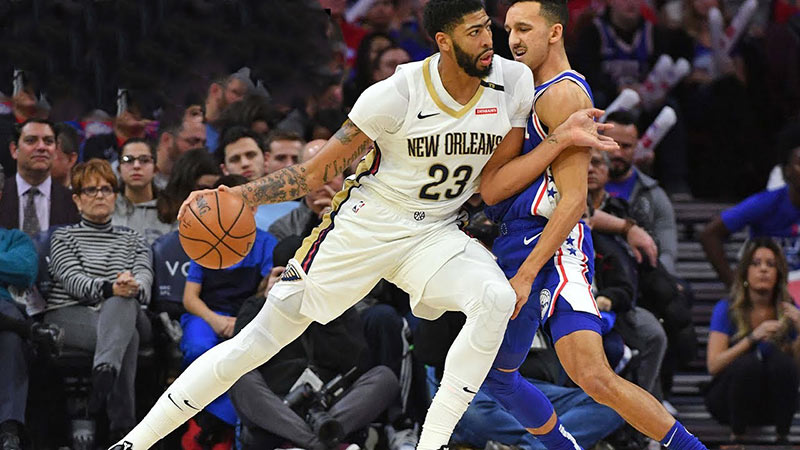
Anthony Davis stands as one of the most versatile frontcourt talents in modern basketball history. Standing 6’10” with an elite wingspan and guard-like mobility, Davis bridges the gap between traditional interior dominance and modern perimeter flexibility.
While casual observers often associate big men strictly with rim protection or dunks, Davis has developed an intricate skill set that allows him to control games from multiple spots on the floor.
At the center of his scoring repertoire is an ability to create separation from defenders in both the mid-range and the low post.
Whether operating out of a high-post face-up or executing a swift post move, his footwork makes him nearly unguardable when isolated against single coverage.
Simultaneously, his physical gifts translate to the defensive end, where his mobility renders him a game-altering presence across all positions on the court.
The Primary Offensive Signature: The Jab Step and Negative Step Mechanics
Facing Up in the Low and Mid-Post
When Anthony Davis receives the entry pass in the low post or near the mid-range elbow, his first instinct is frequently to face up his defender.
By turning his chest toward the basket rather than remaining in a traditional back-to-the-basket posture, Davis immediately puts the defender at a spatial disadvantage.
Facing up allows Davis to evaluate the defensive alignment, read help defense rotations, and isolate his primary defender in a high-leverage scenario.
Executing the Jab Step (Negative Step)
The core offensive weapon in Davis’s arsenal is his rapid jab step, often referred to as a negative step. When facing up his defender in the low post or mid-range, Davis throws a quick jab step to fake an attack or test the defender’s stance.
- The Set-Up Phase: Davis catches the ball, establishes a solid pivot foot, and maintains a strong stance ready to shoot, pass, or drive.
- The Probe (Negative Step): He executes a short, powerful jab step directly toward or slightly past the defender’s lead foot. This negative step tricks the defender into believing he is initiating an explosive drive to the rim.
- Reading the Reaction:
- If the defender bites or shifts back: Davis immediately uses the newly created spatial buffer to elevate for an uncontested jumper.
- If the defender remains static or overcommits: Davis leverages his quick first step to drive past them directly to the basket.
This footwork sequence is devastating because it forces big men—who are accustomed to playing physical back-to-basket post defense—to make split-second lateral decisions on the perimeter or mid-range zone.
The Counter-Attacks: Post Spin and Short-Stop Pull-Up Jumper
The Post Spin Mechanics
A signature move is only as effective as its counter-options. When defenses over-anticipate Davis’s face-up drive or crowd his jab step, he transitions into his signature post spin move.
Anthony Davis is widely recognized for combining his jab step with a post spin-to-jump-shot or layup to consistently create separation from defenders in the mid-range and low post.
- Catching with Back to the Basket: After catching the ball with his back to the basket or receiving it out of a pick-and-roll action, Davis immediately gauges the defender’s physical contact and body weight.
- The Pivot and Spin: He pivots sharply, spinning off the defender’s torso to seal them behind his body.
- Finishing the Play: Depending on how the help defense rotates, he either rises for a smooth, uncontested short-range pull-up jumper or finishes with a lay-up or dunk directly at the rim.
The Short-Stop Jumper out of the Pick-and-Roll
In modern pick-and-roll heavy offenses, Davis utilizes the short-stop jumper to punish drop coverage.
When rolling toward the paint, if the opposing center drops back to protect the rim, Davis receives the pass in the short roll, quickly gathers his feet with a short-stop pivot, and spins or pulls up for a soft-touch mid-range jumper.
This quick-stop capability stops his momentum on a dime, making it nearly impossible for trailing defenders to contest without committing a foul.
Perimeter Fluidity: The Face-Up Mid-Range Jumper
Leveraging Early Guard Skills
Before his famous high school growth spurt, Anthony Davis played as a point guard. This background plays a critical role in his fluid perimeter mechanics and ball-handling capability.
Leveraging his guard skills from his early basketball days, Davis can catch the ball on the perimeter or high post and operate with the fluidity of a wing player.
The Crossover to Step-Back Execution
When positioned at the high post or three-point line, Davis initiates his attack using perimeter-oriented ball skills:
- Catch and Floor Vision: Receives the ball on the perimeter or high post, immediately surveying the defense.
- Ball Fake or Quick Crossover: Uses a quick crossover or ball fake to shift the defender’s center of gravity.
- Step-Back Elevation: Creates space by stepping back into a fluid, high-release jumper that rises above the reach of contesting defenders.
Because Davis releases the ball at its highest point with a high trajectory, contesting this shot is exceptionally difficult for conventional interior defenders.
The Defensive Signature: The Hip Swivel (“Flip the Hips”)
Elite Mobility and Hip Flexibility
While offensive signature moves grab headlines, Davis’s defensive impact is equally defined by a unique physical signature move: the defensive hip swivel, widely known as “flipping the hips”. On defense, his signature physical trait is his elite hip mobility.
Unlike typical big men who struggle with stiff lateral movement when dragged into perimeter action, Davis possesses the extraordinary anatomical flexibility required to fluidly rotate his hips without losing speed or balance.
Multi-Positional Coverage and Paint Protection
This elite hip mobility unlocks two distinct defensive advantages:
- Perimeter Switching: When dragged out to the three-point line in pick-and-roll switches, Davis can flip his hips instantly to change directions and stay with elite perimeter shooters and agile guards.
- Paint & Rim Protection: If a guard manages to drive past him, Davis turns his hips mid-stride to recover, tracking the ball in mid-air to contest or block shots at the rim.
This rare combination of lateral hip swivel and vertical leap makes Davis a defensive anchor capable of dominating both the perimeter and the interior simultaneously.
Tactical Insights for Coaches, Analysts, and Players
Key Lessons for Developing Players
- Develop Footwork First: Power and height are valuable, but Davis demonstrates that footwork—specifically the jab step, negative step, and spin pivot—creates effortless scoring opportunities.
- Master the Face-Up Game: Learning to face up in the mid-post opens a full decision tree (jab, drive, pull-up, or pass) that back-to-the-basket moves alone cannot replicate.
- Focus on Hip Mobility: Mobility drills that emphasize hip flexibility allow interior players to survive in modern perimeter-oriented defense setups.
Strategic Takeaways for Defensive Schemes
When opposition coaches prepare for Anthony Davis, traditional single coverage in the mid-post is rarely effective.
- Playing him tight opens up his jab-step drive and post spin.
- Sagging off gives him comfortable rhythm for his face-up mid-range jumper.
- Consequently, team defenses must utilize double-teams or early stunt-and-recover tactics to disrupt his rhythm before he catches and faces up.
Conclusion
Anthony Davis represents the ideal evolution of the modern basketball big man. By pairing guard-like perimeter handling and mid-range footwork with elite post craft, he has created an offensive toolkit anchored by his jab step and post spin.
On the other end of the floor, his elite hip mobility enables him to anchor defenses from the three-point line to the rim.
Whether analyzing game film or developing skills on the court, Anthony Davis’s signature moves serve as the modern textbook for complete, two-way basketball dominance.