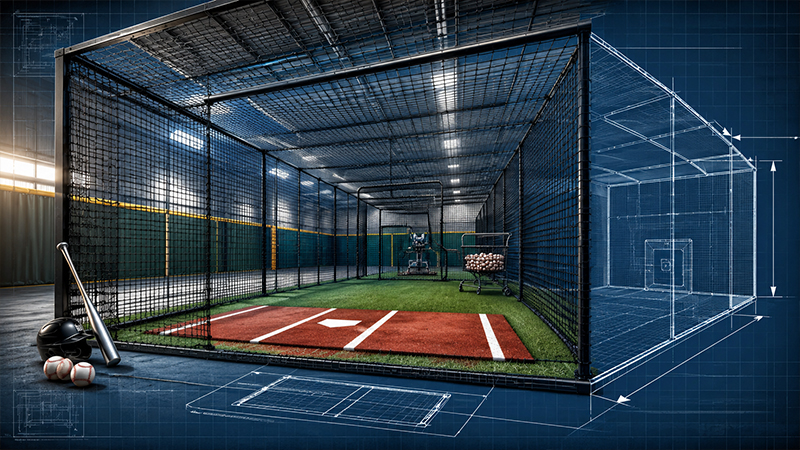
In the landscape of athletic development, the architecture of a training environment is a primary determinant of performance outcomes.
For organizations ranging from elite collegiate programs to high-performance residential setups, the precise calibration of a batting cage is not merely a matter of convenience—it is a matter of engineering.
The dimensions of a hitting tunnel dictate the mechanics of the swing, the safety of the participants, and the longevity of the facility infrastructure.
Selecting the appropriate footprint requires an analytical approach that balances available square footage with the physiological requirements of the athlete.
Whether the objective is to facilitate professional-grade live pitching or to optimize a modular space for youth development, adherence to industry-standard specifications ensures a high return on investment and a superior training experience.
The Industry Standard: The 70-Foot Regulation Tunnel
The definitive benchmark for a professional-grade batting cage is a 70-foot length, 14-foot width, and 12-foot height.
This configuration is categorized as the “Gold Standard” for several critical reasons, primarily its ability to accommodate the full spectrum of competitive play from the varsity level through the professional ranks.
Length Considerations for Advanced Play
At 70 feet in length, a facility can comfortably accommodate the regulation pitching distance of 60 feet, 6 inches, while maintaining the necessary structural buffers. This length is the recommended specification for high schools, colleges, and adult training environments.
The primary advantage of the 70-foot model is the spatial allowance it provides for a comprehensive battery of equipment.
It offers sufficient depth to house a pitching machine, a live pitcher behind an L-screen, and a designated safety zone for the batter and catcher.
By replicating the distance and visual cues of a regulation diamond, athletes can develop the timing and pitch recognition skills necessary for high-velocity competition.
Scaling for Performance: Intermediate and Youth Dimensions
While the 70-foot cage is the ideal for professional development, spatial constraints and specific demographic needs often necessitate scaled-down alternatives.
Understanding the utility of 55-foot and 35-foot configurations is essential for facility managers and property owners looking to maximize utility.
The 55-Foot Intermediate Configuration
The 55-foot batting cage serves as the primary choice for intermediate play and specialized softball training. This dimension is particularly effective for:
- Travel Ball Programs: Ideally suited for athletes in the 13–14 age bracket who are transitioning toward full-sized diamonds.
- Fastpitch Softball: Since the regulation pitching distance for high school softball is 43 feet, a 55-foot tunnel provides an optimal balance of flight time and safety clearance.
- Residential Constraints: For homeowners who lack the depth for a full varsity-sized cage, the 55-foot model offers a professional-grade experience within a more manageable footprint.
Youth and Specialized Training (35–50 Feet)
For the youngest demographic (ages 9–12), or for facilities focused on high-repetition technical drills, a cage length of 35 to 50 feet is often sufficient.
- Tee-Work and Soft-Toss: Cages in the 35–40 foot range are highly effective for “front-toss” drills or stationary tee-work where long-distance ball flight is not the primary objective.
- Space Management: In scenarios where backyard space is severely limited, these smaller footprints allow for consistent mechanical training without requiring a massive land commitment. However, experts recommend that if the space allows for a 55-foot cage, it should be prioritized to accommodate the athlete’s future physical growth and increased power.
The Geometry of the Swing: Width and Height Dynamics
While length is the most discussed dimension, the width and height of a hitting tunnel are equally vital for maintaining the integrity of the swing plane and ensuring athlete safety.
The 14-Foot Width Rule
A standard width of 14 feet is the industry recommendation to facilitate a full, unrestricted rotational swing.
A narrower cage can inadvertently affect a hitter’s psychological approach, leading to a “cramped” swing or a subconscious adjustment of mechanics to avoid hitting the side netting.
The 14-foot clearance ensures that even power hitters with significant extension can train with complete confidence.
The 12-Foot Height Standard
A height of 12 feet provides the necessary vertical clearance for the ball’s exit trajectory. This height is sufficient to capture initial launch angles without the ball immediately impacting the ceiling netting, which allows coaches to better analyze the quality of contact during training sessions.
Safety Infrastructure and Spatial Buffers
Engineering a high-performance batting cage extends beyond the interior dimensions; it must also account for the “Safety Zone”—the external clearance required to protect both the equipment and the surrounding structure.
Internal Clearance and End Buffers
When utilizing a 70-foot cage, it is imperative to maintain 5 to 10 feet of clearance behind the pitcher or the pitching machine.
This space acts as a safety buffer for the operator and prevents high-velocity equipment from being crowded against the rear netting, which can lead to premature wear and tear on the mesh.
The Perimeter Safety Zone
A critical oversight in many DIY or amateur installations is the proximity of the netting to hard surfaces.
To prevent dangerous rebounds and “trampoline effects,” a minimum of 3 to 5 feet of space should be maintained between the netting and any solid walls, fences, or structural supports.
This buffer allows the net to displace the energy of a foul ball or high-velocity hit safely without the ball ricocheting back toward the hitter or pitcher.
Strategic Selection Guide: Matching Dimensions to Use Case
To streamline the decision-making process for stakeholders, the following breakdown aligns specific cage dimensions with their optimal use cases:
- For Professional and High School Excellence:
- Dimension: 70′ x 14′ x 12′
- Key Benefit: Accommodates 60’6″ regulation pitching and automated machines.
- For Competitive Youth and Softball Programs:
- Dimension: 55′ x 14′ x 12′
- Key Benefit: Perfectly calibrated for 43′ softball distances and travel ball transitions.
- For High-Density Residential/Technique Focus:
- Dimension: 35’–40′ x 14′ x 12′
- Key Benefit: Ideal for front-toss, tee-work, and localized mechanical drills in restricted spaces.
Conclusion: Investing in Precision
The dimensions of a batting cage are the foundation upon which athletic skill is built. By adhering to the standard 70-foot varsity model where possible, or strategically scaling to a 55-foot or 35-foot footprint based on demographic needs, organizations can ensure they are providing an elite training environment.
Precision in sizing is not just about fitting a product into a space; it is about respecting the physics of the game.
A properly sized cage protects the athlete, preserves the equipment, and provides the necessary environment for the development of championship-level hitting mechanics.
Enhanced FAQ: Technical Specifications for Batting Cage Design
Q: Can a 55-foot cage be used for high school baseball players?
A: While a 55-foot cage can be used for technical drills, it does not accommodate the full 60’6″ regulation pitching distance required for varsity-level timing. For high school athletes, a 70-foot cage is the recommended standard to ensure game-day realism.
Q: Is 12 feet of width sufficient for a batting cage?
A: While some residential cages are sold at 12 feet wide, the professional recommendation is 14 feet. This additional width is crucial for allowing a full, natural swing and preventing the hitter from feeling restricted by the netting.
Q: What is the minimum space required behind a pitching machine?
A: For safety and operational efficiency, you should maintain a buffer of 5 to 10 feet behind the pitcher or machine. This is especially important in 70-foot models where high-velocity training is common.
Q: Why is a 3-foot buffer needed between the net and a wall?
A: When a ball hits a net, the net must be able to “give” or flex to absorb the energy. If the net is flush against a wall, the ball will hit the hard surface and rebound at high speed, creating a significant safety hazard.