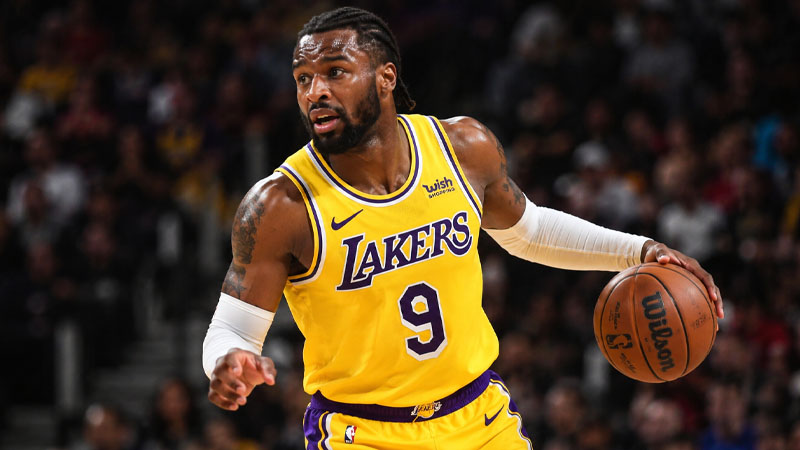
Wesley Matthews is a premier example of elite 3-and-D efficiency, transitioning from an undrafted rookie to a 16-year NBA veteran.
In his prime, he was a borderline All-Star and high-volume sniper, primarily with the Portland Trail Blazers, where he set franchise records for three-pointers.
Despite a career-altering Achilles injury in 2015, his resilience allowed him to reinvent himself as a high-IQ defensive specialist for championship contenders.
Ultimately, Matthews’ value lies in his defensive versatility, 37.5% career perimeter shooting, and leadership, earning over $114 million through sheer persistence and a legendary work ethic that defined an era.
How Good Was Wesley Matthews in His Prime Years?
Evaluating the peak of Wesley Matthews requires looking at the 2010–2015 era, where he established himself as one of the most reliable shooting guards in the league.
During this span, he was a core starter in a powerhouse lineup that included Damian Lillard and LaMarcus Aldridge, providing the essential floor spacing and perimeter defense necessary for playoff contention.
His “Iron Man” reputation began here, as he routinely faced the most difficult defensive assignments while maintaining a high offensive workload.
Elite Perimeter Shooting and Volume
Between 2010 and 2015, Matthews was not just a shooter; he was a high-volume sniper who consistently maintained an efficiency near 40% from beyond the arc.
He held the record for the most career three-pointers in Trail Blazers history with 774 before it was eventually surpassed by Damian Lillard.
His ability to hit shots under pressure was highlighted by a career-high performance where he connected on 10 three-pointers in a single game, demonstrating a scoring ceiling that few role players ever reach.
The Unique Tactical Advantage of the Post-Up Game
What truly separated Matthews from his peers was a skill set rarely seen in modern “3-and-D” wings: a highly efficient post-up game.
While most guards focused solely on spot-up opportunities, Matthews utilized his physical strength to punish smaller defenders in the paint.
This tactical versatility allowed his teams to exploit mismatches, making him a multi-dimensional offensive threat rather than a static floor spacer. This combination of “bully ball” and elite shooting made him a nightmare to defend during his prime years in Portland.
Statistical Breakdown of a Legendary 16-Year Career
To understand the sheer magnitude of Matthews’ impact, one must look at the cumulative totals and efficiency ratings he maintained across nearly a thousand games. His career is a testament to the value of specialized excellence and physical durability.
| Career Metric | Statistical Total / Percentage |
|---|---|
| Total Games Played | 986 Regular-Season Games |
| Total Career Points | 11,209 Points |
| 3-Point Field Goals Made | 1,821 Threes |
| Career 3-Point Efficiency | 37.5% |
| Free Throw Percentage | 82.3% (Elite Tier) |
| Career Earnings | Over $114 Million |
| Career Rebounds / Assists | 2,752 Rebounds / 1,833 Assists |
What Defines the “Iron Man” Archetype in the Modern NBA?
The “Iron Man” moniker was not merely a nickname for Wesley Matthews; it was a professional identity built on a foundation of relentless work ethic and the ability to play through minor injuries.
In an era where “load management” has become common, Matthews’ career serves as a blueprint for players who prioritize availability and consistency.
This reputation was forged early in his journey, starting from his college days and carrying through his transition into a seasoned professional.
The Foundation at Marquette and the “Three Amigos”
The blueprint for Matthews’ professional success was designed at Marquette University between 2005 and 2009.
Playing alongside future pros Jerel McNeal and Dominic James in the “Three Amigos” era, he developed the rugged, team-first mentality that would define his NBA tenure.
By his senior year, he was already showing the flashes of an elite scorer, averaging 18.3 points per game and shooting an impressive 47.5% from the floor.
This collegiate success established the high basketball IQ and toughness that would allow him to thrive even when overlooked by scouts.
Mastering the 3-and-D Specialization
In the modern basketball landscape, the 3-and-D wing is the most sought-after role player, and Matthews mastered this role better than almost anyone of his generation.
He combined lateral quickness with brute strength to act as a defensive stopper, often tasked with guarding the opponent’s best perimeter scorer.
By pairing this defensive intensity with the ability to space the floor, he became an indispensable asset for eight different franchises. His career longevity proves that mastering a specific, high-value niche is often more lucrative than being a secondary star.
From Undrafted Rookie to the $114 Million Contract Club
The financial trajectory of Wesley Matthews is one of the most successful “underdog” stories in sports history. Despite being overlooked in the 2009 NBA Draft, he managed to outearn the vast majority of players selected ahead of him.
His path from a non-guaranteed contract to a nine-figure career total is a masterclass in professional self-positioning and maximizing market value.
The Utah Steal and the Historic Offer Sheet
After going undrafted, Matthews signed a non-guaranteed deal with the Utah Jazz, where he immediately disrupted the depth chart. He played with such intensity that he beat out lottery pick CJ Miles for a starting position, proving his worth almost overnight.
This rapid ascent led to a historic 2010 offer sheet from the Portland Trail Blazers: a 5-year, $34 million deal.
At the time, this made him the highest-paid sophomore in his entire class, a staggering achievement for a player who was completely bypassed on draft night just one year prior.
Navigating the Business of Professional Longevity
Matthews’ ability to secure high-value contracts throughout his thirties is a result of his adaptability and reputation as a winner. Even as his role shifted from a core starter to a bench veteran, his presence remained a priority for championship-contending teams.
By filling playoff rotation slots for elite teams like the Milwaukee Bucks and Los Angeles Lakers, he remained a high-utility asset.
This persistence allowed him to cross the $114 million mark in total career earnings, cementing his legacy as one of the most financially successful undrafted players to ever play the game.
The Resilience of the Post-Achilles Second Act
A defining moment in Matthews’ career occurred in March 2015 when he suffered a devastating Achilles tendon tear. For many athletes, an injury of this magnitude marks the end of their effectiveness at the highest level.
However, Matthews used the setback to demonstrate a different kind of “Iron Man” strength, successfully pivoting his game to remain relevant for another decade.
Reinventing the Style of Play
Post-injury, Matthews acknowledged that he had lost the peak explosiveness that once allowed him to drive and finish with power. Rather than fading away, he transformed into a strict floor-spacer and high-IQ situational defender.
This adaptation required a deep understanding of defensive positioning and shooting mechanics, allowing him to stay on the floor during high-stakes playoff minutes for top-tier contenders.
He transitioned from a “third option” scorer to a lockdown defensive specialist who provided veteran stability.
Transitioning to Leadership and the Broadcast Booth
In the final stages of his playing career, such as his stint with the Atlanta Hawks, Matthews’ value shifted toward mentorship and locker room leadership.
He became an invaluable resource for younger players, teaching them the nuances of communication and professional preparation.
This natural inclination for analysis and communication facilitated his most recent transition: becoming a broadcast analyst for the Milwaukee Bucks.
His move to the booth is a logical conclusion for a player whose career was defined by intelligence, preparation, and an unparalleled understanding of the game.
Frequently Asked Questions about Wesley Matthews
How many teams did Wesley Matthews play for during his NBA career?
Wesley Matthews was a highly reliable journeyman who played for eight different NBA franchises, including the Utah Jazz, Portland Trail Blazers, Dallas Mavericks, Indiana Pacers, Milwaukee Bucks, Los Angeles Lakers, and Atlanta Hawks.
What is Wesley Matthews’ most significant career record?
For a significant period, Matthews held the franchise record for the most made three-pointers in Portland Trail Blazers history with 774. Additionally, he was once the second-fastest player in the history of the league to reach 1,000 career three-pointers.
How did Wesley Matthews perform after his Achilles injury?
While he lost some of his scoring volume—dropping from a peak of 16.4 PPG to a defensive-minded role averaging between 3.0 and 5.0 PPG later in his career—he remained a vital playoff rotation piece due to his high basketball IQ and situational defense.
Was Wesley Matthews ever an All-Star?
Though he never officially made an All-Star team, he was considered a “near All-Star” during his prime in Portland, where he was one of the premier shooting guards in the league and a key part of one of the NBA’s most efficient starting lineups.
Conclusion: The Blueprint for Professional Longevity
The career of Wesley Matthews is a masterclass in resilience, proving that “how good” a player is cannot always be measured by All-Star appearances alone.
From his “Three Amigos” days at Marquette to becoming an undrafted legend who earned over $114 million, Matthews redefined the expectations for role players in the modern era.
His ability to adapt after a career-threatening injury and transition into a respected veteran leader and broadcaster showcases a level of professional excellence that every young athlete should strive to emulate.