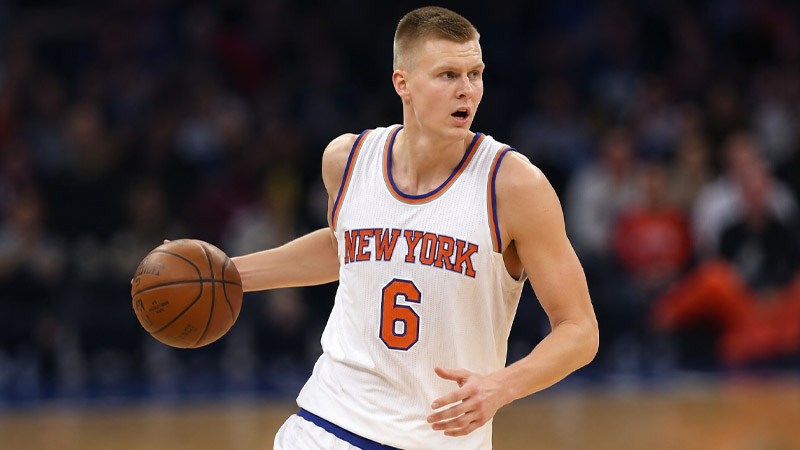
Kristaps Porzingis is famously called “The Unicorn” because he possesses an incredibly rare, almost mythical combination of 7-foot-3 stature and elite guard-like skills.
NBA superstar Kevin Durant coined the moniker in January 2016 during Porzingis’ rookie season with the New York Knicks.
Durant was awestruck by a player who could protect the rim as a premier shot-blocker while simultaneously hitting deep three-pointers and handling the ball like a wing.
This blend of size and finesse was previously unseen in basketball history, making Porzingis a one-of-a-kind specimen that redefined the modern big man archetype forever.
Who Defined the Unicorn Label in the NBA?
The creation of the “Unicorn” label was not the result of a marketing campaign or a media brainstorm, but rather a spontaneous reaction from one of the greatest players in the history of the sport.
In January 2016, after a highly anticipated matchup between the New York Knicks and the Oklahoma City Thunder, the basketball world received a new descriptor that would permanently alter how we evaluate talent in the frontcourt.
The 2016 Encounter with Kevin Durant
During his rookie campaign, Kristaps Porzingis faced off against Kevin Durant and the Oklahoma City Thunder.
Despite a narrow overtime loss, the rookie made an indelible impression by recording 15 points and five rebounds while showcasing defensive range that disrupted veteran scorers.
It was following this specific performance that Durant spoke to reporters, expressing his disbelief at the rookie’s versatile toolkit.
He noted that seeing a 7-footer who could “shoot all the way out to the 3-point line” and “block shots” was an anomaly so extreme it could only be compared to a mythical creature.
A Shift in Basketball Philosophy
Durant’s endorsement was significant because it highlighted a pivot in the league’s evolutionary timeline. For decades, players of Porzingis’ height were expected to remain stationary near the basket.
By labeling him a unicorn, Durant acknowledged that the traditional limitations of a 7-footer were being shattered by a player who could make the “right plays” and “defend” in space.
This praise helped silence early critics who were skeptical of a tall, slender European prospect, validating Porzingis as a skilled technician rather than just a physical marvel.
Why is Kristaps Porzingis Called the Unicorn?
The technical justification for the nickname lies in the intersection of extreme physical dimensions and refined perimeter technicality.
Historically, the NBA was divided between “bigs” who occupied the paint and “guards” who managed the perimeter. Porzingis effectively merged these two distinct worlds into a single 7-foot-3 frame.
| Attribute | Traditional Center Capability | Kristaps Porzingis (The Unicorn) |
|---|---|---|
| Height & Reach | 6’10” – 7’0″ / Standard Wingspan | 7’3″ Height / 7’6″ Wingspan |
| Shooting Range | Restricted to the Painted Area | Elite Accuracy Beyond the 3-Point Line |
| Defensive Role | Static Post Defense | Versatile Rim Protection & Perimeter Agility |
| Ball Handling | Limited Dribbling / Post-Ups | Playmaking Off the Dribble & Fast Breaks |
| Mobility | Lumbering / High Center of Gravity | Fluid, Guard-like Movement |
Elite Perimeter Shooting for a 7-Footer
One of the primary pillars of the unicorn identity is the ability to stretch the floor. Most players with a 7-foot-3 frame are naturally anchored to the basket to maximize their rebounding and high-percentage scoring opportunities.
However, Porzingis demonstrated the coordination to hit deep three-pointers consistently, which forces opposing centers to leave the paint and defend him at the perimeter.
This spacing creates lanes for teammates and disrupts the entire defensive structure of the opposition.
Defensive Dominance and Rim Protection
While many “stretch bigs” sacrifice defense for shooting, the unicorn moniker requires excellence on both ends of the floor. Porzingis utilizes his massive 7-foot-6 wingspan to serve as a high-level shot-blocker.
His defensive impact is often cited as the true “rare” trait that separates him from other tall shooters; he can anchor a defense and protect the rim while also having the lateral quickness to defend in space.
Exceptional Agility and Coordination
The final component of the nickname is the player’s fluidity. Observers often note that watching Porzingis live is “surreal” because his movement patterns do not compute with his sheer size.
He possesses the coordination to put the ball on the floor, execute crossovers, and run the fast break with the grace of a wing player.
This athleticism allows him to score via finesse in the post or off the dribble, making him a matchup nightmare for slower, traditional centers.
How Did Porzingis React to the Nickname?
When a nickname becomes as globally recognized as “The Unicorn,” it often takes on a life of its own. However, the initial reception of the name by Porzingis himself was a mixture of confusion and cultural disconnect.
Coming from Latvia, he was unfamiliar with American slang and the specific metaphorical weight the word carried in a sports context.
Initial Confusion: The Horse with a Ponytail
During an appearance on The Tonight Show Starring Jimmy Fallon, Porzingis admitted that he was genuinely baffled when he first heard the term.
He literally envisioned “a horse with a ponytail” and didn’t understand why a legendary player like Durant would compare him to a fairytale animal.
At first, he was slightly put off by the label because the translation of the concept didn’t immediately convey “uniqueness” or “elite talent” in his native linguistic framework.
Embracing a Mythical Identity
Once coaches and teammates explained that the nickname was meant to signify he was a “one-of-a-kind” talent, Porzingis fully embraced the branding. He began to view it as a badge of honor, recognizing that it celebrated his unconventional skill set.
This acceptance eventually led to commercial ventures, including a partnership with Adidas where he featured unicorn logos on the soles of his custom basketball sneakers. What began as a confusing remark evolved into a central pillar of his personal brand.
The Evolution of the Unicorn in Modern Basketball
While Kristaps Porzingis is recognized as the “original” unicorn, the term has since expanded to describe a new generation of players.
It has transitioned from a specific nickname for one individual into a legitimate scouting category used by front offices to describe versatile giants who can do everything on the court.
Redefining the Standard for Big Men
The success of Porzingis proved that a team could build a modern system around a mobile 7-footer. His impact shifted the priorities of NBA draft scouts, who began looking for players who mirrored his combination of length and perimeter skill.
Before his arrival, a player of his height was often seen as a risk if they played too far from the basket; after Porzingis, that “risk” became a highly sought-after competitive advantage.
Paving the Way for Wembanyama and Holmgren
Today, the “Unicorn” lineage continues through players like Victor Wembanyama and Chet Holmgren. These athletes are frequently measured against the blueprint that Porzingis established during his time with the Knicks.
While the league now features more versatile big men, analysts still point to Porzingis as the catalyst who popularized the term and proved that the “mythical” combination of size and guard skills could lead to high-level winning basketball.
The Impact of the Unicorn on the Boston Celtics
The most recent chapter of the unicorn’s journey is taking place in Boston. After various stints with other organizations, Porzingis has found a role that perfectly utilizes his unique talents to support a championship-contending roster.
His arrival in Boston was marked by immediate, record-breaking impact that reminded the league why the nickname remains relevant.
A Record-Setting Debut in Boston
In his regular-season debut for the Celtics, Porzingis set a franchise record for the most points in a debut with 30. More impressively, he became the first player in the history of the NBA to record five made 3-pointers and four blocks in a debut with a new team.
This performance was a microcosm of his career: elite scoring from distance paired with elite defensive rim protection.
The Key to Banner 18
For the Celtics, Porzingis represents the ultimate “X-factor.” His ability to floor-space alongside stars like Jayson Tatum and Jaylen Brown makes the Boston offense nearly impossible to guard.
When he is healthy and operating at his full potential, he provides the defensive interior presence the team needs while remaining a constant threat from 25 feet out.
As long as he remains on the floor, the “Unicorn” will play a pivotal role in the franchise’s pursuit of another championship.
Frequently Asked Questions About the NBA Unicorn
Who was the first NBA player called a unicorn?
Kristaps Porzingis is widely credited as the first player to popularize the “Unicorn” label after Kevin Durant used it to describe him in early 2016.
Does the nickname only apply to Kristaps Porzingis?
While it was originally his specific moniker, it is now used as a general scouting term to describe any exceptionally tall player (usually 7-feet or taller) who possesses guard-like skills such as 3-point shooting and elite ball handling.
What are the essential “Unicorn” skills?
To be considered a true unicorn, a player must typically possess three main traits: elite height/wingspan, consistent perimeter shooting, and high-level defensive rim protection.
Did Porzingis ever dislike the name?
Yes, he was initially confused and somewhat frustrated by the name because he did not understand the American slang. He eventually grew to love it after learning it meant he was a unique player.
How has the nickname influenced basketball culture?
It has changed the way the media and fans talk about player archetypes. Instead of calling someone a “center,” they are often called a “unicorn” to emphasize that they don’t fit into traditional positional boxes.
Conclusion: The Lasting Legacy of a Mythical Archetype
Kristaps Porzingis has done more than just earn an iconic nickname; he has served as the bridge between the traditional NBA and the positionless future of the sport.
By blending the height of a giant with the skill set of a floor general, he forced the league to expand its imagination of what a 7-footer could achieve.
From the confused rookie in New York to a cornerstone of a championship pursuit in Boston, the story of the Unicorn is a testament to the power of unique talent.
While more versatile big men will inevitably enter the league, Porzingis will always hold the title of the original specimen that turned a mythical creature into a basketball reality.