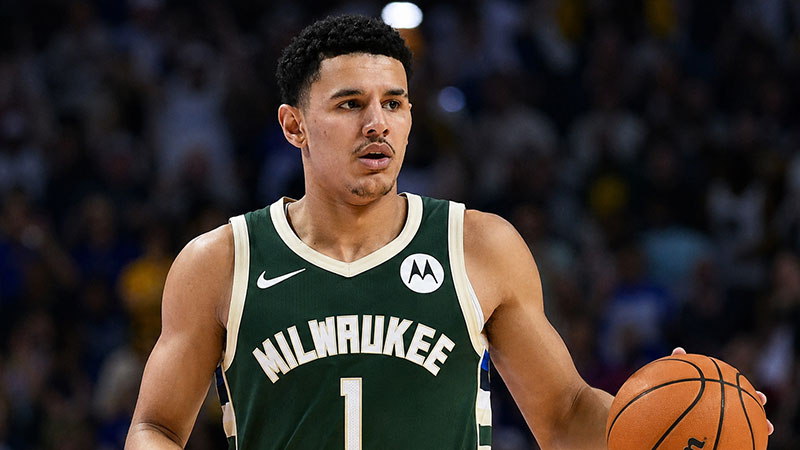
Johnny Davis was an elite collegiate athlete whose professional career unfortunately failed to mirror his Big Ten dominance.
After being selected 10th overall in the 2022 NBA Draft by the Washington Wizards, his performance saw a significant downturn, resulting in a career average of just 3.5 points on 39.7% shooting.
His primary struggles originated from a deteriorating shooting mechanic and a lack of the elite athleticism required to create space against professional defenders.
Currently, Davis has moved on from the NBA and is playing for Manisa Basket in Turkey, seeking to rebuild his professional trajectory.
How Good was Johnny Davis at Wisconsin?
Before his professional struggles, Davis was the focal point of a high-major offense and a consensus All-American.
During his sophomore season at the University of Wisconsin, he established himself as a hard-nosed, high-motor guard who excelled in the mid-range and on the glass.
He was the engine behind a successful Badgers season, often taking and making difficult shots that vaulted him to the top of draft boards.
The following table highlights the sharp contrast between his peak collegiate performance and his realized professional output:
| Statistic | Wisconsin (Sophomore) | NBA Career Average |
|---|---|---|
| Points Per Game | 19.7 | 3.5 |
| Rebounds Per Game | 8.2 | 1.6 |
| Assists Per Game | 2.1 | 0.6 |
| FG Percentage | 42.7% | 39.7% |
| FT Percentage | 79.1% | 56.1% |
While his numbers at Wisconsin were voluminous, some analysts noted even then that his efficiency was not elite, particularly his 30.6% shooting from beyond the arc.
He relied heavily on “bully ball”—using his size and strength to overpower smaller college guards—a strategy that rarely translates effectively to the size and speed of the NBA.
Why Did Johnny Davis Struggle in the NBA?
The transition from a high-usage star to a rotational professional player proved to be an insurmountable hurdle for Davis.
The game that looked so polished in Madison appeared sluggish and unrefined against the length and speed of NBA defenders. Several specific factors contributed to this sudden decline in effectiveness.
The Mechanical Breakdown of His Jump Shot
One of the most glaring issues in his professional tenure was the total collapse of his shooting mechanics. In college, he was a reliable free-throw shooter at nearly 80%, but this plummeted to a staggering 56.1% in the NBA.
He developed a noticeable “hitch” in his release, which stripped him of his shooting confidence and made him a liability on the perimeter. Without a reliable catch-and-shoot game, his utility as an off-ball guard evaporated.
Lack of Athletic Separation and Speed
NBA scouts and fans quickly observed that Davis lacked the “vertical pop” or the first step necessary to blow past professional athletes. In the NBA, he struggled to create separation off the dribble, which was his bread and butter at Wisconsin.
Because he couldn’t beat his man to the spot, he was forced into taking contested, inefficient mid-range pull-ups, which further damaged his statistical profile.
The Difficulty of a Specialized Role
In college, Davis was “the man,” but in Washington, he was asked to be a “3-and-D” contributor. However, he was only an average three-point shooter at best and lacked the specialized skill set required to thrive in a limited role.
While his defense was occasionally viewed as a bright spot for a young player, it wasn’t enough to compensate for an offensive game that offered almost zero “bag” or space-creating ability.
Evaluating the G-League and Summer League Red Flags
Many observers suggest that the warning signs for Davis’s career were present long before his final exit from the league. His stints in the NBA Summer League and the G-League provided early indicators that his scoring prowess would not translate.
These environments, which often favor high-usage guards, only highlighted his inability to find a rhythm.
The Statistical Warning from the G-League
Even when sent down to the Capital City Go-Go for development, the results were concerning. Davis averaged 11 points on 11 shots—an equal ratio of scoring to attempts that signaled a massive efficiency problem.
At one point, he was even benched during the regular G-League season due to a True Shooting percentage in the 48–50% range, which is significantly below league standards for a top-10 draft pick.
Summer League Struggles and Lack of Space
His performance in the Summer League was equally telling. In one documented stretch, he shot just 18-of-48 from the field, including a dismal 1-of-10 on jump shots off the dribble.
These specific numbers confirmed the scouting fear: he could not generate the space required to get clean looks against even fringe-NBA competition.
This lack of offensive production made it difficult for the coaching staff to justify giving him extended minutes during the regular season.
Is the Wisconsin Development System at Fault?
The failure of high-profile prospects often leads to a broader critique of their collegiate programs. In Davis’s case, the University of Wisconsin’s basketball philosophy has come under fire for how it prepares players for the professional ranks.
Critics argue that the “Wisconsin style” may mask athletic deficiencies that become fatal flaws at the next level.
Systemic Pace and Professional Readiness
The Badgers program is historically known for being one of the slowest teams in college basketball. This deliberate pace allows players to succeed through discipline and sets, rather than raw athleticism and transition play.
Some argue this environment fails to expose players to the high-speed decision-making required in the NBA, leading to a “culture shock” when they enter a more dynamic league.
The Athleticism Gap in Recruiting
There is a recurring sentiment that Wisconsin often lands recruits who lack elite NBA-level athleticism. While these players can be highly effective in a structured collegiate system, they often hit an “athletic ceiling” when facing elite wings in the pros.
Aside from rare exceptions like Devin Harris or Michael Finley, the program has struggled to produce consistent NBA starters, leading some to view Davis as a product of this systemic limitation.
Where is Johnny Davis Playing Today?
Despite the “bust” label frequently applied by domestic fans, Davis remains an elite global athlete. His career has taken him across the Atlantic, where he is currently competing in one of Europe’s most respected domestic leagues.
This move represents a “change of scenery” that many hoped would save his professional career.
The Transition to Manisa Basket in Turkey
Davis is currently under contract with Manisa Basket in Turkey’s Basketbol Süper Ligi. European basketball often rewards the high-IQ, mid-range-heavy game that Davis displayed in college.
By stepping away from the intense scrutiny of the NBA, he has the opportunity to fix his mechanical hitches and regain the confidence that made him the Big Ten Player of the Year.
The “Taco Bell” Legacy and Cultural Impact
Interestingly, Davis is often remembered as much for his off-court presence as his on-court play.
He starred in a high-profile Taco Bell commercial during his draft cycle, leading to a running joke among fans that he was an “imaginary person made up by Taco Bell” because they saw him in commercials more often than on the court.
While humorous, it underscores the gap between his perceived star power as a draftee and his eventual on-court reality.
Common Questions Regarding Johnny Davis
Is Johnny Davis still in the NBA?
No, Johnny Davis is currently out of the NBA. After appearing in 112 games over three seasons with the Washington Wizards, the team moved on, and he is now playing professionally in Turkey.
Was Johnny Davis considered a draft bust?
Yes, by most statistical and scouting standards, he is viewed as a significant disappointment. Being drafted 10th overall—ahead of stars like Jalen Williams—and failing to maintain a roster spot past his rookie contract is the standard definition of a draft bust.
What were his final NBA stats?
Davis finished his NBA tenure with career averages of 3.5 points, 1.6 rebounds, and 0.6 assists per game. His shooting splits were 39.7% from the field and a low 27.3% from the three-point line.
Can he still make a comeback?
While difficult, a comeback is not impossible. Players like Jordan Poole or Killian Hayes have struggled early only to find different levels of success or second chances.
However, Davis would need to completely overhaul his shooting mechanics and prove he can contribute in a limited role to earn another NBA look.
Final Thoughts on the Translation of Talent
The story of Johnny Davis is a cautionary tale about the difference between production and projection.
While he was undeniably one of the best players in college basketball during his time at Wisconsin, the physical and mechanical traits required to sustain that success in the NBA simply weren’t there.
His struggle to create separation and the eventual collapse of his shooting form highlight how narrow the margin for error is at the highest level of the sport.