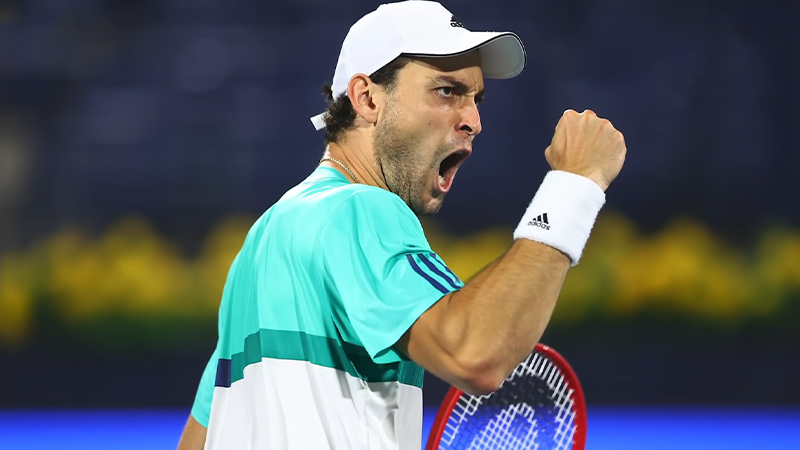
Aslan Karatsev is a uniquely explosive talent in modern tennis, best known for his historic 2021 Australian Open run where he became the first male qualifier in the Open Era to reach a Grand Slam semifinal.
At his peak, Karatsev achieved a world ranking of No. 14, propelled by a hyper-aggressive baseline game that dismantled elite players like Novak Djokovic and Daniil Medvedev.
However, his high-risk style and chronic knee injuries led to a sharp decline. Currently ranked No. 1,290, Karatsev remains an enigmatic figure whose ceiling was world-class, though remarkably fleeting.
Aslan Karatsev’s Historic Grand Slam Breakthrough
The emergence of Aslan Karatsev is often described as one of the most unexpected surges in the history of the ATP Tour.
For years, Karatsev was a staple of the Challenger circuit, struggling to break into the elite echelon of the sport until a “lightning-in-a-bottle” moment changed his career trajectory forever.
His performance at the start of the 2021 season did not just put him on the map; it rewrote the record books for what a qualifier could achieve on the world’s biggest stage.
Shattering Records at the 2021 Australian Open
Entering the 2021 Australian Open, Karatsev was ranked No. 114 and had to fight through the qualifying rounds just to secure a spot in the main draw. What followed was a sequence of victories that left analysts stunned.
By reaching the semifinals, he became the first man in the Open Era to reach that stage in his Grand Slam debut.
This run was characterized by a fearless approach to the game, where he consistently out-hit seeded opponents with a level of power that few expected from a player who had spent so much time outside the top 100.
The Impact of an Unseeded Semifinalist
The significance of Karatsev’s run extended beyond the individual matches he won. It challenged the prevailing narrative that players must establish themselves in their early twenties to reach the pinnacle of the sport.
At 27 years old, Karatsev proved that a late-career surge was possible through a combination of physical conditioning and mental fortitude.
His ability to maintain a high level of play over two weeks in Melbourne established him as a legitimate threat to the top tier of the ATP, setting the stage for a year of remarkable achievements.
What Made Aslan Karatsev’s Playing Style So Effective?
Karatsev’s success was built on a technical foundation that prioritized extreme aggression and pace redirection.
While many modern players rely on heavy topspin to create safety, Karatsev opted for a flatter, more penetrating ball that took time away from his opponents.
This style made him a nightmare for players who preferred rhythm, as he could end points quickly from either wing.
The Power of Hyper-Aggressive Baseline Play
Karatsev played what has been described as an “all-universe” brand of tennis when he was at his absolute best.
His primary weapon was his ability to hit massive groundstrokes with a compact backswing, which allowed him to take the ball early and redirect pace effortlessly.
This technical efficiency meant that even the hardest hitters on tour found their own pace coming back at them with interest. His backhand, in particular, was noted for its clinical accuracy and breathtaking speed, often leaving opponents stationary.
Physical Strength and Technical Foundations
A significant part of Karatsev’s ability to generate such immense power came from his exceptional lower-body strength.
Tour players frequently commented on his massive calves, which provided the explosive base necessary to launch into his shots with extreme force.
This physical prowess allowed him to maintain stability even when hitting on the run, ensuring that his flat shots remained deep and dangerous.
However, this high-octane physical requirement also meant that any slight dip in fitness or confidence could cause his game to unravel due to the zero margin for error in his stroke production.
Analyzing the Statistical Peak of Aslan Karatsev
The numbers behind Karatsev’s career illustrate a player who experienced an intense but condensed period of dominance. While his overall career winning percentage is relatively modest, his statistics during his 2021–2022 peak rivaled those of the world’s elite.
| Statistic | Singles Performance | Doubles Performance |
|---|---|---|
| Career Record | 79–88 (47.3% Win Rate) | 25–34 (42.4% Win Rate) |
| ATP Titles | 3 Singles Titles | 1 Doubles Title |
| Highest Ranking | World No. 14 (Feb 7, 2022) | World No. 76 (May 16, 2022) |
| Career Prize Money | $5,404,762 (Combined) | $5,404,762 (Combined) |
Beyond these core numbers, his performance in major events highlights his versatility during his prime.
He was not just a singles specialist; he won an Olympic Silver Medal in Mixed Doubles at Tokyo 2020 and reached the Mixed Doubles final at the 2021 French Open.
His three ATP singles titles—Dubai, Moscow, and Sydney—all came during a prolific 12-month span that solidified his status as a top-20 player.
Who Are the Biggest Players Karatsev Has Defeated?
One of the best ways to measure “how good” a player is involves looking at their record against the best in the world. At his peak, Karatsev was one of the few players who could truly say they had the game to overpower the legends of the sport.
He earned the reputation of a “giant-killer” because he didn’t just beat top players; he often did so by outplaying them at their own game.
Conquering Novak Djokovic in Belgrade
Perhaps the most impressive win of Karatsev’s career occurred in the semifinals of the 2021 Belgrade Open. Facing World No. 1 Novak Djokovic on his home clay courts, Karatsev emerged victorious after a grueling three-hour epic.
Defeating Djokovic on clay is one of the hardest tasks in tennis, but Karatsev’s ability to save 23 of 28 break points while maintaining a barrage of winners showcased a level of mental and physical peak performance that few ever reach.
Ending Andrey Rublev’s Winning Streak
During 2021, Andrey Rublev was nearly untouchable at the ATP 500 level, amassing a historic 23-match winning streak. It was Karatsev who finally snapped this streak during his run to the title in Dubai.
By dismantling one of the cleanest ball-strikers on tour, Karatsev proved that his power was not just a fluke but a consistent weapon that could neutralize the most in-form players in the world.
Dominating the Madrid Clay Against Medvedev
Even after his initial surge cooled, Karatsev showed he could still summon world-class tennis. In 2023, as a qualifier ranked No. 121, he reached the semifinals of the Madrid Masters.
During this run, he delivered a “hall-of-fame baseline masterclass” to defeat Daniil Medvedev.
This victory was particularly telling because it showed that despite his inconsistencies, Karatsev’s ceiling remained high enough to dominate a former World No. 1 and Grand Slam champion.
Why Did Aslan Karatsev’s Ranking Drop So Sharply?
The decline of Aslan Karatsev is as dramatic as his rise. After reaching a career-high of No. 14, his ranking plummeted, eventually leading him to the outskirts of the top 1,000.
This fall was not due to a lack of talent but rather a combination of his high-risk tactical approach and severe physical setbacks.
The Double-Edged Sword of High-Risk Tennis
Karatsev’s game was built on playing with “almost zero margin over the net”. When he was confident, he hit lines and corners with ease. However, when that confidence wavered, his unforced error count would skyrocket.
This volatility meant that he often lost matches “on his own racquet,” where he would simply miss too many shots to remain competitive against steady opponents.
This inconsistency made it difficult to sustain the week-to-week success required to maintain a top-20 ranking.
Chronic Knee Issues and Physical Limitations
The most devastating factor in Karatsev’s decline has been his health. He has missed extensive time on the tour due to recurring knee issues, which are particularly detrimental for a player whose game relies so heavily on explosive lower-body movement.
These injuries led to consecutive mid-match retirements and long absences from competition, preventing him from building any momentum or defending the ranking points he had earned during his peak years.
Where Is Aslan Karatsev Playing Now?
For fans who remember his 2021 heroics, Karatsev’s current status is a stark contrast to his former glory. He has largely disappeared from the main ATP Tour televised stages, but he has not retired.
Instead, he is attempting one of the most difficult paths in professional sports: a comeback from the very bottom of the ladder.
The Transition to the ITF Futures Circuit
As of mid-2024, Karatsev sits at World No. 1,290 in the ATP rankings. This massive drop has forced him to compete in low-tier ITF Futures and qualifying events, far removed from the global spotlight of Grand Slam center courts.
In these smaller tournaments, he faces young, hungry players in an environment with minimal prize money and no glamour, testing his resolve to continue his professional career.
Prospects for a Late-Career Resurgence
While the odds are stacked against him given his injury history and current age, Karatsev has proven people wrong before. His 2023 run to the Madrid semifinals showed that the “top-10 level” still exists within him when he is healthy.
If he can manage his chronic knee issues and find a string of matches where his high-risk shots are landing, he remains a dangerous floater that no seeded player would want to face.
However, his current focus is simply on rebuilding his body and finding the consistency to compete regularly again.
Frequently Asked Questions About Aslan Karatsev
What is Aslan Karatsev’s highest ranking?
Aslan Karatsev reached a career-high ranking of World No. 14 on February 7, 2022.
How many ATP titles has Aslan Karatsev won?
Karatsev has won three ATP singles titles: the Dubai Tennis Championships (2021), the Kremlin Cup in Moscow (2021), and the Sydney Tennis Classic (2022).
Is Aslan Karatsev an Olympic medalist?
Yes, he won the Silver Medal in Mixed Doubles at the Tokyo 2020 Olympics, partnering with Elena Vesnina.
Why is Karatsev’s ranking so low now?
His ranking dropped to No. 1,290 primarily due to chronic knee injuries and a high-risk playing style that led to significant inconsistency and missed time on the tour.
Who has Aslan Karatsev beaten?
Karatsev holds notable wins over legendary players including Novak Djokovic, Daniil Medvedev, and Andrey Rublev.
The Lasting Legacy of a Tennis Outlier
Aslan Karatsev may be viewed by some as a “one-hit wonder,” but that label fails to capture the sheer magnitude of what he achieved during his window of dominance.
He didn’t just have a lucky week; he spent over a year as one of the most feared ball-strikers on the planet, winning multiple titles and an Olympic medal while taking down the greatest players of all time. His story serves as a testament to the fact that greatness doesn’t always follow a linear path.
While injuries have currently pushed him into the shadows of the ITF circuit, the memories of his 2021 Australian Open run and his epic battle against Djokovic in Belgrade remain etched in tennis lore.
Whether he completes a successful comeback or not, Karatsev has already secured his place in history as the man who proved that anyone, at any age, can briefly touch the stars.