On a Sunday afternoon, you see two cars and two drivers. What you don’t see is the army behind them: hundreds of engineers, a wind tunnel running on a strict ration of hours, a factory machining parts overnight, and a room full of strategists thousands of kilometres away watching every corner live.
So, how do Formula 1 teams work? In short, an F1 team is a high-performance engineering company. It designs, builds and races its own cars under tight rules on spending, testing and staffing.
Every team splits its effort between a factory that develops the car and a travelling race team that runs it, with data flowing between the two around the clock.
This guide breaks down who does what, how a car goes from idea to grid, how a race weekend really runs, and where the money comes from. It is updated for the 2026 season, the biggest rule reset the sport has seen since 2014.
At a Glance
- An F1 team is a constructor: it must design and build its own chassis.
- 11 teams race in 2026, with Cadillac the newest entry and Audi a new works team.
- Every team is split between a factory that develops the car and a race team that runs it.
- Fewer than 60 people work on the cars at the track; hundreds more support them from base.
- Performance spending is capped at $215 million a year in 2026, with driver pay among the exclusions.
What Is a Formula 1 Team?
A Formula 1 team is officially a constructor. Unlike many racing series, F1 requires each team to design and own its chassis, so every car on the grid is its own engineering project. That is why the sport awards two titles each year: one for drivers and one for constructors.
The 2026 grid has 11 teams, up from 10. Cadillac joined as a brand-new entry, and Audi arrived as a works team after completing its takeover of Sauber.
Ownership varies widely. Some teams belong to car makers, such as Ferrari, Mercedes and Audi. Others are backed by billionaires, investment groups or consumer brands.
Yet all of them race under the same rulebook, written and policed by the FIA, the sport’s governing body, while Formula 1 itself runs the commercial side of the championship.
Who Does What Inside an F1 Team
Every team runs like a fast-moving company with a clear chain of command. Job titles differ from team to team, but the core roles look much the same across the grid.
- Team principal: the leader of the racing operation. Sets direction, manages budget and people, and represents the team to the FIA, Formula 1 and partners.
- Technical director: owns the car. Leads design, aerodynamics and performance, and decides which ideas make it onto the car.
- Sporting director: runs the race team, manages the rulebook and handles communication with race control.
- Aerodynamics: often the biggest engineering group. It shapes every surface of the car using simulation and wind tunnel testing.
- Design and vehicle dynamics: turns concepts into parts, from suspension to cooling layouts, and models how the car behaves.
- Manufacturing and quality: machining, carbon-fibre composites and inspection. Teams make most of their own parts in-house.
- Strategy: a dedicated group that models tyre wear, weather and rivals to plan every race.
- Business operations: logistics, finance, legal, HR, partnerships and media.

Every department ultimately answers to the team principal, but day to day the work flows through three branches: the car, the race and the business behind them.
Two Worlds: The Factory and the Track
An F1 team lives in two places at once. The factory is where the car is invented, built and improved. The race team is the travelling squad that takes it around the world.
Trackside numbers are tightly controlled. McLaren says it is allowed 58 people at the track to work on the car, plus a small number of trainee exceptions across the season.
Add catering, hospitality, logistics, marketing and communications staff, and that number roughly doubles.
Back home, the factory rarely sleeps. Big teams employ around a thousand people in their F1 operations; Mercedes had roughly 1,000 staff when the cost cap arrived in 2021.
Many race engineers who stay home still work every session from a remote operations room, which McLaren calls Mission Control.
The logistics alone are a feat. McLaren runs six identical sets of garage equipment, rotating them, much of it by sea freight, so one set can be travelling while another is in use.
From Idea to Grid: How a Car Is Designed and Built
Designing an F1 car is a year-round loop of ideas, testing and refinement. A new car starts life many months before its first race, and it keeps changing until the final round.
- Concept. Technical leaders set the car’s overall layout within the rules: weight distribution, cooling, suspension and aero philosophy.
- Simulation (CFD). Computational fluid dynamics lets aerodynamicists test huge numbers of virtual shapes before a single part is made.
- Wind tunnel. Promising shapes are tested on a scale model to confirm what the computer predicted.
- Driver-in-the-loop simulator. Drivers try new setups and parts virtually, giving feedback before anything reaches the track.
- Manufacture and inspection. Parts are produced, crash-tested where the rules require it, and checked for quality.
- Track correlation. Real-world data shows whether the factory’s predictions were right, and the loop starts again.
Testing time is rationed. Under the Aerodynamic Testing Restrictions, each team gets an allowance of wind tunnel runs and CFD work per two-month period, scaled by championship position.
The baseline is 320 wind tunnel runs and 2,000 CFD tests; the champion gets around 70% of that, while the teams at the back get more than 100%. The table resets twice a year.
This sliding scale is a quiet but powerful equaliser. It rewards smart engineering over brute force, which is why efficiency is now one of the most prized skills in the paddock.
Power Units: Works Teams vs Customer Teams
The engine, officially called the power unit, is the one major component a team does not always build itself. In 2026, five manufacturers supply all 11 teams.
A works team races with its own manufacturer’s engine; a customer team buys its engine from another maker but still designs its own car.
| Team | Power unit (2026) | Status |
|---|---|---|
| Mercedes | Mercedes | Works |
| McLaren | Mercedes | Customer |
| Williams | Mercedes | Customer |
| Alpine | Mercedes | Customer |
| Ferrari | Ferrari | Works |
| Haas | Ferrari | Customer |
| Cadillac | Ferrari | Customer |
| Red Bull | Red Bull Ford | Works |
| Racing Bulls | Red Bull Ford | Works (sister team) |
| Aston Martin | Honda | Works partner |
| Audi | Audi | Works |
Supplier list per Autosport. Cadillac plans to switch from Ferrari to General Motors engines after the end of 2028.
The 2026 rules transformed the power unit. Electrical energy now delivers close to half of total output, a near 50:50 split with the combustion engine, and the fuel must be fully sustainable.
Being a customer is no barrier to success. McLaren won the 2024 and 2025 constructors’ titles with Mercedes power, while Mercedes itself sealed the 2026 constructors’ crown in São Paulo.
Inside a Race Weekend
A Grand Prix weekend is the visible tip of weeks of preparation. The garage is built days before the cars turn a wheel, and the work carries on long after the chequered flag.
Who does what at the circuit:
- Race engineer: the driver’s main voice on the radio, managing setup and live instructions.
- Performance engineers: dig through data to find lap time in the car and tyres.
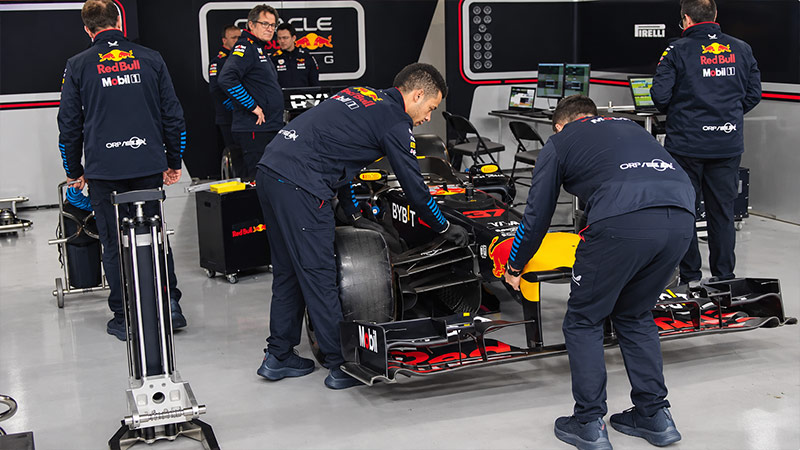
- Mechanics: build, set up and repair the car, often working late after a practice crash.
- Strategists: sit on the pit wall and back at base, running live race models.
- Team principal and sporting director: make the big calls and deal with race control and the stewards.
The pit stop is where all this teamwork becomes visible. A crew of roughly 20 people changes four tyres in around two seconds. The official record is 1.80 seconds, set by McLaren on Lando Norris’s car at the 2023 Qatar Grand Prix.
Then comes the pack-up. On a normal Sunday, McLaren aims to have the cars stripped and the garage boxed up between 11pm and midnight, with even senior engineers filling flight cases after their debriefs.
Data and Strategy: The Invisible Race
Modern F1 is as much a data contest as a driving one. Each car carries hundreds of sensors, streaming live readings on tyres, brakes, energy use and aerodynamics to engineers at the track and at base.
That data drives three kinds of decisions:
- Setup: wing levels, ride heights, suspension stiffness and cooling for each circuit.
- Strategy: when to pit, which tyres to fit, and how to react to safety cars or rain.
- Development: which upgrades really work, and where the next tenth of a second will come from.
History matters too. McLaren notes that the previous season’s data is central to race planning, though strategists find it less useful when the car’s pace has changed sharply from one year to the next.
The 2026 cars add a new layer. With electrical power now providing close to half of total output, managing when to harvest and deploy energy has become a strategic battle of its own, fought lap by lap from the pit wall.
The Money: Cost Cap and Revenue
F1 teams race under a cost cap, a limit on what they can spend on car performance each season. For 2026 it rose to $215 million, up from a $135 million base.
Formula 1 says the jump is roughly neutral overall, because several costs that used to sit outside the cap now count, such as the annual depreciation of equipment.
Inside the cap: research and development, design, and manufacturing of parts that make the car faster.
Outside the cap: driver salaries, the three highest-paid staff, marketing, legal, HR, finance, heritage car programmes, race travel, health and safety, and catering.
Teams can carry up to $2 million of unspent cap into the next year, and there is an allowance for staff in high-cost countries such as Switzerland, where Audi is based. Engine makers work under a separate cap of their own.
The rules have teeth. Red Bull was fined $7 million and lost 10% of its aero testing time after breaching the 2021 cap.
So where does the money come from? Teams earn a share of Formula 1’s commercial income, with more paid to higher championship finishers. They add sponsorship and partnerships, merchandise and investment from owners. A strong season is worth money as well as silverware.
Where Drivers Fit In
Drivers are the most famous people in the team, but they are also its most valuable sensors. Their feedback shapes setup changes, upgrade decisions and simulator programmes.
Each team fields two race drivers, backed by reserve drivers who can step in at short notice and often carry much of the simulator workload.
The bond between a driver and their race engineer is one of the most important in the sport. They talk constantly over the radio and review every session together.
Driver pay sits outside the cost cap. That is why top teams can still offer star salaries without cutting into car development.
How People Get Jobs in F1
For engineers, the most common route is a degree in mechanical, aerospace or electrical engineering, often paired with university motorsport projects such as Formula Student. But teams also hire in data science, software, composites, logistics, finance, marketing and hospitality.
Practical steps that help:
- Build real projects: student racing teams, CAD portfolios or data analysis you can show.
- Apply early: most teams advertise placements, graduate schemes and apprenticeships on their careers pages.
- Use feeder routes: suppliers, junior racing series and engineering firms often lead into F1.
- Be ready for the pace: trackside roles mean long hours and heavy travel, though teams now rotate staff more as calendars grow.
Conclusion
So, how do Formula 1 teams work? They work as tightly run engineering companies built around one goal: making two cars faster than everyone else’s.
The factory designs, simulates and builds; the race team executes; and data links the two every minute of a race weekend.
Rules on spending, testing and staffing force every team to win through smarter decisions rather than bigger budgets.
That is what makes modern F1 so absorbing to follow. Next time you watch a two-second pit stop or hear a calm radio call, you will know the hundreds of people working behind it.