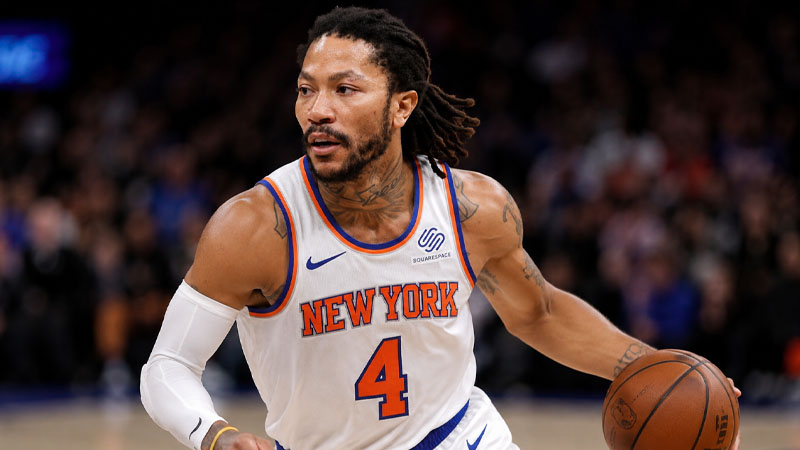
Derrick Rose saved his NBA career through a radical transformation of his physical mechanics, tactical approach, and psychological perspective.
Following a series of devastating knee injuries that compromised his elite athleticism, the former MVP pivoted from a high-velocity slasher to a high-IQ perimeter threat and veteran floor general.
By mastering landing techniques to protect his joints, developing an elite three-point shot, and embracing a specialized “Sixth Man” role, Rose extended his tenure to 15 seasons.
This comeback serves as a blueprint for professional longevity, proving that elite mental resilience can overcome even the most severe physical setbacks.
Why Did Derrick Rose Have to Change His Playing Style?
The necessity for change was born out of biological reality. The early version of Rose was defined by a hyper-athletic, rim-punishing style that relied on violent acceleration and sharp crossover pivots.
While this approach made him the youngest MVP in league history, it placed massive torque on his joints, eventually leading to a torn left ACL in 2012 and multiple subsequent meniscus tears.
To survive in a league that demands peak physical output, Rose had to abandon the habits that had once made him a superstar.
The Impact of Early Career Biomechanics
In his youth, Rose’s game was predicated on explosive, baseline-to-baseline drives that often ended in dangerous rim-finishing.
This style took a heavy toll on his body because he frequently landed hard on a single foot after dunks or layups, which contributed significantly to joint wear and eventual failure.
The sheer violence of his movements meant that even without contact, his body was under constant threat from the very agility that gave him an edge over defenders.
Transitioning from Athleticism to Basketball IQ
As his physical tools declined following major surgeries, Rose underwent a fundamental re-engineering of his court presence.
He transitioned from a player who could simply blow past any defender to a methodical floor general who manipulated modern defenses through intelligence and positioning.
This shift required him to stop playing at maximum speed at all times and instead master the nuances of the game, such as body shields and footwork, to maintain his effectiveness without the 40-inch vertical leap of his prime.
The Biomechanical Blueprint for Physical Durability
Saving a career after multiple knee reconstructions requires more than just willpower; it requires a scientific overhaul of how an athlete moves.
Rose dedicated his recovery cycles to analyzing his own movement patterns and identifying the flaws that led to his injuries. By focusing on kinetic efficiency, he was able to return to the court and compete against elite athletes for another decade.
Correcting High-Impact Landing Mechanics
One of the most critical adjustments Rose made was in his landing mechanics. During his extensive rehabilitation periods, he trained himself to absorb force evenly across both feet and his hips rather than putting all the pressure on one leg.
This technical correction significantly reduced the impact on his reconstructed knees and helped prevent the compensational injuries that often plague athletes returning from major surgeries.
The Art of Deceleration and Change-of-Pace
Rose learned to play the game at different speeds, a concept known as “slow-to-fast” play. Instead of sprinting throughout the shot clock, he began relying on change-of-pace hesitations to keep defenders off-balance.
By mastering deceleration, he could dictate the rhythm of the game, allowing him to navigate the paint with precision rather than brute force. This tactical shift preserved his energy and minimized the high-intensity bursts that put his ligaments at risk.
Utilizing the Floater to Avoid Rim Collisions
To remain an elite paint scorer without having to jump over seven-foot rim protectors, Rose developed a lethal teardrop floater and a reliable bank shot.
This arsenal allowed him to finish plays before reaching the secondary line of defense, effectively avoiding the violent mid-air collisions that characterized his early career.
These “soft” finishes became his signature in his later years, proving that skill could replace sheer verticality in the scoring column.
How Rose Became an Elite Perimeter Threat
In his early years with the Chicago Bulls, perimeter shooting was considered Rose’s primary weakness. Defenders would routinely sag off him, daring him to shoot from distance so they could better contain his drives.
Realizing that his waning explosive burst would no longer allow him to dominate solely in the paint, Rose spent thousands of hours in the gym rebuilding his jump shot from the ground up.
From Shooting Liability to 40% Three-Point Sniper
The transformation of Rose’s outside game is statistically staggering. Once an unreliable shooter from deep, he evolved into a legitimate floor-spacer that defenses were forced to respect.
This evolution peaked during his tenure with the New York Knicks in the 2020–21 and 2021–22 seasons, where he shot an incredible 41.1% and 40.2% from three-point range.
This efficiency allowed him to stay on the floor in the modern NBA, where three-point shooting is a non-negotiable skill for guards.
Methodical Playmaking in the Half-Court
Beyond his own scoring, Rose altered his court vision to become a highly methodical pick-and-roll orchestrator. He tightened his handle and focused on making the “right” play rather than the “spectacular” play.
This shift in playmaking efficiency allowed him to operate as a high-IQ floor general who could lead both starting and secondary units with veteran poise.
By becoming a threat from the perimeter, he opened up passing lanes that were previously closed, making him a more versatile offensive weapon.
Embracing the Sixth Man Role and Minutes Management
Many former superstars struggle to remain in the league because their egos prevent them from accepting a diminished role. Rose, however, completely humbled himself and embraced a specialized bench position.
This willingness to pivot from being the face of a franchise to a supporting piece was perhaps the most vital component of his career’s second act.
Leading the Second Unit in Minnesota and Detroit
Rose found a highly effective niche as a backup point guard who could torch secondary defensive units.
During his time with the Minnesota Timberwolves, he proved his career was fully revived on October 31, 2018, when he scored a legendary 50 points against the Utah Jazz.
He continued this “Sparkplug” phase with the Detroit Pistons, where he averaged a brilliant 18.1 points per game during the 2019–20 season, almost entirely off the bench.
Strategic Workload Limitations for Long-Term Health
A key part of Rose’s longevity was his adherence to strict minutes management. During his later stints in Detroit and New York, he willingly limited his playing time to approximately 22–26 minutes per game.
These restrictions were not a sign of weakness, but a calculated strategy to preserve his legs and maximize his intensity while on the floor.
By managing his workload, he minimized the risk of re-injury and ensured he could remain productive over the course of a long 82-game season.
The Psychological Shift: Relinquishing the MVP Identity
In late 2017, while playing for the Cleveland Cavaliers, Rose reached a breaking point. Mentally and physically drained by the cycle of injury and rehab, he briefly left the team to contemplate walking away from basketball entirely.
His eventual return was marked by a profound internal shift that redefined his relationship with the game.
Overcoming Mental Exhaustion and Retirement Thoughts
Rose’s career-saving pivot was ultimately an internal one. He chose to return to the court only after stripping away the crushing pressure of trying to regain his former “MVP status”.
By relinquishing the need to be the player he was at age 22, he was able to find joy in the game again. He decided to play purely for the love of the sport, a mental clarity that allowed him to focus on the present rather than mourning his lost athleticism.
Pioneering Recovery Science and Veteran Mentorship
As he aged, Rose shifted his training focus entirely toward durability and recovery. He became a pioneer in the use of sleep science, advanced nutrition, and recovery technology, creating a model that younger players across the league now follow.
Furthermore, in his final active seasons with teams like the Memphis Grizzlies, he embraced the role of an elder statesman, dedicating his energy to mentoring the next generation of guards.
The Evolution of a Legend: A Comparative Overview
To understand the magnitude of Rose’s transformation, one must look at the data across the different phases of his career. He did not just “stay” in the league; he reinvented his entire statistical profile to match the needs of the modern game.
| Career Phase | Core Playstyle Focus | 3-Point Accuracy | Primary NBA Role |
|---|---|---|---|
| Peak MVP Era (2008–2012) | Hyper-athletic slasher, rim-crashing, violent landings | ~28% to 33% | Franchise Superstar |
| The Dark Years (2013–2017) | Forcing old explosive habits with a damaged body | 21% to 29% | Struggling Starter |
| The Reinvention (2018–2024) | High-IQ floor general, floaters, elite spacing | 37% to 41% | Elite Sixth Man / Leader |
Frequently Asked Questions About Derrick Rose’s Comeback
How did Derrick Rose change his jump shot?
Rose spent thousands of hours rebuilding his form to become an elite floor-spacer. He focused on a more consistent release and increased his range, eventually shooting over 40% from three-point distance during his time with the New York Knicks.
What was the “50-point game” and why was it important?
On October 31, 2018, Rose scored 50 points for the Minnesota Timberwolves against the Utah Jazz. This performance was a symbolic turning point, proving to the world—and himself—that he could still be an elite force in the NBA despite his injury history.
Why did Rose leave the Cleveland Cavaliers in 2017?
Rose briefly stepped away from the Cavaliers to evaluate his future in basketball. He was physically and mentally exhausted by the constant cycle of rehabilitation and contemplated retirement before deciding to return with a new, purified focus on the game.
What are “landing mechanics” in the context of Rose’s career?
Early in his career, Rose landed hard on one foot, which put extreme stress on his joints. During his recovery, he trained to land on both feet and use his hips to absorb the force, a change that was vital for his long-term knee health.
Conclusion: The Ultimate Survival Story
The story of how Derrick Rose saved his career is more than just a sports narrative; it is a masterclass in adaptation.
By choosing to evolve when his body could no longer support his original style, he transformed a potential tragedy into a triumphant 15-season legacy.
Rose proved that while athleticism is a gift, longevity is a choice made through discipline, humility, and the relentless pursuit of improvement. For any professional facing a forced transition, the Rose blueprint remains the gold standard for reclaiming a legacy.