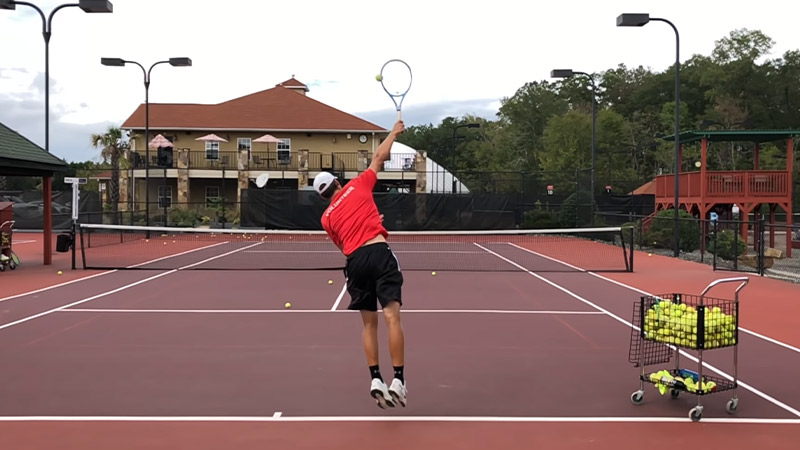
In the world of elite athletics, few motions are as visually striking or technically complex as the professional tennis serve. From the stands, it appears that the world’s top players are performing a deliberate, vertical leap into the air as they strike the ball.
This observation often leads amateur players and fans to ask a fundamental question: Do professional tennis players jump when they serve?
The answer is yes, they do leave the ground, but the reality of this motion is far more nuanced than a simple jump.
For a professional, this elevation is not a conscious leap of faith; rather, it is the natural and inevitable result of a highly refined kinetic chain designed for maximum power and tactical precision.
The Illusion of the Conscious Jump
One of the most common misconceptions in tennis coaching is the idea that a player should “jump” to reach the ball. In reality, focusing on the act of jumping often disrupts the timing and balance of the serve.
For elite professionals, the feet leaving the ground is simply the final stage of a series of movements that begin at the feet and travel through the entire body.
The goal of the serve is not height for the sake of height; it is the efficient transfer of energy from the ground, through the legs and torso, and finally into the racket head at the exact moment of impact.
When this energy transfer is executed correctly, the upward momentum becomes so great that the player is naturally lifted off the court.
Step 1: The Leg Bend and Energy Storage
The foundation of every powerful serve is found in the lower body. This is known as the “loading” phase. As a player begins their motion and tosses the ball into the air, they simultaneously initiate a deep knee bend.
This motion is critical because it turns the legs into a coiled spring, storing potential energy that will soon be unleashed.
In professional circles, this is often referred to as the “trophy position.” During this stage, the player’s weight is distributed in a way that allows them to drive against the ground.
The deeper and more controlled the leg bend, the more energy the player can potentially generate for the upward explosion. Without this initial storage of energy, the subsequent “jump” would be impossible to achieve with any level of consistency or power.
Step 2: The Upward Push and Kinetic Momentum
Once the ball reaches the desired height and the legs are fully loaded, the player begins the “upward push.” This is the most explosive part of the serve. As the racket begins its path toward the ball, the player pushes off the ground with immense force.
This upward and forward explosion is what creates the momentum that eventually lifts the feet off the ground. It is a vertical drive that serves two purposes. First, it accelerates the racket upward into the ball.
Second, it shifts the player’s center of mass forward into the court, ensuring that the weight of their entire body—not just the arm—is behind the shot.
Because the force of this push is directed toward the ball at a high velocity, the player’s feet naturally lose contact with the court surface.
This is the moment spectators identify as a “jump,” but for the player, it is merely the sensation of the ground falling away as they reach for the apex of their swing.
Step 3: Maximizing the Contact Point
The primary reason professionals seek this vertical elevation is to reach the highest possible contact point. In tennis, geometry is everything.
By hitting the ball at the absolute peak of its upward motion, players can achieve a much steeper angle into the opponent’s service box.
When a player strikes the ball from an elevated position, they are essentially “hitting down” on the ball. This allows them to clear the net with a greater margin of safety while still landing the ball deep in the box with high velocity.
If a player were to stay flat-footed, their contact point would be significantly lower, forcing them to hit the ball with more arc to clear the net, which in turn reduces the potential for a direct, powerful strike.
Furthermore, hitting at the peak of the motion ensures that the racket arm is fully extended. This extension maximizes the leverage of the “long lever” (the arm and racket combined), which is essential for generating the triple-digit speeds seen in professional matches.
Step 4: The Strategic Landing and Recovery
What goes up must come down, and in tennis, how you come down is just as important as how you went up. Professional players are trained to land inside the court, typically on their front foot.
This landing is not just a way to return to Earth; it is a tactical transition. By landing inside the baseline, the player has already effectively “shrunk” the court.
This forward momentum allows them to keep their balance and immediately begin moving toward the net or recovering to the center of the baseline for the next shot.
A balanced landing is a hallmark of an elite serve. If a player jumps without control, they will land off-balance, leaving them vulnerable to a quick return.
The “natural jump” of a professional is so well-calibrated that the landing looks effortless, putting them in the perfect position to dominate the ensuing point.
The Competitive Advantages: Power and Bounce
Why is this mechanic so universal among the pros? The advantages are twofold: increased power and a more difficult bounce for the receiver.
- Explosive Power: By utilizing the legs and the resulting upward momentum, players can hit the ball significantly harder than they could by using their upper body alone. The legs are the largest muscle group in the body; failing to use them would be leaving a massive amount of potential speed on the table.
- The “Heavy” Bounce: When a ball is struck from a high contact point with great force, it creates a “heavy” bounce. This means that after the ball hits the service box, it continues to move through the air with pace and height, forcing the returner to strike the ball at an uncomfortable shoulder-high level or even higher.
The Legal Framework: Navigating the Rules of the Serve
For those concerned about the legality of leaving the ground, the rules of tennis are quite clear. According to the standard regulations governing professional play, a player is permitted to leave the ground during the service motion.
The primary restriction is that the player must remain behind the baseline at the moment the service motion begins.
As long as the feet are behind the line when the “push” starts, the player is free to explode upward and forward, landing well inside the court after the ball has been struck.
This distinguishes a legal serve from a “foot fault,” which occurs if a player’s foot touches the baseline or the court inside the baseline before the racket makes contact with the ball.
Common Misunderstandings in Serve Mechanics
Many intermediate players attempt to mimic the pros by trying to jump. This often leads to a “leak” in power where the energy goes upward but doesn’t translate into the ball. The difference lies in the timing of the extension.
- Pro Reality: The legs drive upward into the ball, and the jump is a consequence.
- Amateur Error: The player jumps first and then tries to hit the ball while hanging in the air, losing the support of the ground and the kinetic link to the legs.
To fix this, coaches often tell players to focus on the “upward push” rather than the jump itself. If you push hard enough at the right time, the jump will take care of itself.
Frequently Asked Questions About the Tennis Serve
Q: Do I have to jump to have a good serve?
A: No. While leaving the ground is a byproduct of a powerful, professional-level serve, many club players can hit effective, accurate serves without their feet leaving the court. Focus first on the leg bend and the upward extension.
Q: Why do some players land on their left foot and others on their right?
A: Most right-handed players land on their left foot because it is their lead foot during the forward weight transfer into the court. This allows them to maintain balance and move forward toward the net efficiently.
Q: Does jumping cause more injuries?
A: If done incorrectly—by forcing a jump rather than letting it happen naturally—it can put undue stress on the knees and back. However, when the kinetic chain is aligned as it is in professional play, the “jump” is actually a way to distribute the physical load across the entire body rather than just the shoulder.
Conclusion: The Path to an Elite Serve
Mastering the tennis serve is a journey of understanding physics as much as it is a journey of physical training.
The vertical motion we see on television—the “jump”—is the signature of a player who has mastered the art of ground-force reaction.
By focusing on a disciplined knee bend, a powerful upward drive, and a high contact point, you can begin to develop the same mechanics that propel the pros into the air.
Remember: don’t try to jump. Instead, push toward the ball with such conviction that the ground has no choice but to let you go.
Whether you are looking to add ten miles per hour to your first serve or simply want to understand the game at a deeper level, recognizing the “natural result” of the service motion is the first step toward mastery.
The next time you watch a match, look past the jump and see the incredible energy storage and release that makes it possible.