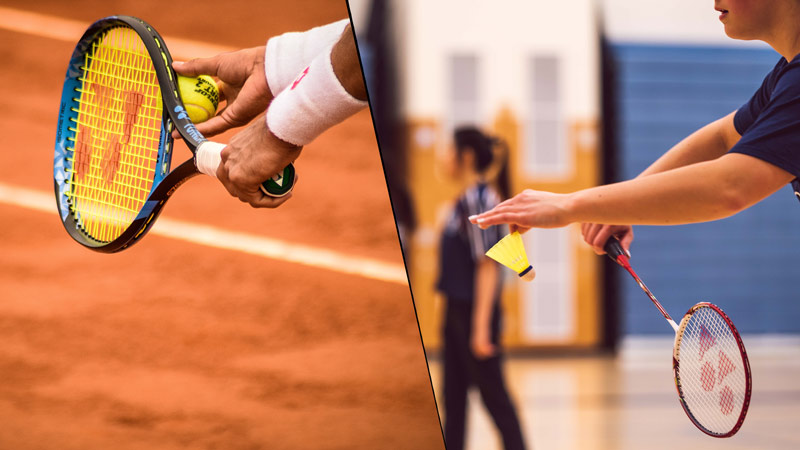
The question of whether tennis or badminton came first is a common point of inquiry for sports historians and enthusiasts alike.
While both disciplines share the fundamental objective of propelling a projectile over a net with a racket, their historical trajectories are distinct.
A rigorous analysis reveals that tennis precedes badminton by several centuries, with its origins rooted in the medieval monasteries of Europe, whereas modern badminton emerged from the colonial dynamics of the 19th century.
Understanding this chronological gap is essential for grasping how these sports evolved from simple recreational pastimes into the multi-billion-dollar global industries they are today.
This report provides a detailed examination of the developmental milestones that shaped both sports.
The Medieval Genesis: The 12th-Century Roots of Tennis
To understand the antiquity of tennis, one must look toward 12th-century France. Long before the invention of the modern yellow ball or graphite rackets, the game existed in a primitive yet highly structured form.
The Monastic Influence
The earliest iteration of tennis was developed by French monks who utilized the enclosed courtyards of their monasteries as playing fields. These early practitioners did not use rackets; instead, they struck wooden balls with their bare hands.
This version of the game was known as jeu de paume, or “game of the palm”. The logistical constraints of the monastery—specifically the use of ropes strung across courtyards—dictated the early rules and the physical boundaries of the play area.
The Transition to Equipment
As the “game of the palm” gained popularity beyond the clergy, the physical toll of striking a hard wooden ball with the hand led to the development of gloves, then paddle-like implements, and eventually the precursor to the modern racket.
By the time the game reached the French and English royalty, it had transitioned into “Real Tennis,” a complex indoor sport played on specialized stone courts.
However, the fundamental concept of a ball traveling back and forth over a central divider remained the core element inherited from those 12th-century courtyards.
The Colonial Evolution: The 19th-Century Birth of Badminton
In contrast to the medieval origins of tennis, the modern sport of badminton is a relatively recent addition to the global athletic landscape. While the act of hitting a shuttlecock—a lightweight object adorned with feathers—has ancient roots in Greece and Asia, it did not exist as a codified competitive sport until much later.
The Innovation in British India
The catalyst for modern badminton occurred in the mid-19th century in British India. During the 1860s, British army officers stationed in India encountered an ancient children’s pastime known as “battledore and shuttlecock”.
In its original form, this was a simple cooperative game where participants kept the shuttlecock in the air for as long as possible.
The officers introduced a critical competitive element: a net. By adding a net, they transformed a leisurely activity into a high-intensity, strategic sport that required precision and agility.
This modification changed the nature of the game, demanding a formalized court and a specific set of rules to govern play.
The Naming of a Sport
The sport we recognize today was formally introduced to England via the Duke of Beaufort. In the late 19th century, the game was played at the Duke’s country estate, which was named “Badminton House”.
This association with the landed gentry provided the sport with its permanent name and the social prestige necessary for it to spread throughout the British Isles and eventually the world.
The Era of Codification: 1870–1934
While the roots of these sports are centuries apart, the late 19th century served as a pivotal era for the formalization of both. However, tennis achieved professional and organizational maturity much faster than its counterpart.
Major Walter Wingfield and Lawn Tennis
In the 1870s, an Englishman named Major Walter Wingfield played a transformative role in the history of tennis. He is credited with creating “modern lawn tennis,” a version of the game designed for the outdoor grass courts of Victorian estates.
Wingfield was instrumental in drawing up the first official rules and defining the specific geometric shapes of the courts. This standardization was a prerequisite for the birth of competitive tournaments.
The Tournament Gap
The disparity in the formal organization of these sports is perhaps most evident in their competition timelines. The first Wimbledon tournament took place in 1877, signaling tennis’s arrival as a premier international sport.
Conversely, badminton’s international governing body, the International Badminton Federation (now the Badminton World Federation), was not established until 1934—nearly 60 years after tennis had already held its first major championship.
Comparative Analysis: Mechanics and Strategic Development
The chronological lead held by tennis allowed it to influence the early expectations of racket sports, yet badminton’s unique projectile—the shuttlecock—created a distinct technical trajectory.
| Feature | Tennis (Origins) | Badminton (Origins) |
|---|---|---|
| Earliest Date | 12th Century | Mid-19th Century |
| Original Region | France | British India |
| Original Projectile | Wooden Balls | Feathered Shuttlecock |
| Initial Hitting Surface | Bare Hands (Jeu de Paume) | Wooden Paddles (Battledore) |
| First Major Org. | 1877 (Wimbledon) | 1934 (IBF) |
Technical Trajectories
Tennis evolved around the physics of a bouncing ball. This necessitated the development of varied court surfaces—clay, grass, and hard courts—to accommodate different speeds and bounce heights. Badminton, centered on the flight of the shuttlecock, never integrated a “bounce” into its play.
Because shuttlecocks are highly susceptible to wind, the sport transitioned into a primarily indoor discipline to maintain competitive integrity, whereas tennis remained an outdoor staple.
Strategic Impact: From Courtyards to Global Dominance
The histories of these two sports reflect broader societal shifts. Tennis’s evolution from a monastic exercise to a royal pastime and eventually a professionalized sport, mirrors the formalization of European leisure.
Badminton’s journey highlights the interconnectedness of the British Empire, where local traditions in Asia were refined by military officers and exported back to the English aristocracy.
Today, both sports are cornerstones of the Olympic Games and maintain massive global followings. While tennis may have the advantage of an 800-year history, badminton has rapidly closed the gap in terms of participation and athletic intensity.
Frequently Asked Questions
Which sport is older, tennis or badminton?
Tennis is significantly older. Its origins trace back to 12th-century France, while the modern version of badminton did not emerge until the 1860s in British India.
Why is badminton named after a house?
The sport gained popularity in England after being played at “Badminton House,” the estate of the Duke of Beaufort. The name of the estate eventually became the official name of the sport.
Who wrote the first official rules for tennis?
Major Walter Wingfield is credited with creating the first official rules and court designs for modern lawn tennis in the 1870s.
What was the original name of tennis?
The game was originally called jeu de paume, which translates to “game of the palm,” because players initially hit the ball with their hands.
What were the original shuttlecocks made of?
Early shuttlecocks used in the games that preceded badminton were light objects typically made with feathers.
Conclusion
The historical evidence is conclusive: tennis came first. From its humble beginnings in French monasteries to the standardized rules of Major Wingfield, tennis established a framework for racket sports centuries before badminton was formalized.
However, both sports share a common thread of innovation—transforming simple games of hitting an object back and forth into sophisticated athletic disciplines that continue to captivate the world.
For the modern athlete, understanding this history provides a deeper appreciation for the technical nuances and cultural significance of every match played on the court today.