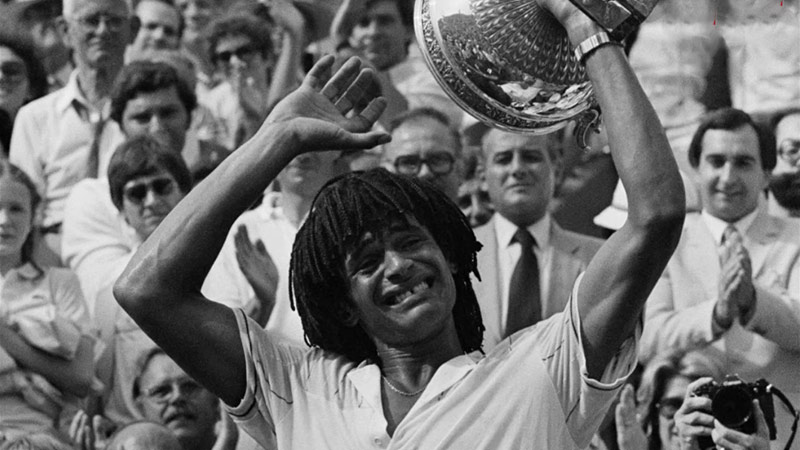
Yannick Noah remains one of the most iconic figures in tennis history, successfully capturing two Grand Slam major titles during his illustrious career.
His most legendary achievement occurred in 1983, when he won the French Open men’s singles title, ending a 37-year drought for French male players. A year later, he solidified his dominance at Roland Garros by securing the 1984 men’s doubles title.
Beyond these trophies, Noah reached a career-high ranking of World No. 3 in singles and World No. 1 in doubles, cementing his status as a versatile and enduring champion on the global stage.
Did Yannick Noah Ever Win a Major?
To understand the magnitude of Yannick Noah’s career, one must look specifically at his performances on the grandest stages of professional tennis.
Noah did indeed win major titles, securing a total of two Grand Slam championships during his peak years in the 1980s.
These victories were not merely statistical entries but served as pivotal cultural moments, particularly for French sports fans who had long waited for a homegrown champion.
The 1983 French Open Singles Masterclass
The crowning achievement of Yannick Noah’s singles career took place on June 5, 1983, at Roland Garros. Entering the tournament as the 6th seed, Noah displayed a level of athletic dominance rarely seen on the slow red clay of Paris.
In the final, he faced the defending champion, Mats Wilander of Sweden, a player known for his baseline consistency and tactical brilliance.
Noah dismantled Wilander in straight sets, winning 6–2, 7–5, 7–6 (7–3). This victory was significant for several reasons: it made him the first Frenchman to win the home major in 37 years, a record dating back to Marcel Bernard in 1946.
To this day, Noah remains the last French man to win a Grand Slam singles title, highlighting the sheer difficulty of the feat he achieved.
The image of Noah collapsing to his knees and being embraced on court by his father, Zacharie, remains one of the most enduring images in tennis history.
The 1984 Men’s Doubles Triumph
While many remember Noah for his singles heroics, his prowess on the doubles court was equally elite. Exactly one year after his singles triumph, Noah returned to the winner’s circle at the 1984 French Open.
This time, he partnered with his compatriot and close friend, Henri Leconte, to take on the world’s best doubles duos.
The final was a grueling five-set test of endurance and skill against the Czechoslovakian pair of Pavel Složil and Tomáš Šmíd. After falling behind, Noah and Leconte staged a remarkable comeback to win 6–4, 2–6, 3–6, 6–3, 6–2.
This victory was instrumental in Noah’s ascent to the top of the doubles world, eventually leading him to achieve the World No. 1 ranking in doubles in August 1986.
Notable Major Final Appearances as a Runner-Up
Beyond his two championships, Noah’s ability to compete at the highest level was evidenced by his multiple appearances in Grand Slam finals. Although he did not secure additional titles, reaching these finals underscored his status as a premier athlete.
- 1985 US Open Men’s Doubles: Partnering again with Henri Leconte, Noah reached the final in New York but finished as a runner-up to the American duo of Ken Flach and Robert Seguso.
- 1987 French Open Men’s Doubles: Two years later, Noah returned to the French Open doubles final with a different partner, Guy Forget. They ultimately fell to the pair of Anders Järryd and Robert Seguso, marking Noah’s final appearance in a major title match.
The Path to Glory: Analyzing the 1983 Tournament Run
Noah’s run to the 1983 singles title was characterized by nearly flawless execution. Throughout the two-week tournament, he utilized an aggressive serve-and-volley style that pressured opponents and dictated the pace of play.
The following data provides a round-by-round look at his dominant performance:
| Round | Opponent | Score |
|---|---|---|
| Round 1 | Anders Järryd | 6–1, 6–0, 6–2 |
| Round 2 | Victor Pecci | 6–4, 6–3, 6–3 |
| Round 3 | Pat Dupré | 6–4, 6–0, 6–2 |
| Round 4 | John Alexander | 6–2, 7–6, 6–1 |
| Quarterfinal | Ivan Lendl (Seed #3) | 7–6, 6–2, 5–7, 6–0 |
| Semifinal | C. Roger-Vasselin | 6–3, 6–0, 6–0 |
| Final | Mats Wilander (Seed #5) | 6–2, 7–5, 7–6 (7–3) |
During this entire run, Noah lost only a single set, which occurred in his high-stakes quarterfinal match against the legendary Ivan Lendl.
Technical Excellence and the End of an Era in Tennis
Yannick Noah’s success was not just about wins and losses; it was about the transition of the sport itself. His 1983 victory is often cited by historians as a bridge between the classic era of tennis and the modern, high-powered game we see today.
His playing style combined traditional finesse with a level of athleticism that was ahead of its time.
The Last Major Title Won with a Wooden Racket
A fascinating historical detail of Noah’s 1983 French Open victory is that he was the last male player to win a Grand Slam singles major using a wooden racket.
At a time when the sport was rapidly transitioning to graphite and composite materials that offered more power and a larger sweet spot, Noah’s ability to dominate the clay with wood was a testament to his exceptional feel and precision.
This milestone effectively marked the end of the “Wooden Racket Era” in men’s professional tennis, making his victory a unique historical bookend.
Serve-and-Volley Mastery on the Red Clay
Typically, clay court tennis is associated with long baseline rallies and defensive play. However, Noah defied these conventions by employing an athletic, aggressive serve-and-volley style.
His ability to move forward and finish points at the net was a nightmare for opponents who preferred to sit back and trade groundstrokes.
This tactical choice required immense physical conditioning, a trait Noah possessed in abundance. Records show he held a 30–20 record in five-set matches throughout his career, proving that his explosive style was backed by world-class stamina.
Global Reach: How Noah Performed Outside of France
While the French Open was undoubtedly Noah’s most successful venue, he was far from a one-tournament wonder.
His career stats reflect a player who was competitive across different surfaces and continents, even if he did not reach the same heights as he did in Paris. He selectively managed his schedule, occasionally skipping events to maintain his peak performance levels.
Hard Court Success at the Australian and US Opens
Noah’s athleticism translated well to hard courts, where he achieved several deep runs. At the US Open, he was a consistent threat throughout the 1980s, reaching the quarterfinals on three separate occasions in 1983, 1985, and 1989.
His career-best performance in a hard-court major came at the very end of his professional journey.
In 1990, during his final full year on the tour, Noah reached the singles semifinals of the Australian Open, demonstrating that his skill set remained elite well into his veteran years.
The Grass Court Struggle at Wimbledon
Wimbledon remained the biggest challenge for Noah throughout his career. Grass requires a very specific set of movement patterns and low-bouncing tactical adjustments that never quite aligned with Noah’s game to the same degree as clay or hard courts.
He only participated in the tournament six times, with his best results being third-round appearances in 1979 and 1985.
Despite his serve-and-volley instincts, which typically favor grass, he never managed to break through into the second week at the All England Club.
By the Numbers: A Comprehensive Statistical Career Review
The following statistics provide a clear picture of Yannick Noah’s consistency and efficiency as a professional athlete. His winning percentages and title counts place him among the elite players of his generation.
- Singles Major Match Record: 85 Wins / 35 Losses
- Grand Slam Winning Percentage: 70.8%
- Total Career Titles: 39 (23 Singles, 16 Doubles)
- Overall Singles Match Record: 476–209 (69.6% win rate)
- Overall Doubles Match Record: 213–109 (66.1% win rate)
- Peak Singles Ranking: World No. 3
- Peak Doubles Ranking: World No. 1
These numbers highlight that while his Grand Slam wins are his most famous achievements, his day-to-day performance on the ATP Tour was remarkably high. Maintaining a winning percentage of nearly 70% over a decade of play is a hallmark of a true champion.
Frequently Asked Questions About Noah’s Major Career
How many Grand Slam titles did Yannick Noah win?
Yannick Noah won two Grand Slam titles: the 1983 French Open singles title and the 1984 French Open doubles title.
Who was the last Frenchman to win a Grand Slam?
Yannick Noah is the last Frenchman to win a Grand Slam singles title, having won at Roland Garros in 1983.
What was Yannick Noah’s highest ranking?
Noah reached a career-high of World No. 3 in singles and World No. 1 in doubles.
Did Yannick Noah ever win Wimbledon?
No, Noah’s best result at Wimbledon was reaching the 3rd round in 1979 and 1985.
Who did Yannick Noah beat in the 1983 French Open final?
He defeated the defending champion, Mats Wilander, in straight sets (6–2, 7–5, 7–6).
What kind of racket did Yannick Noah use to win his major?
Noah famously won the 1983 French Open using a wooden racket, making him the last man to win a major singles title with one.
Conclusion: The Enduring Legacy of Yannick Noah
The career of Yannick Noah is a story of historic firsts and cultural breakthroughs. By winning two major titles at Roland Garros, he secured his place as a national hero and an inspiration for future generations of athletes.
His success as a Black athlete was particularly meaningful, as he followed in the footsteps of his mentor and discoverer, Arthur Ashe, becoming only the second Black male player in the Open Era to win a Grand Slam singles title.
Noah’s legacy is defined not just by the trophies he lifted, but by the manner in which he won—with an athletic flair, a wooden racket, and an unbreakable bond with his home crowd.
Whether analyzing his World No. 1 doubles ranking or his legendary 1983 singles run, it is clear that Yannick Noah remains a titan of the sport. His record as the last Frenchman to win a home major still stands, a testament to the extraordinary nature of his 1983 triumph.