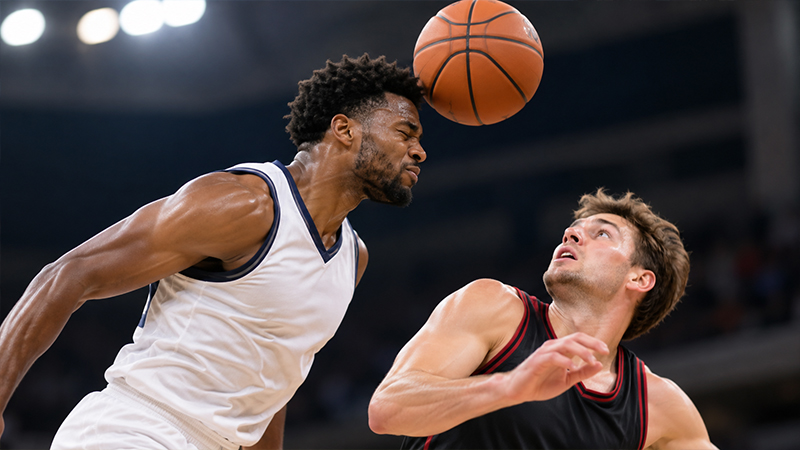
In the traditional understanding of basketball, the game is defined by the dexterity of the hands and the agility of the feet.
Most enthusiasts and even seasoned players operate under the assumption that any contact with the ball involving a body part other than the hands is either a violation or a fluke.
However, a deeper analysis of the regulatory framework and the biomechanical possibilities of the sport reveals a more nuanced reality.
The head, while certainly not a primary tool for ball manipulation, occupies a unique and often overlooked space in the tactical landscape of the court.
Understanding the utility of the head requires a shift in perspective. It is not merely a pedestal for the eyes and ears; it is a physical asset that, when used within the boundaries of the law, can facilitate turnovers, create space, and execute the ultimate psychological deception.
This analysis explores the legalities, physical applications, and mental stratagems involving the head in high-level basketball.
The Regulatory Framework: What is Actually Legal?
To understand why the head is a legal tool, one must look at how rules are constructed. In many competitive sports, regulations are exclusionary—they define what is prohibited rather than listing every permissible action.
In basketball, the rules against intentional body contact are quite specific, explicitly banning the use of the feet (kicking) and the fists (punching).
Because the head is not mentioned in these specific prohibitions, intentional contact with the basketball using the head does not carry an automatic penalty.
This creates a fascinating gray area. While a player cannot intentionally “kick” the ball to a teammate to stop a fast break, they could, theoretically, use their head to redirect a high pass without fear of a violation whistle.
However, there is a significant caveat regarding player-to-player contact. While the head can touch the ball, it cannot be used as a weapon against another player.
“Excessively forceful headbutting” is strictly classified as an offensive foul, ensuring that the physical utility of the head remains focused on the ball or spatial positioning rather than aggression.
The Physics of Inaccuracy: Why Heading Isn’t Soccer-Adjacent
A common question for multi-sport athletes is why the “heading” techniques prevalent in soccer haven’t transitioned into the basketball lexicon.
The answer lies in the physics of the equipment and the mechanics of the sport. A basketball is significantly heavier, more pressurized, and has a different surface friction than a soccer ball.
In soccer, the head is used for precision strikes and long-distance clearing because the ball is designed to be aerodynamic and responsive to the hard surface of the cranium. In basketball, attempting to “head” the ball is a high-risk endeavor.
The technique is notoriously inaccurate and incredibly difficult to control compared to manual handling.
Because basketball is a game of millimeters and high-percentage shots, relying on a body part that offers low directional control is generally seen as a sub-optimal strategy. Thus, while legal, it remains a rare occurrence reserved for specialized situations.
Physical Tactics: The Head as a Tool for Turnover Creation
If the head is too inaccurate for standard passing or shooting, how is it physically utilized? The most effective applications involve using the head as a tactical “backboard” or a point of ricochet.
One of the most clever, albeit rare, plays in basketball involves forcing an out-of-bounds turnover by deliberately bouncing the ball off an opponent’s head.
In a situation where a player is trapped near the baseline with no clear passing lane, “drilling” the ball off a defender’s head can cause the ball to fly out of bounds, resulting in a retained possession for the offensive team. It is a high-level awareness play that turns a defender’s positioning against them.
Similarly, the “teammate ricochet” is a maneuver used to catch a defense off-guard. By passing the ball off a teammate’s head, a player can create a trajectory that is nearly impossible for a defender to track or intercept.
These plays rely on the element of surprise and the fact that most defenders are conditioned to watch the hands, not the head, for the next movement of the ball.
Spatial Dominance: The Low Post and the Drive
Beyond direct contact with the ball, the head is instrumental in claiming and maintaining physical space on the court. This is most evident in the low post or during aggressive drives to the basket.
As a player maneuvers through traffic, they often lean their head and shoulders forward. This serves two primary purposes: protecting the ball and establishing a center of gravity that is difficult to displace.
By leading with the head (within the bounds of non-foul contact), a player can effectively “carve out” a path through a defender’s reaching arms.
It allows the ball-handler to shield the ball with their entire torso and head, making a clean steal almost impossible without the defender reaching across the body and committing a foul.
However, the line between “claiming space” and “committing a foul” is thin. If the forward lean transitions into a striking motion—a headbutt—the official will immediately intervene. Mastery of this tactic requires a balance of physical assertiveness and legal restraint.
The Mental Game: The Mechanics of the Head Fake
While the physical uses of the head are intriguing, its most powerful application is undoubtedly psychological. The “Head Fake” is a foundational element of elite basketball, utilized by everyone from primary ball-handlers to off-ball shooters.
The efficacy of the head fake is rooted in human biology and defensive training. Defenders are taught to watch a player’s “midsection” to avoid being fooled by crossovers, but the brain is naturally wired to track the eyes and the direction of the head.
When a ball-handler quickly turns their head in one direction, the defender’s nervous system often reacts instinctively, causing them to shift their weight in anticipation of a pass or a drive in that direction.
Once the defender has shifted their weight, they are momentarily “stuck” due to inertia. The ball-handler can then immediately exploit this lapse in balance by driving in the opposite direction.
It is a masterpiece of deception that requires no contact with the ball at all, yet it is arguably the head’s most impactful contribution to the scoreboard.
Biomechanical Efficiency and Player Longevity
In the modern era, where player health and data-driven performance are paramount, the use of the head must be viewed through a lens of safety.
While the rules allow for contact, the medical consensus on sub-concussive impacts has made players and coaches more cautious.
This is perhaps why the “Head Fake” remains the preferred use of the head; it offers a massive strategic advantage with zero physical risk.
In high-stakes environments, such as professional leagues or international tournaments, the difference between a win and a loss often comes down to these marginal gains.
A player who understands that they can legally use their head to redirect a ball or force an opponent into an out-of-bounds error has one more tool than a player who views the game through a strictly traditional lens.
Enhanced FAQ: Navigating Head Usage in Basketball
1. Is it a technical foul if the ball hits my head?
No. There is no rule that penalizes the ball for making contact with your head, whether that contact is accidental or intentional. It is simply treated as a live ball, provided no other violations (like out-of-bounds) occur.
2. Can I “header” the ball into the hoop for a basket?
Theoretically, yes. If you were to intentionally redirect a ball into the basket with your head, it would be a legal field goal, as it is not a “kicked ball” or a “punched ball”. However, the likelihood of achieving the necessary accuracy for such a play is extremely low.
3. What is the difference between a head fake and an offensive foul?
A head fake is a non-contact deceptive movement where you turn your head to trick a defender. An offensive foul occurs when you use your head to physically strike or “headbutt” a defender with excessive force to move them out of your way.
4. Why don’t players use their heads to rebound more often?
The primary reason is control. Rebounding requires the ability to secure the ball quickly and transition into an outlet pass. Using your head would only bounce the ball away in an unpredictable direction, making it harder for your team to maintain possession.
5. Can I use my head to block a shot?
Yes, it is legal to block a shot with your head. As long as you do not commit a foul on the shooter’s body, the “head block” is a legal defensive play. However, for obvious safety reasons, it is not a recommended or taught defensive technique.
Conclusion: The Unconventional Asset
The head is a multi-functional tool in the world of basketball. While it will never replace the precision of a jump shot or the utility of a crossover dribble, its role in the game’s strategic depth is undeniable.
From the legal nuances that allow for intentional contact to the physical grit required to hold position in the post, the head provides a unique set of options for the creative player.
Ultimately, the most successful players are those who can integrate the physical and mental aspects of the game seamlessly.
By mastering the head fake to manipulate defender weight and understanding the rare but effective moments for physical ball contact, a player can elevate their game beyond the standard expectations of the court.
Basketball is a game played with the hands, but it is often won by those who know how to use their head.