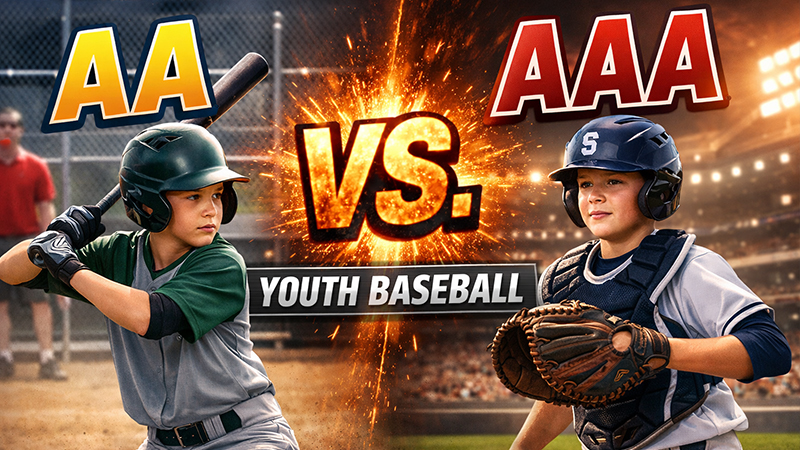
For many families, the transition from local recreational leagues to the structured world of travel baseball feels like stepping onto a different planet. You begin hearing a new language: AA, AAA, and Majors.
While they might seem like mere letters on a jersey, these designations represent the most critical crossroads in a young athlete’s development.
As a parent, you aren’t just choosing a team; you are mapping out a multi-year journey in your child’s athletic and personal growth.
This guide serves as a high-level strategic analysis—a Fortune 500-standard breakdown of the youth baseball hierarchy—to help you navigate these tiers with precision, authority, and clarity.
The Foundation: Understanding the Youth Baseball Hierarchy
Before diving into the specifics of AA and AAA, it is essential to understand where they sit in the broader ecosystem of the sport. Youth baseball is built on a “sprawling tapestry” of progression.
- Rookie/Tee Ball (Ages 4–5): The introduction to fundamentals like hitting off a tee and basic fielding.
- Single-A (Ages 6–7): Hitting moves from a tee to machine-pitched balls; the focus remains strictly on non-competitive enjoyment.
- Double-A (AA) (Ages 7–9): This is the entry-level competitive division. It marks the pivotal shift where players move from coach-pitched or machine-pitched games to facing actual youth pitchers.
- Triple-A (AAA) (Ages 9–11): The “Proving Ground.” This is the highest minor division before players move to the Majors.
- Majors (Ages 11–12): The pinnacle of Little League or regional travel ball, preparing athletes for high school varsity and potentially collegiate play.
The AA Experience: Building the Developmental Launchpad
In the AA tier, the diamond serves as a classroom. While it is considered the first rung of competitive baseball, the primary goal remains developmental.
1. Skill Progression and “Friendly Competition.”
At this stage, players are sharpening the foundational mechanics of the game. You will see “fastballs gain velocity and curveballs start to actually curve”.
The competition is described as “friendly yet earnest,” meaning that while the score is kept, the atmosphere is rooted in learning and the sheer joy of the game.
2. Mastering the Nuances
AA is where the “basics” evolve into “nuance.” Players begin to execute strategic plays that define upper-level baseball, such as:
- Double plays and pickoffs.
- Advanced positioning and situational awareness (e.g., cutoffs and shift strategies).
- The Transition to Live Pitching: Learning to hit off a peer rather than a coach or machine is perhaps the most significant mental and physical hurdle at this level.
3. The Coaching Feedback Loop
Coaching in AA is heavily focused on repetition and muscle memory. Evaluations at this level are often more detailed than in recreational leagues, providing parents and players with a clear understanding of their strengths and areas for improvement.
The AAA Shift: Entering the Proving Ground
When you leap AAA, the atmosphere undergoes a “notable shift”. The game speeds up, the stakes rise, and the commitment level intensifies for both the player and the family,.
1. Consistency: The Great Separator
Expert coaches agree that the primary difference between an AA player and a AAA player is consistency. While an AA player might make a spectacular play followed by a routine error, a AAA player “nearly never misses a routine play”.
- Hitting: AAA hitters are expected to adjust to “gas” (high-velocity pitching) and consistently put the ball in play.
- Defense: Mental errors, common in AA, are far less frequent in AAA.
2. The Watchword: Commitment
In AAA, the game is no longer just a hobby; it is a lifestyle. “Commitment” becomes the defining characteristic of the team. This includes:
- Increased Training Intensity: More frequent and demanding practice schedules.
- Travel and Resources: Families must be prepared for frequent weekend tournaments, out-of-town travel, and a higher level of financial investment.
- The “Pro” Mentality: Players at this level often have a “deeper hunger for the game” and “live for those diamond battles”.
3. Advanced Baseball IQ
AAA development focuses on the mental side of the game. Programs often utilize video analysis tools to study techniques and opponent tendencies. Players are trained to think a step ahead, mastering:
- Pitcher-hitter matchups.
- Base-running intelligence and defensive shifts.
- Situational hitting and pitch selection.
The Tryout Matrix: What Coaches Really Look For
One of the most common “gaps” in parent knowledge is what actually happens during the AAA tryout process. It is a common misconception that a child must have a “perfect” tryout to make a AAA roster. In reality, coaches are looking for “tools” and “athleticism”.
1. The Physical Threshold (The Size Factor)
It is an uncomfortable truth in youth baseball that coaches often prioritize physicality.
- Size and Strength: Larger, more physically mature players are often favored because they can handle the move to larger fields and higher speeds more effectively.
- Velo and Exit Speed: Data points like throwing velocity and hitting exit velocity are the primary metrics used to separate AAA prospects from the pack.
2. Advanced Fielding Mechanics
In the infield, coaches aren’t just looking at whether you caught the ball. They are watching:
- Footwork and how the player “pushes through the ball” to field the hop.
- Quick transfers and the accuracy of the throw.
- The “First Step”: In the outfield, coaches evaluate the first 2-3 steps off the bat and how the player reacts to short-dropping balls.
3. Psychological Resilience
A major differentiator in AAA is how a child reacts to failure. Coaches look for players who can “handle their mistakes,” show “hustle,” and maintain a positive attitude even when the team is losing. A “bad attitude” or being a “pouty pants” can often prevent a skilled player from making a high-level team.
The Red Flags: Navigating “Money Grab” Organizations
As a world-class content strategist, I must provide the “Trust” signals that traditional blogs often omit. Not every AAA team is created equal. The youth baseball industry is susceptible to “money grab” organizations.
- The “C-Team” Trap: Some organizations will take your money (upwards of $4,000) and place your child on a “C” team that may be coached by high school students or unqualified parents.
- The “Dad-Ball” Influence: Be wary of teams where the coaching staff is composed entirely of parents. Strategic advice suggests seeking programs run by professional coaches with no children on the roster to ensure unbiased player development.
- Selective Enrollment: In true AAA/Majors tiers, you often have to “win” your way in or meet strict ranking criteria. If an organization lets every child make an “AAA” team, it may just be an “expensive rec ball league”.
The Decision Framework: Is Your Child Ready for AAA?
Deciding whether to stay in AA or move to AAA is a pivotal choice. Use this strategic framework to assess your situation:
1. The Performance Audit
- Is your child dominant in AA games?.
- Are they showing a deep understanding of baseball’s nuances beyond just hitting and catching?.
- What is the feedback from current coaches?.
2. The Lifestyle Audit
- Is your family ready for long hours at practice and frequent weekend tournaments?.
- Can you maintain a balance so the child doesn’t burn out?.
- Is the child’s passion for the game strong enough to withstand the “fierce” competition and “palpable intensity” of AAA?.
3. The “Big Fish, Small Pond” Question
Sometimes, it is better to be a top 5 player in a lower league than a bottom 5 player in a higher league. In AA, your child may get more playing time and the opportunity to rotate through different positions.
In AAA, lineups are often rigid, and players may “ride the bench” if they aren’t performing at an elite level.
Enhanced FAQ: Strategic Insights for Parents
Q: What is the primary difference between AA and AAA?
A: In short: Consistency and commitment. AA is about mastering fundamentals in a developmental setting. AAA is a “proving ground” where game speed is higher, mental errors are fewer, and the time/travel commitment is significantly greater.
Q: Why does my child’s size matter so much to coaches?
A: While it may seem unfair, physicality often correlates with the ability to hit with more power and throw with higher velocity. However, fundamentals and “hustle” can still make a smaller player highly valuable in AAA.
Q: Is AAA baseball necessary for high school success?
A: While AAA is designed to prepare players for high school varsity, it is not the only path. Consistent skill development and a high “baseball IQ” can be fostered in any competitive environment, provided the coaching is high-quality.
Q: How do I avoid “money grab” organizations?
A: Ask for the coaching credentials of the specific team your child will be on. Research if the organization has a history of ranking or winning at the AAA level, and talk to other parents about the “hidden” costs and travel requirements.
Conclusion: The Journey is the Destination
Ultimately, the choice between AA and AAA is about matching your child’s current skill level, passion, and maturity with the right environment.
Whether they are refining their swing in AA or navigating the high-pressure matchups of AAA, the goal is the same: to foster a lifelong love for the game while building essential life skills like resilience, teamwork, and strategic thinking.
Trust your instincts. If your child “lives for those diamond battles,” the challenge of AAA may be the fuel they need. If they are still mastering the crack of the bat and enjoying the social aspect of the game, AA provides the perfect foundation.