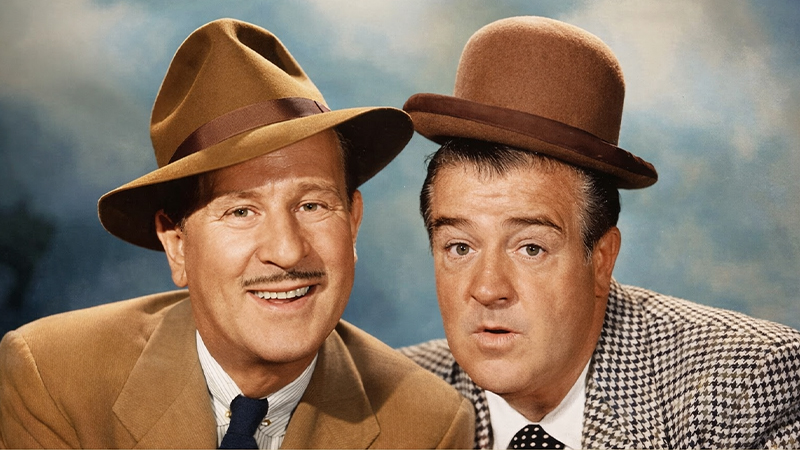
Abbott and Costello are remembered primarily as one of the greatest comedy duos in American entertainment history. Bud Abbott played the fast-talking straight man; Lou Costello delivered childlike confusion, explosive reactions, and impeccable timing.
Together, they created some of the most iconic routines in radio, film, and television—most famously “Who’s on First?”
But beyond their rapid-fire wordplay and slapstick humor, some viewers and cultural critics have wondered: Did Abbott and Costello predict anything about the future?
Were their jokes merely absurd comedy, or did they unintentionally foreshadow political tensions, social changes, or cultural trends?
While they weren’t prophets in the literal sense, Abbott and Costello’s work reflected—and sometimes eerily anticipated—major developments in American society. To understand what they may have “predicted,” we need to examine their comedy in historical context.
Cold War Anxiety Before It Fully Erupted
Abbott and Costello rose to peak fame during the 1940s, a decade dominated by World War II and its aftermath.
By the late 1940s and early 1950s, tensions between the United States and the Soviet Union were intensifying. The Cold War had begun, and American media was increasingly influenced by anti-communist fears.
Although Abbott and Costello were not political commentators, some of their later work reflected subtle themes of suspicion, paranoia, and confusion about authority—core elements of Cold War culture.
Their 1953 film Abbott and Costello Go to Mars is often cited as an example of how comedy intersected with Cold War-era fears.
The film plays with themes of space exploration, mistaken identities, and government authority. Though absurd and lighthearted, it arrived just as the U.S. and USSR were entering the early stages of the Space Race—a competition that would soon define global politics.
While they didn’t explicitly predict the Space Race, the film captured an emerging fascination with space travel and alien worlds years before Sputnik launched in 1957.
Their comedic take on space exploration reflected growing public curiosity—and anxiety—about science, technology, and international competition.
Media Confusion and the Age of Information Overload
Perhaps the most famous Abbott and Costello routine, “Who’s on First?”, feels oddly modern today.
The routine centers on misunderstandings caused by names that double as common question words: Who, What, I Don’t Know. The humor comes from linguistic confusion spiraling out of control.
At first glance, it’s simply wordplay. But viewed through a contemporary lens, it resembles something surprisingly relevant: communication breakdown in a world overloaded with information.
In the digital age, misinformation, miscommunication, and semantic confusion dominate social media, politics, and journalism. Words are interpreted differently depending on context; clarity is constantly undermined by ambiguity.
The frustration Lou Costello expresses mirrors the exasperation many people feel today when navigating contradictory headlines and circular arguments.
While Abbott and Costello weren’t predicting the internet, their comedy captured a universal truth: language can be manipulated, misunderstood, and weaponized. In that sense, “Who’s on First?” foreshadowed the chaos of modern communication culture.
Government Bureaucracy and Institutional Confusion
Another recurring theme in Abbott and Costello’s films is confusion within systems of authority—whether military, police, or government institutions.
In movies like Buck Privates (1941), the duo portrayed bumbling recruits navigating military life. Released just before America entered World War II, the film humorously depicted military bureaucracy, rigid systems, and misunderstandings between authority figures and ordinary people.
Although comedic, the film subtly reflected growing awareness that massive institutions—like the military—were complex, impersonal, and often confusing.
This theme would only grow in postwar America, as government agencies expanded and bureaucratic systems became more entrenched. Later decades would see rising skepticism toward authority, particularly during the Vietnam War and Watergate era.
Abbott and Costello didn’t predict those events directly. But their portrayal of ordinary men struggling inside rigid systems anticipated later cultural critiques of bureaucracy and institutional power.
Science Fiction Popularity Before the Boom
During the 1940s and early 1950s, science fiction was still largely considered pulp entertainment. However, Abbott and Costello dabbled in sci-fi parody before it became mainstream cinema.
In addition to Abbott and Costello Go to Mars, the duo famously starred in horror-comedy crossovers like:
- Abbott and Costello Meet Frankenstein (1948)
- Abbott and Costello Meet the Invisible Man (1951)
- Abbott and Costello Meet Dr. Jekyll and Mr. Hyde (1953)
These films blended comedy with supernatural and speculative themes at a time when Hollywood was just beginning to experiment heavily with sci-fi and horror.
In the 1950s, science fiction exploded in popularity, fueled by atomic fears and technological advancement. By the 1960s and beyond, space travel, aliens, and futuristic storytelling became central to American entertainment.
Abbott and Costello were ahead of the curve in combining humor with speculative concepts. They helped normalize genre blending—something now common in blockbuster films and streaming series.
In that sense, they predicted the mainstream appeal of sci-fi comedy and genre mashups.
The Evolution of Television Entertainment
Abbott and Costello were among the early major film stars to transition successfully into television. The Abbott and Costello Show aired from 1952 to 1954.
At the time, television was still a relatively new medium. Many established film actors were hesitant to move to TV, fearing it was inferior to cinema. Abbott and Costello embraced it.
Their show helped demonstrate that television could sustain recurring characters, serialized comedic storytelling, and national popularity.
Television would soon dominate American entertainment for decades. Sitcoms became a central cultural force—from I Love Lucy to Friends to modern streaming comedies.
By moving into television early, Abbott and Costello anticipated the shift from film dominance to home-based entertainment. Today, streaming platforms continue that trajectory—bringing cinematic storytelling directly into living rooms.
Comedy as Cultural Mirror
Abbott and Costello’s routines often revolved around misunderstanding authority, struggling with systems, and navigating social expectations. Lou Costello’s character frequently represented the “little guy”—confused, overwhelmed, but relatable.
This archetype became foundational in American comedy.
From Jerry Lewis to Jim Carrey, from sitcom dads to modern stand-up comedians, the “everyman overwhelmed by modern life” is a recurring figure.
In the postwar years, America experienced rapid economic growth, suburban expansion, and technological change. With progress came confusion. Abbott and Costello captured that feeling before it became a central theme in later comedy.
They didn’t predict specific events—but they predicted emotional patterns: anxiety about modernization, skepticism toward authority, and frustration with complex systems.
The Fragility of Fame and Changing Media Landscapes
Another subtle “prediction” embedded in Abbott and Costello’s career is the fleeting nature of fame.
They were once among the highest-paid entertainers in the world during the 1940s. By the late 1950s, their popularity had declined significantly.
Their rise and fall foreshadowed a pattern now common in entertainment: rapid fame followed by cultural turnover. As new formats emerge—radio to film, film to television, television to streaming—audiences shift quickly.
Abbott and Costello’s transition from radio to film to TV illustrates how entertainers must adapt or risk irrelevance. That cycle has only accelerated in the digital age.
The Human Condition: Timeless Confusion
Perhaps the most enduring “prediction” in Abbott and Costello’s work is this:
Human beings will always struggle to understand each other.
At its core, their comedy is about communication breakdown. Lou hears one thing; Bud means another. Words collide. Meaning dissolves. Frustration builds.
Despite advances in technology, this dynamic remains universal. In politics, workplaces, relationships, and online debates, miscommunication fuels conflict.
Their routines endure because they tap into a permanent aspect of human interaction.
Did They Predict Anything Specific?
Occasional claims are circulating online that Abbott and Costello “predicted” specific political events or modern issues. However, most of these claims are exaggerated or taken out of context.
They were not political prophets or conspiracy theorists. They were entertainers responding to the cultural climate of their time.
Their “predictions” were not literal forecasts—but reflections of emerging trends:
- Growing distrust in institutions
- Fascination with space and science
- The power of television
- The complexity of language and communication
- The anxieties of modernization
Great comedians often function as early detectors of cultural tension. They sense what’s changing beneath the surface.
Abbott and Costello were masters of that sensitivity.
Conclusion: Reflection, Not Prophecy
So what did Abbott and Costello predict?
Not specific world events. Not technological inventions. Not political revolutions.
What they anticipated—perhaps unintentionally—were the emotional and cultural patterns that would shape the second half of the 20th century and beyond.
They captured:
- The confusion of living in a rapidly changing world
- The absurdity of bureaucratic systems
- The instability of language
- The anxieties surrounding science and authority
- The coming dominance of television entertainment
Their comedy feels surprisingly modern because human confusion hasn’t changed.
In the end, Abbott and Costello weren’t fortune-tellers. They were observers. And sometimes, the sharpest observers can feel prophetic—simply because they understand people so well.
More than 70 years later, audiences still laugh at “Who’s on First?” Not because it predicts the future, but because it perfectly captures the timeless comedy of misunderstanding.
And as long as people keep miscommunicating—which is to say, forever—Abbott and Costello will always feel ahead of their time.