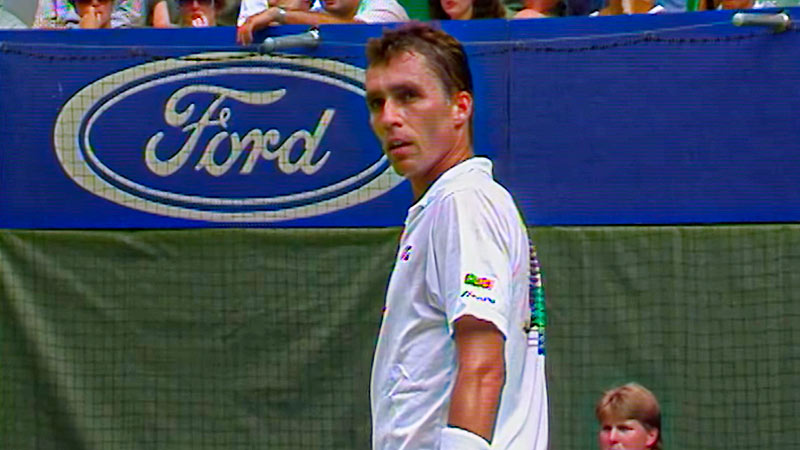
Ivan Lendl is not typically ranked as the single Greatest of All Time (GOAT) in men’s tennis, as that honor usually falls to Novak Djokovic, Rafael Nadal, or Roger Federer.
However, he remains a vital candidate for his revolutionary role as the architect of modern tennis. With 94 ATP titles, 270 weeks at World No. 1, and 8 Grand Slam titles, Lendl’s statistical resume is elite.
While his 8-11 record in Major finals and missing Wimbledon title hinder his top-tier ranking, his transformation of the sport’s physicality and baseline strategy changed tennis forever.
Examining the Statistical Profile of Ivan Lendl
When evaluating whether a player belongs in the highest echelon of the sport, the first point of reference must be the data.
Ivan Lendl’s career numbers are not merely impressive; they represent a level of sustained dominance that very few players in the history of the Open Era have ever matched.
During the 1980s, Lendl was the definitive force in men’s tennis, accumulating a trophy cabinet that remains one of the largest ever seen.
| Statistic | Ivan Lendl’s Record | All-Time Open Era Rank |
|---|---|---|
| Grand Slam Singles Titles | 8 | Tied 8th |
| Grand Slam Finals Appearances | 19 | 4th |
| ATP Singles Titles | 94 | 4th |
| Weeks at World No. 1 | 270 | 4th |
| Career Match Win Percentage | 81.5% (1,068–242) | 5th |
| Consecutive Weeks at No. 1 | 157 | 3rd |
| Year-End Championships | 5 | N/A |
His 1,068 career match wins place him in an exclusive club of only five men to have surpassed the 1,000-win milestone.
Furthermore, his consistency was so profound that he reached eight consecutive US Open finals between 1982 and 1989, a feat of endurance and skill that highlights his mastery over the hard-court surface.
While these numbers are lower than the modern totals of the “Big Three,” they established the benchmarks for excellence for decades.
Why Ivan Lendl is the Architect of Modern Tennis
While his title count is a significant part of his legacy, Lendl’s most compelling argument for greatness lies in his role as a pioneer. Before Lendl arrived on the scene, the professional tour was largely defined by serve-and-volley players and masters of finesse.
Lendl systematically dismantled this style, replacing it with a scientific, high-power approach that serves as the blueprint for 95% of the professionals competing today.
The Power Baseline Revolution
Lendl’s primary contribution to the evolution of the game was the introduction of heavy, aggressive topspin from the baseline. He proved that a player could dictate play and win major championships without constantly charging the net.
He popularized the “inside-out” forehand, a tactic where a player runs around their backhand to strike a powerful, angled forehand to an opponent’s weaker side.
This specific shot remains a primary weapon in the modern game and is a direct inheritance from Lendl’s strategic innovations.
His ability to generate pace while maintaining high safety margins with topspin made him nearly impossible to beat from the back of the court.
Professionalizing Fitness and Nutrition
Long before specialized trainers and nutritionists became standard in a player’s entourage, Lendl was treating tennis like a hard science.
He was the first player to adopt a truly modern approach to physical conditioning, which included strict dieting, dedicated weight lifting, and sport-specific aerobic training.
He recognized that if he could not out-finesse his rivals like John McEnroe, he could certainly outlast them physically.
This shift toward extreme athleticism forced the entire tour to adapt, ending the era of the “casual” professional and ushering in the era of the elite athlete.
Scientific Preparation and Equipment Customization
The meticulous nature of Lendl’s approach extended beyond his body and into his equipment. He was a pioneer in matching his racquets to specific environmental conditions.
It was common for Lendl to change racquet tensions frequently during a match to account for changes in climate, humidity, or altitude.
This level of detail ensured that his equipment never compromised his performance, a practice that is now a standard operating procedure for every top player on the ATP and WTA tours.
Why does Ivan Lendl fall short of the GOAT title?
Despite his revolutionary impact and immense statistical success, Lendl is rarely placed at the very top of the all-time list.
In the modern era, the “Greatest of All Time” conversation is heavily weighted toward Grand Slam totals, and this is where Lendl faces his most significant hurdle when compared to his successors.
His career occurred in an era of intense competition, yet he finished with fewer Majors than the men who would eventually surpass him.
The Grand Slam Deficit
The primary reason Lendl falls behind names like Novak Djokovic, Rafael Nadal, and Roger Federer is the sheer gap in Grand Slam titles.
While Lendl’s eight Major titles are legendary, they are dwarfed by Djokovic’s 24, Nadal’s 22, and Federer’s 20. Even when compared to his closer contemporaries, he trails Pete Sampras, who finished with 14, and Björn Borg, who secured 11.
In a sport where the four Major tournaments are the ultimate currency of greatness, this deficit is often the deciding factor in historical rankings.
The Wimbledon Blind Spot
A defining characteristic of many GOAT candidates is the completion of the Career Grand Slam—winning all four Major tournaments at least once. Lendl never achieved this.
He won three French Opens, three US Opens, and two Australian Opens, but the grass courts of Wimbledon remained his “blind spot”. He reached the final at the All England Club twice, in 1986 and 1987, but was unable to secure the victory.
His heavy topspin baseline game was less effective on the low-bouncing grass of that era, and despite extreme efforts to adapt, the most prestigious trophy in tennis eluded him.
The Record in Major Finals
Lendl’s reputation was occasionally marred by his performance in the final rounds of the biggest tournaments. Throughout his career, he reached 19 Grand Slam finals but lost 11 of them.
This 8–11 record led to an early-career narrative that he struggled to cross the finish line in high-pressure situations.
While reaching 19 finals is a testament to incredible consistency, the high loss rate in those matches is often used as a critique of his “big match” temperament compared to players with more clinical finals records.
The Lendl Legacy: Impact on Future Champions
Lendl’s influence did not end when he retired from professional play. His legacy is carried forward not only by the way the game is played but also through his work as a mentor.
His “Iron Architect” persona transitioned seamlessly into coaching, where he proved that his meticulous methods could still produce world-class results in the 21st century.
Contrasting Styles with John McEnroe
One of the most famous elements of Lendl’s career was his rivalry with John McEnroe, whom he played 36 times.
This rivalry defined tennis in the 1980s because it was a clash of diametrically opposed philosophies: McEnroe’s artistic, feel-based serve-and-volley versus Lendl’s mechanical, relentless power. Lendl eventually took the lead in their head-to-head record, finishing 21–15.
Their most iconic meeting was the 1984 French Open final, where Lendl roared back from two sets down to win his first Grand Slam, a victory that shattered his “finals curse” and signaled the beginning of his era of dominance.
Transitioning from Player to Championship Coach
The “Lendl Blueprint” proved its worth again when he became the coach of Andy Murray. Murray, much like a young Lendl, was a player of immense talent who struggled to overcome mental hurdles in Grand Slam finals.
Under Lendl’s guidance, Murray adopted a more aggressive mindset and improved his physical conditioning.
This partnership resulted in Murray winning three Grand Slam titles and reaching the World No. 1 ranking, effectively breaking the dominance of the Big Three for a period.
This success solidified Lendl’s reputation as a man whose work ethic and strategic mind could transcend generations.
Analyzing the Psychological Warfare of the Iron Architect
Lendl was as famous for his mental approach as he was for his forehand. He cultivated an icy, unblinking, and largely emotionless demeanor on the court.
This was a deliberate choice designed to achieve two goals: to keep his own mind focused on the task at hand and to intimidate his opponents.
He did not engage in the theatrics of Connors or the outbursts of McEnroe; instead, he applied a relentless, mechanical pressure that eventually broke the spirit of many challengers.
This extreme focus was best exemplified in 1990, when Lendl chose to skip the French Open—a tournament he had already won three times and where he was a master—to spend months practicing on grass in a final, desperate attempt to win Wimbledon.
While he did not win the title, the sheer discipline required to walk away from a “guaranteed” deep run at a Major to pursue a weakness demonstrated the singular drive that defined his career.
Frequently Asked Questions
Did Ivan Lendl ever win a Grand Slam on grass?
No, Ivan Lendl never won a Grand Slam on grass. While he was a dominant force on hard courts and clay, his best results at Wimbledon were two runner-up finishes in 1986 and 1987.
How many weeks was Ivan Lendl ranked number one?
Ivan Lendl spent a total of 270 weeks at World No. 1, which ranks as the fourth most in the history of men’s tennis. He also held the top spot for 157 consecutive weeks, the third-longest streak ever recorded.
What was the result of the Lendl vs. McEnroe rivalry?
Ivan Lendl led his head-to-head rivalry against John McEnroe with 21 wins to McEnroe’s 15. Their most famous match was the 1984 French Open final, which Lendl won in five sets.
Why is Lendl called the architect of modern tennis?
He is called the architect because he pioneered the high-power baseline game, the use of heavy topspin, and the professionalization of fitness and nutrition that define the modern sport.
Conclusion: The Lasting Mark of the Iron Architect
In the final assessment, whether Ivan Lendl is the Greatest of All Time depends entirely on how you define “Greatest.” If the title is reserved solely for the player with the most trophies, then he sits comfortably in the top ten but below the modern titans of the game.
However, if greatness is measured by the impact a player has on the evolution of their sport, Lendl’s case is as strong as anyone’s.
He took a sport of touch and elegance and turned it into a game of power, endurance, and scientific preparation. He was the bridge between the old world of tennis and the ultra-professional era we see today.
Every time a modern player hits an inside-out forehand or spends hours in the gym to prepare for a five-set match, they are following the blueprint laid down by Ivan Lendl.
He may not hold the record for the most Grand Slams, but he is undeniably the man who built the modern game.