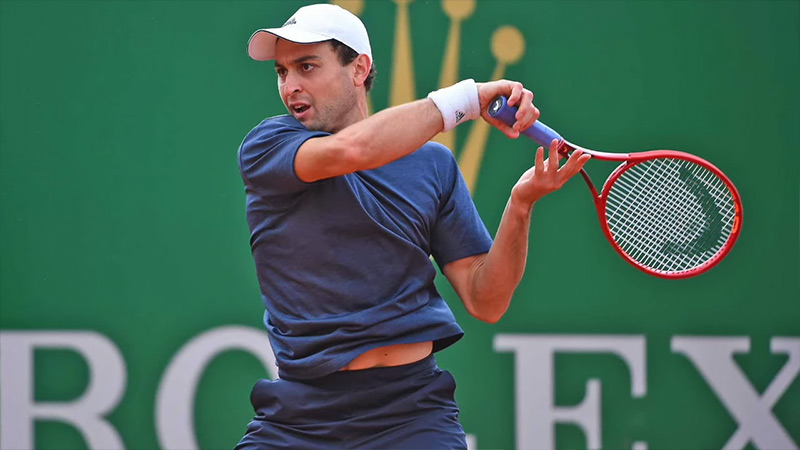
Aslan Karatsev is a professional tennis player who holds dual Russian and Israeli nationality, though he officially represents Russia in international competitions.
Born in Vladikavkaz, Russia, to an ethnic Ossetian father, his family immigrated to Israel when he was three years old, where he was raised and learned to speak fluent Hebrew.
Despite his deep cultural and familial ties to Israel through his maternal Jewish lineage, Karatsev returned to Russia at age 12 to pursue elite tennis training.
Today, he remains a Russian citizen, competing under the Russian flag while maintaining his Israeli citizenship and strong personal connections to both nations.
What Is Aslan Karatsev’s Official Nationality?
Understanding the background of a world-class athlete often requires looking beyond the flag next to their name on a scoreboard. For Aslan Karatsev, his identity is a tapestry of different cultures and geographical influences that have shaped his professional path.
| Category | Details |
|---|---|
| Official Nationality | Russian |
| Secondary Citizenship | Israeli |
| Country Represented | Russia (ATP Tour, Davis Cup, Olympics) |
| Place of Birth | Vladikavkaz, Russia |
| Primary Languages | Russian, Hebrew |
| Ethnic Heritage | Ossetian (Paternal), Jewish (Maternal) |
The Formative Years in Vladikavkaz and Tel Aviv
The journey of Aslan Karatsev began in the North Caucasus and quickly moved to the Mediterranean coast, creating a unique upbringing that influenced his perspective on the world.
Birth in the North Caucasus
Aslan Karatsev was born on September 4, 1993, in Vladikavkaz, the capital city of the Republic of North Ossetia-Alania, Russia. His father is of ethnic Ossetian descent, connecting Karatsev to the rich traditions of the Caucasus region.
While his time in Russia during his earliest years was brief, the roots established there would eventually pull him back when his professional ambitions required more robust resources.
Growing Up in Israel
When Karatsev was just three years old, his family made the life-altering decision to move to Israel. They settled in Tel Aviv, where Aslan spent the majority of his childhood. It was during this period that he became fully integrated into Israeli society, becoming fluent in Hebrew and starting his formal tennis education at the training centers in Jaffa.
This decade spent in Israel was foundational, not just for his tennis skills, but for his cultural identity as a young man growing up in a diverse Middle Eastern environment.
Why Aslan Karatsev Holds Dual Citizenship
The legal status of Karatsev’s dual citizenship is rooted in his family history and the specific immigration laws of the State of Israel.
Maternal Jewish Roots and Aliyah
The reason for the family’s move to Israel and Karatsev’s subsequent citizenship lies in his maternal heritage. Karatsev’s mother has a Jewish background, and his maternal grandfather is Jewish.
Under the Israeli Law of Return, individuals with at least one Jewish grandparent are eligible to immigrate to Israel and receive immediate citizenship, a process known as making Aliyah.
This heritage provided the legal framework for Karatsev to hold an Israeli passport from a very young age.
Maintaining Ties Across Borders
Even after his career necessitated a move back to Russia, Karatsev never relinquished his Israeli citizenship. His family remains split between the two countries, which serves as a constant bridge between his two worlds.
While he and his father eventually returned to Russia to seek better training opportunities, his mother and sister remained in Israel, where they continue to reside today.
This personal dynamic ensures that while he represents Russia on the court, a significant part of his private life remains rooted in the Israeli community.
Why Does He Represent Russia Instead of Israel?
One of the most common questions regarding Karatsev’s career is why a player with such deep ties to Israel chooses to compete under the Russian flag. The answer is a pragmatic blend of athletic infrastructure and professional loyalty.
Infrastructure and Support Gaps
The primary driver for Karatsev’s return to Russia at age 12 was the pursuit of excellence. At that time, the Israel Tennis Federation faced significant challenges in providing the financial support and elite-level infrastructure necessary for a top-tier prospect to reach the professional tour.
Recognizing that the competitive environment in Russia offered a more viable path to the ATP Tour, Karatsev and his father made the difficult decision to move back to their country of birth.
This move allowed him to access the high-performance training camps and coaching networks that eventually propelled him to the top of the game.
The Decision to Reject the 2020 Offer
As Karatsev’s talent began to translate into major results, the Israel Tennis Association attempted to bring him back into their fold.
In late 2020, just as he was on the verge of his historic Australian Open breakthrough, Israeli officials formally approached him with an offer to switch his sporting allegiance and play for Israel.
Karatsev declined this offer, choosing to remain loyal to the Russian system that had supported his development through his teenage years and early adulthood.
Having already committed to the Russian Davis Cup team, he felt his sporting future was firmly tied to the nation he had represented since leaving Tel Aviv.
Career Highlights Under the Russian Flag
Karatsev’s decision to represent Russia has led to significant success on the international stage, where he has contributed to some of the nation’s greatest recent tennis achievements.
Olympic Glory in Tokyo
One of the crowning moments of Karatsev’s career occurred at the Tokyo Olympics, where he competed for the Russian Olympic Committee (ROC).
Alongside Elena Vesnina, he reached the final of the mixed doubles competition, ultimately securing a silver medal.
This achievement was a major milestone, cementing his status as one of Russia’s elite athletes and demonstrating his ability to perform under the intense pressure of the world’s biggest sporting stage.
Davis Cup and Team Success
In addition to his individual accolades and Olympic success, Karatsev has been an integral part of the Russian Davis Cup team.
His presence provides the team with significant depth, and he has been a key contributor in international team competitions where he wears the national colors with pride.
His journey from a young boy training in Jaffa to an Olympic medalist representing Russia serves as a testament to the complex, global nature of modern tennis careers.
Frequently Asked Questions
Does Aslan Karatsev speak Hebrew?
Yes, having lived in Israel from age three to twelve, Karatsev is fluent in Hebrew. This skill allows him to maintain close connections with his family and fans in Israel.
Where does Aslan Karatsev’s family live?
His family is divided between two nations. While he spent much of his professional development in Russia, his mother and sister still live in Israel.
What is the ethnic background of Aslan Karatsev?
He has a multicultural background, including ethnic Ossetian heritage from his father’s side and Jewish heritage from his mother’s side.
Did Aslan Karatsev ever consider playing for Israel?
While he trained in Israel as a child, he moved to Russia for better support. He was officially asked to switch to Israel in 2020 but declined because he was already committed to the Russian tennis system.
The Impact of a Multicultural Identity
The story of Aslan Karatsev is more than just a list of citizenships; it is a reflection of how professional athletes navigate a globalized world. By embracing his dual heritage, Karatsev has been able to draw on the strengths of two different tennis cultures.
His early technical foundation in Israel and his subsequent high-performance grooming in Russia combined to create the unique “lion” of the ATP Tour.
For fans and analysts, Karatsev represents a modern archetype: the athlete who belongs to multiple places at once. Whether he is speaking Hebrew in an interview or standing on an Olympic podium for Russia, his identity remains a bridge between his Ossetian roots, his Israeli upbringing, and his Russian professional life.
This complexity does not diminish his nationality; rather, it enriches the narrative of a player who overcame financial and geographical hurdles to reach the pinnacle of professional sport.
As he continues to compete at the highest level, Karatsev remains a figure of pride for both Russian and Israeli tennis fans. His success serves as a reminder that talent often knows no borders, and the path to greatness is rarely a straight line.
By honoring his past while remaining committed to his professional allegiances, Aslan Karatsev has carved out a unique space in the world of tennis that is as multifaceted as his own background.