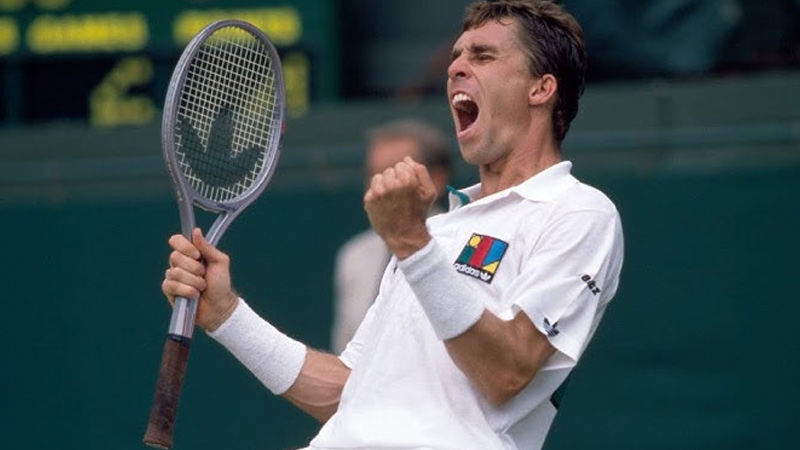
Ivan Lendl quit tennis primarily due to a chronic and degenerative spinal condition known as facet joint syndrome. This progressive disease caused debilitating back spasms and constant pain, rendering him unable to compete or even play occasionally.
Although Lendl remained deeply in love with the sport, he officially announced his retirement on December 21, 1994, at age 34. Doctors warned that continued play on hard courts would cause irreversible spinal damage.
Consequently, the former world No. 1 was forced to retire, ending an era-defining career that included 94 ATP titles.
Why Did Ivan Lendl Quit Tennis? The Medical Reality
The cessation of Ivan Lendl’s professional career was not a choice made by the athlete, but rather a surrender to a deteriorating physical state.
The following subheadings explore the specific medical constraints that forced one of history’s most durable competitors off the court.
The Science of Spinal Degeneration
The primary catalyst for Lendl’s departure was facet joint syndrome, a chronic and progressive spinal condition affecting the lower back.
This ailment is characterized by the degeneration of the joints that provide stability to the spinal column, leading to severe inflammation.
For an elite athlete whose game relied on explosive movement and a heavy baseline “power tennis” style, this diagnosis was catastrophic.
The condition resulted in debilitating muscle spasms that were so intense they rendered him unable to play even on a casual basis.
The Physician’s Final Ultimatum
The timeline leading to his official announcement was accelerated by stark medical advice. Just one week before he addressed the media, specialists explicitly informed Lendl that there was no hope for a full recovery.
The doctors delivered a definitive warning: the repeated stress of running and pivoting on hard courts would lead to irreversible spinal damage.
Faced with the prospect of permanent disability, Lendl had to prioritize his long-term health over his professional aspirations.
The 1994 US Open: A Legendary Career’s Final Chapter
While the official announcement came in December, the practical end of Lendl’s career occurred under the bright lights of Flushing Meadows. This section details the sudden and unceremonious conclusion of his competitive journey.
The Second Round Collapse Against Bernd Karbacher
Lendl’s final professional match took place during the 1994 US Open in a second-round encounter against Germany’s Bernd Karbacher.
Throughout the season, Lendl had already been forced to skip major events like Wimbledon due to mounting physical concerns.
During this specific match, the cumulative toll of facet joint syndrome reached a breaking point, as his back completely seized up while he was on the court.
A Career-Ending Injury in Real Time
The imagery of Lendl’s exit was a jarring contrast to his years of dominance. Unable to maintain his posture or execute his signature shots, he was forced to withdraw mid-match.
This “silent exit” saw the former champion walk off the court in the middle of the second round, a moment that served as the functional conclusion to his playing days.
At the time of this final match, the physical limitations had already caused his world ranking to plummet to No. 55.
The Official Retirement Announcement of December 1994
The transition from active player to retired legend was formalized in late 1994. The following subheadings examine the emotional and logistical details of that historic press conference.
The Call from Greenwich, Connecticut
On December 20 or 21, 1994, Lendl officially confirmed the end of his career during a press conference call organized by the ATP from Greenwich, Connecticut.
At 34 years of age, he addressed the tennis world not as a player seeking a new challenge, but as a man whose “body had left him no option”. The timing was particularly poignant as he was still ranked within the top 60 globally despite his injuries.
A Departure Without Closure
The mental toll of a forced retirement was evident in Lendl’s reflections. He explicitly stated that he was still “deeply in love” with tennis and would have continued playing if his physical condition allowed.
He described the situation as an “unchosen ending,” noting that while he had planned to play until he no longer had the desire, his back did not consult his plans. This lack of agency in his retirement remains one of the more somber footnotes in modern sports history.
Ivan Lendl’s Career Statistics and Legacy at Retirement
To understand the magnitude of his exit, one must look at the unprecedented success Lendl achieved before his spinal health declined. The following tables summarize the “Ivan the Terrible” era.
| Metric | Career Achievement |
|---|---|
| Grand Slam Singles Titles | 8 (3 US Open, 3 French Open, 2 Australian Open) |
| Total ATP Singles Titles | 94 (Second all-time at the time of retirement) |
| Weeks Ranked at World No. 1 | 270 Weeks |
| Total Career Prize Money | Over $20 Million (All-time leader at retirement) |
Historical Dominance and Financial Impact
| Category | Historical Standing in 1994 |
|---|---|
| Prize Money Ranking | #1 All-Time |
| ATP Title Ranking | #2 All-Time (behind Jimmy Connors) |
| World Ranking at Retirement | No. 55 |
| Era Definition | Pioneer of heavy-baseline power tennis |
Analyzing the Legacy of a Strategic Pioneer
Lendl did not just win matches; he fundamentally altered the way tennis was played at the professional level. His retirement marked the end of a specific evolutionary step in the sport’s history.
Redefining the Baseline Game
Lendl is widely recognized as the pioneer of the heavy-baseline “power tennis” that dominates the modern tour. Before his rise, the sport often favored a variety of styles, including serve-and-volley.
Lendl’s commitment to extreme physical conditioning and high-velocity groundstrokes from the back of the court set a new blueprint for success.
This strategic shift forced his contemporaries to adapt or be left behind, establishing the baseline-centric era seen today.
The Physical Cost of Innovation
There is a tragic irony in Lendl’s retirement: the very style he pioneered may have contributed to the spinal issues that ended his career. The “power tennis” model requires immense torque and repetitive high-impact movement on hard surfaces.
As doctors noted, the continued stress of this specific athletic profile on hard courts was the primary driver of his irreversible spinal damage. He was effectively a victim of the high-intensity standard he set for the rest of the world.
What is Ivan Lendl Doing Now? Life After the ATP
Despite a “severed reign” as a player, Lendl has remained a central figure in the sports world through high-level coaching and new competitive outlets.
Cultivating Grand Slam Champions
Lendl has transitioned into one of the most successful coaches in history. He famously guided Andy Murray to multiple Grand Slam titles and Olympic gold, proving that his strategic mind remained sharp long after his back failed.
More recently, he has served as a core training consultant for top-tier Polish star Hubert Hurkacz, operating out of his base in Florida. His ability to transmit the “Lendl mentality” to new generations has solidified his status as an elite tactical mind.
A New Era in Professional Pickleball
In a surprising yet characteristic move, Lendl has brought his competitive drive to the world of professional pickleball. He has signed a brand partnership with Selkirk Sport and has become a dominant force on the senior circuit.
His success in this new arena is significant; he recently swept the 60-69 division title at the Pictona Challenge, demonstrating that while he cannot run on hard tennis courts, his hand-eye coordination and competitive spirit remain world-class.
Ambassador for the Global Game
Lendl continues to be honored by the institutions he once dominated. As a prominent member of the ATP No. 1 Club, he represents tennis on a global stage.
This was recently highlighted by his appearance at the US Open, where he was chosen to present the championship trophy during the men’s singles final, bringing his journey full circle from his forced exit at the same venue decades earlier.
Common Questions Regarding the Lendl Era
When did Ivan Lendl officially retire?
Lendl announced his retirement on December 21, 1994, though his final match was played months earlier at the 1994 US Open.
What was the specific cause of his retirement?
The cause was facet joint syndrome, a degenerative spinal condition that led to chronic lower back pain and muscle spasms.
Could he have continued playing with modern medicine?
At the time, doctors were clear that there was no hope for recovery and that further play would result in permanent, irreversible spinal damage.
What is his highest-ranking achievement?
Lendl spent 270 weeks as the World No. 1 and retired with 94 singles titles and 8 Grand Slams.
Conclusion: The Unchosen Ending of a Tennis Titan
Ivan Lendl’s retirement remains one of the most significant “what-ifs” in tennis history. Unlike many of his peers who stepped away due to a lack of motivation or a decline in skill, Lendl was a victim of his own physical durability reaching its limit.
He left the game while still possessing the mental fortitude and love for competition that had defined his career.
Today, his legacy is visible in every baseline rally and every tactical coaching adjustment on the ATP tour. From his record-breaking prize money to his current dominance in the senior pickleball circuit, Lendl has proven that while a physical condition can “sever” a playing career, it cannot extinguish the drive of a true champion.
He remains a testament to the idea that a “second act” can be just as influential as the first.