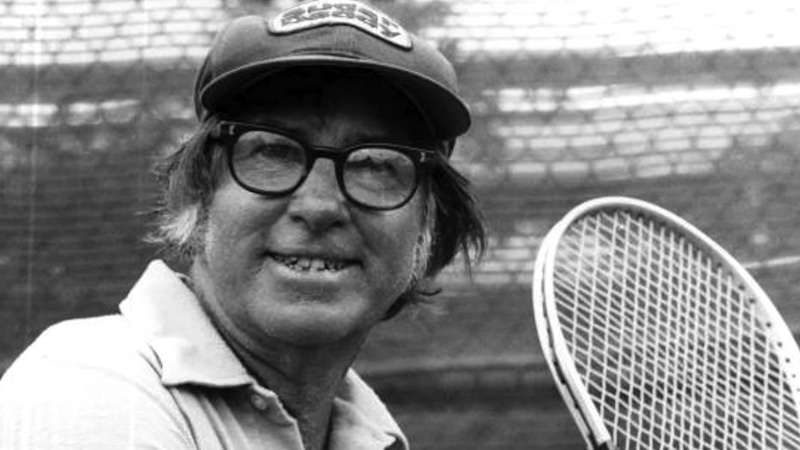
Bobby Riggs is most famous for the 1973 “Battle of the Sexes,” a global cultural event where he played Billie Jean King in a match that transformed women’s sports.
While known for his provocative “male chauvinist pig” persona, his fame also rests on being a World No. 1 champion in both amateur and professional eras. He achieved a rare Wimbledon Triple Crown in 1939 and dominated the 1940s professional circuit.
Beyond the court, Riggs was a master hustler who famously bet on himself, blending elite athletic precision with unparalleled showmanship to create a legacy that reshaped the sporting world.
Why is Bobby Riggs a Household Name Today?
Bobby Riggs remains a household name primarily because of his role as the ultimate sports villain in the most-watched tennis match in history.
In 1973, at the age of 55, Riggs orchestrated a media frenzy that transcended the world of sports, positioning himself as the antagonist against the rising women’s liberation movement.
The Provocateur and the Showman
Riggs earned his lasting fame by explicitly branding himself as a “male chauvinist pig” to generate controversy and high-stakes opportunities.
He loudly claimed that the women’s game was so inferior to the men’s that even a retired player of his age could defeat any top female professional.
This was not merely an expression of opinion but a calculated promotional gimmick designed to drum up media hype and lure opponents into matches with massive gambling stakes.
The 90 Million Viewer Milestone
The culmination of this provocation was the match against Billie Jean King at the Houston Astrodome. This event was a massive spectacle, with King entering on an Egyptian litter and Riggs wearing a warm-up jacket stitched with “Sugar Daddy”.
An estimated 90 million people worldwide tuned in, making it a landmark moment that brought massive legitimacy and commercial growth to women’s sports.
A Symbol of Cultural Change
While Riggs lost the match, his participation provided the platform necessary for a societal shift. King’s victory validated women’s professional sports and boosted the newly formed WTA, turning a televised exhibition into a milestone for the broader women’s liberation movement.
Even in defeat, Riggs’ ability to command global attention ensured his name would be forever linked to the progress of gender equality in athletics.
Elite Foundations: The Professional Career of a World No. 1
Long before he was a media provocateur, Bobby Riggs was one of the most successful and dominant tennis champions of his era. His athletic pedigree is often overshadowed by his later antics, yet his statistical achievements place him among the all-time greats of the sport.
| Career Statistic | Achievement Detail |
|---|---|
| Total Career Titles | 103 Titles across Amateur and Professional circuits |
| Official Match Record | 804–300 (72.8% win rate) or 838–326 (71.9%) |
| Amateur World No. 1 | Ranked No. 1 in the world in 1939 |
| Professional World No. 1 | Ranked No. 1 in the world in 1946 and 1947 |
| Grand Slam Titles | 6 Amateur Grand Slam Titles |
| Professional Majors | 3 U.S. Pro Singles Championships (1946, 1947, 1949) |
The Precision of “The Great Retriever”
Riggs lacked a powerful serve, but he compensated with a playing style that earned him the nickname “The Great Retriever”. He relied on precision, baseline endurance, and a brilliant defense to wear down opponents.
His tactical mastery allowed him to track down and return almost any shot, using strategic court positioning rather than raw power to dominate the baseline.
Dominating Multiple Eras
Riggs achieved the pinnacle of the sport in two entirely different eras. He was the top-ranked amateur in 1939, and after his career was interrupted by military service in the U.S. Navy during World War II, he returned to reach World No. 1 on the professional circuit in 1946 and 1947. This longevity and ability to adapt to different levels of competition cemented his status as a true Hall of Fame champion.
The Art of the Hustle: Gambling and Gimmicks
Bobby Riggs was as famous for his activities off the court as he was for his performance on it. He was a notorious high-stakes gambler and a master of the “hustle,” often finding creative ways to trick opponents into betting against him.
The Legendary Wimbledon Triple Crown Bet
One of the most famous stories of Riggs’ career involves his historic sweep at Wimbledon in 1939. Before the tournament, he reportedly placed a £100 bet on himself at odds of 25–1 to win the “Triple Crown”—Singles, Men’s Doubles, and Mixed Doubles.
When he successfully won all three titles, he walked away with over $108,000, which was a massive amount of money at the time.
Playing with Hand-icaps and Stunts
Riggs frequently engaged in tennis matches while intentionally handicapping himself to lure wealthy opponents into wagers.
Some of his most famous stunts included playing while carrying an open umbrella, wearing a heavy overcoat, or even stepping over chairs between shots. On one occasion, he even played a match while leading a live lion cub on a leash.
These antics served a dual purpose: they were highly entertaining for spectators and served as a deceptive tool to convince opponents that he was easily beatable.
The 1973 Spectacle: A Timeline of the Battle
The 1973 “Battle of the Sexes” was not a single event but a progression of challenges that captivated the world. It began with Riggs’ desire to prove the superiority of the men’s game, leading to two high-profile matches.
The Mother’s Day Massacre
Riggs first challenged the reigning women’s World No. 1, Margaret Court, on Mother’s Day in 1973. At 55 years old, he handily defeated her with a score of 6–2, 6–1.
This easy victory shocked the sports world and amplified Riggs’ claims that the female game could not compete with the male game, even against a retired player.
The Houston Astrodome Main Event
Following his win over Court, Riggs faced 29-year-old Billie Jean King on September 20, 1973. The match was held in the Houston Astrodome and was treated like a heavyweight boxing championship.
Despite the intense media hype and Riggs’ extreme confidence, King defeated him in straight sets with scores of 6–4, 6–3, 6–3.
Why Riggs Lost the Match
Historians attribute Riggs’ defeat to several key factors, most notably his lack of physical conditioning compared to the much younger King.
While Riggs was overconfident and focused on the spectacle, King utilized a flawless and exhausting baseline strategy that neutralized his tactical advantages. The loss was physically and emotionally devastating for Riggs, who had bet heavily on himself to win.
Addressing the Conspiracy: Did He Throw the Match?
Since his defeat in 1973, persistent conspiracy theories have suggested that Bobby Riggs lost to Billie Jean King on purpose. However, historical consensus and evidence strongly suggest otherwise.
Debunking the Mafia Rumors
One common theory claimed that Riggs threw the match to settle massive gambling debts with the Mafia. These rumors have been thoroughly debunked by sports historians, journalists, and witnesses who were close to Riggs at the time.
There is no credible evidence to support the idea that the match was fixed for financial gain or to appease organized crime.
A Highly Competitive Spirit
Riggs was a legendary competitor who took great pride in his abilities. Those who knew him noted that he was physically devastated by the loss to King. Furthermore, because he had bet so heavily on himself to win, a loss was financially counterproductive.
His failure is widely accepted as a result of poor preparation and King’s superior performance on that specific day.
What Was Bobby Riggs’ Highest Ranking in Tennis?
To understand the full scope of his fame, one must look at his standing within the history of professional tennis rankings. Riggs reached the absolute top of the sport twice, a feat that is rare in any era.
- Amateur World No. 1 (1939): He reached this rank following his historic “Triple Crown” sweep at Wimbledon, where he won the Singles, Doubles, and Mixed Doubles titles in a single year.
- Professional World No. 1 (1946 & 1947): After turning professional, he secured the top spot by winning a grueling multi-city tour against his great rival, Don Budge.
- Induction into the Hall of Fame: His career achievements led to his induction into the International Tennis Hall of Fame in 1967, years before the “Battle of the Sexes” took place.
The Final Set: Legacy and Lasting Impact
After the 1973 match, Riggs largely faded from the mainstream spotlight but remained an active figure in the sports world. He continued to dominate senior tennis circuits and spent decades as a passionate golf hustler with a 3-handicap.
A Surprising Friendship
Perhaps the most unexpected part of Riggs’ legacy was his lifelong friendship with Billie Jean King. Despite the “chauvinist” persona he adopted for the cameras, the two maintained a warm relationship and spoke regularly.
Their final conversation occurred just days before his death in 1995 from prostate cancer at the age of 77.
The Evolution of the Sport
Riggs’ willingness to play the villain provided the catalyst for the growth of modern tennis. By creating a spectacle that 90 million people wanted to watch, he helped prove the commercial viability of women’s sports.
His legacy is a complex mix of elite athletic brilliance and masterful promotion that changed the trajectory of the game forever.
Frequently Asked Questions
What were Bobby Riggs’ nicknames?
He was known as “The Great Retriever” for his defensive playstyle and “The Male Chauvinist Pig” for his 1973 promotional persona.
Did Bobby Riggs win a Grand Slam?
Yes, he won six Grand Slam titles as an amateur and three Professional Majors, including the U.S. National Championships in 1939 and 1941.
How did Bobby Riggs die?
He passed away in 1995 at age 77 following a long battle with prostate cancer.