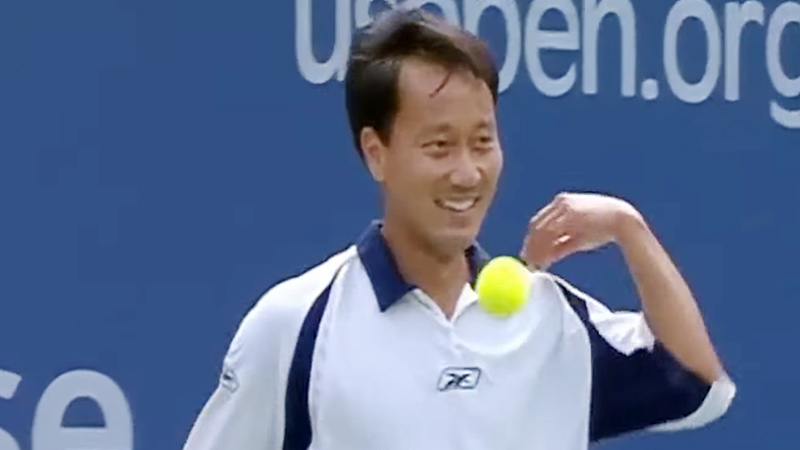
Michael Chang was an elite, Hall of Fame powerhouse who redefined tennis through speed and mental resilience. Achieving a world No. 2 ranking and 34 career titles, he remains the youngest male Grand Slam champion in history, winning the 1989 French Open at just 17.
Despite standing only 5’9”, Chang dominated the 1990s as a premier defensive counter-puncher against icons like Sampras and Agassi.
His career is defined by legendary court coverage and tactical brilliance, proving that grit could neutralize raw power. He is widely considered one of the greatest players to never reach No. 1.
A Career Defined by Historic Breakthroughs
Michael Chang’s career was not merely about longevity; it was punctuated by record-breaking moments that remain unmatched in the modern era of the sport.
The Youngest Grand Slam Champion in History
Chang’s victory at the 1989 French Open is the centerpiece of his professional legacy. At just 17 years and 109 days old, he navigated a draw filled with seasoned legends to claim the title.
This achievement remains an unbroken record in men’s professional tennis, marking him as a prodigy who matured faster than almost any peer in history.
His victory was not a fluke; he had already won a professional title in San Francisco eight months earlier at the age of 16.
Unrivaled Longevity in the ATP Top 15
Beyond his early success, Chang established himself as one of the most durable and consistent baseline players to ever pick up a racket. He maintained a position within the ATP Top 15 for nine consecutive seasons, spanning from 1989 to 1997.
For six of those years, he was a permanent fixture in the year-end Top 10. This consistency is particularly impressive given that he competed during a “hyper-competitive” era featuring some of the greatest athletes to ever play the game.
Analyzing the Michael Chang Statistical Profile
To understand how high Chang’s ceiling truly was, one must look at the data-driven results he produced over a professional career spanning from 1988 to 2003.
| Metric | Achievement |
|---|---|
| Career Match Record | 662 wins – 312 losses |
| Winning Percentage | 68.0% |
| Career-High Ranking | World No. 2 (September 1996) |
| Total ATP Singles Titles | 34 |
| Grand Slam Finals | 4 (1 Win, 3 Runner-up) |
| ATP Masters 1000 Titles | 7 |
| Official Prize Money | $19,145,632 |
Mastery of the Hard Court Surface
While his most famous victory occurred on the red clay of Paris, the statistics reveal that Chang was actually a hard-court specialist of the highest order.
The Hard Court Statistical Dominance
Chang secured 21 of his 34 career titles on hard courts, showcasing a game that was perfectly suited for the medium-fast bounds of North American tournaments. In addition to his hard-court success, he was a master of indoor carpet surfaces, where he claimed nine titles.
Interestingly, despite his French Open triumph, he only won four career titles on clay, suggesting that his 1989 run was as much a triumph of will as it was surface expertise.
The King of the North American Masters
Chang’s performance at the Masters 1000 level remains legendary, particularly in the United States. He was exceptionally dominant at the Cincinnati Masters, winning the tournament four times between 1993 and 1996.
He also enjoyed a fruitful relationship with the Indian Wells Masters, where he was a three-time champion. His ability to win seven Masters titles—all on hard courts—solidifies his status as one of the most dangerous opponents of the 1990s outside of the Grand Slams.
What Was Michael Chang’s Playing Style?
Because he lacked the raw power and towering height of his rivals, Chang had to revolutionize the game with a unique tactical blueprint centered on movement and psychology.
The Tactical Genius of “Speedy” Chang
Often referred to by the nickname “Speedy,” Chang possessed legendary court coverage and lightning-fast footwork. He was known for tracking down shots that appeared to be guaranteed winners, forcing his opponents to hit “one more ball” in every rally.
This defensive counter-punching style was not passive; he used his speed to turn defensive positions into offensive opportunities, possessing one of the sharpest return games of his generation.
Mental Fortitude and the 1989 Lendl Match
The most famous display of Chang’s mental grit occurred during his 1989 French Open round-of-16 match against world No. 1 Ivan Lendl.
Battling severe full-body cramps, Chang resorted to unconventional tactics to survive, including hitting high “moonballs” to disrupt Lendl’s rhythm.
Most famously, he utilized an underhand serve in the fifth set to psychologically break Lendl’s concentration. He even stood at the service line to receive Lendl’s serve, a move that so rattled the veteran that he eventually double-faulted the match away.
Innovation Through Equipment
Chang was also a pioneer in equipment experimentation. Recognizing that he was being overpowered by taller players, he experimented with a longer racket to compensate for his lack of reach and to add more leverage to his groundstrokes.
This willingness to adapt showed a player who was constantly looking for a competitive edge to overcome his physical limitations. His forehand, while not the heaviest on tour, packed a significant punch when he chose to be aggressive.
How Did Michael Chang Compare to His Rivals?
Chang played in what many consider a golden era for American tennis, often finding himself overshadowed by the massive presence of Pete Sampras and Andre Agassi.
Battles with Sampras and Agassi
Against Pete Sampras, Chang struggled with the sheer power of the serve, ending with a 7–12 head-to-head record. He famously lost to Sampras in the 1996 US Open Final, a match where the No. 1 ranking was on the line.
His rivalry with Andre Agassi was a classic clash of baseline speed versus aggressive ball-striking. While Agassi led their head-to-head 15–7, their frequent meetings in Masters finals were highlights of the 1990s tennis calendar.
The Brutal Physicality of the Courier Rivalry
One of the most physically demanding rivalries in tennis history was between Michael Chang and Jim Courier. Their matches were characterized by incredibly long baseline rallies that tested the aerobic capacity of both athletes.
Chang remained highly competitive in this matchup, finishing with an 11–13 record against the powerful American, proving he could go toe-to-toe with the most physical players of the era.
Holding His Own Against Stefan Edberg
Chang’s rivalry with Stefan Edberg was one of the most balanced of his career, ending in a perfect 11–11 tie.
The highlight of this matchup was their grueling five-set final at the 1989 French Open, where Chang denied the legendary Swedish serve-and-volleyer a Career Grand Slam.
While some viewed the match as a missed opportunity for Edberg, it remains a testament to Chang’s ability to neutralize elite net players.
Exploring the Limitations: Why Only One Major?
Despite his incredible talent and 34 titles, some fans wonder why Chang was unable to secure a second Grand Slam trophy.
The Power Deficit and Service Vulnerability
The primary hurdle for Chang was the lack of a “true, unreturnable weapon” like a massive first serve. In an era dominated by heavy hitters, his second serve was often vulnerable to attack.
While he reached three other Grand Slam finals—the 1995 French Open, 1996 Australian Open, and 1996 US Open—he often ran into players like Sampras or Boris Becker who were simply better matchups for his defensive style on faster courts.
Surface Specialization and the Grass Court Gap
Chang’s resume has one notable absence: a grass-court title. While he was a master of hard courts and a champion on clay, he never quite mastered the low-bouncing, fast-paced nature of grass, where his defensive speed was less effective than on other surfaces.
He came within one match victory of the world No. 1 ranking on two separate occasions but was ultimately blocked by the elite power players of the decade.
The Enduring Legacy of Michael Chang
Michael Chang’s impact on the sport extends far beyond his trophy cabinet, influencing both cultural representation and the tactical development of future players.
A Beacon of Representation for Asian Athletes
During his peak, Chang was a lone figure representing the Asian community on the global tennis stage.
For many fans, especially in Taiwan and across Asia, he was a cultural icon whose success provided vital representation in a sport historically dominated by European and North American athletes.
His induction into the International Tennis Hall of Fame in 2008 solidified his status as a global ambassador for the game.
Shaping the Next Generation: Coaching Kei Nishikori
In his post-retirement life, Chang transitioned into a highly successful coach. Most notably, he guided Japan’s Kei Nishikori to a career-high ranking of world No. 4 and a place in the 2014 US Open final.
By passing on his tactical brilliance and mental fortitude, Chang has ensured that his “giant killer” blueprint remains a relevant strategy for shorter, mobile players in the modern power-baseline era.
Frequently Asked Questions About Michael Chang
How many titles did Michael Chang win?
Michael Chang won a total of 34 ATP singles titles throughout his career, with 21 of those coming on hard courts.
Is Michael Chang in the Hall of Fame?
Yes, he was inducted into the International Tennis Hall of Fame in 2008 to honor his contributions to the sport and his record-breaking achievements.
What is Michael Chang’s most famous match?
His most iconic match is his 1989 French Open victory over Ivan Lendl, where he overcame severe cramping and used an underhand serve to win.
What was Michael Chang’s highest ranking?
He reached a career-high of World No. 2 in September 1996. He was only one match win away from the No. 1 ranking on two different occasions.
Who did Michael Chang coach?
Chang is most famous for coaching Kei Nishikori, helping him reach the top 5 of the world rankings and a Grand Slam final.
The Blueprint for the Modern Underdog
Michael Chang proved that tennis is not just a game of height and power; it is a game of angles, endurance, and psychological warfare. He maximized every inch of his physical frame to compete with—and often defeat—the giants of the baseline.
Whether you remember him for the “moonballs” in Paris or his relentless speed in Cincinnati, his career stands as a masterclass in how to excel when the odds are stacked against you.