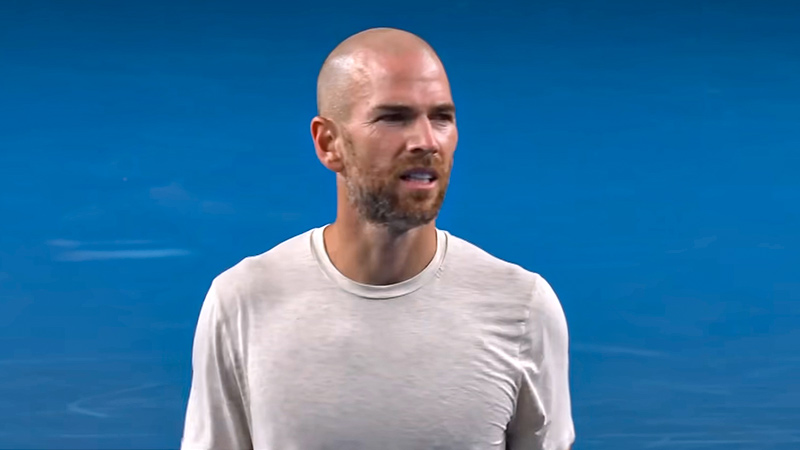
Adrian Mannarino is undeniably an exceptional professional tennis player, characterized by his remarkable longevity and a highly unconventional style that defies modern power-hitting trends.
Reaching a career-high ranking of world No. 17 at age 35, he has secured five ATP titles and earned over $14.9 million in prize money.
His success stems from technical eccentricities, including ultra-low string tension and flat groundstrokes that disrupt the rhythm of elite opponents.
While he sits just below the absolute top tier, his tactical mastery and consistency inside the Top 75 for thirteen consecutive years confirm his elite status.
Is Adrian Mannarino Good? The Statistical Reality
To understand if a player is “good” in the context of the ATP Tour, one must look beyond the aesthetics of the game and focus on the data-driven results of a career spanning two decades.
Adrian Mannarino’s resume places him in a rare bracket of consistent high-level performers who have successfully navigated the transition from the “Big Three” era into the current generation of power hitters.
| Metric | Career Achievement |
|---|---|
| Career-High Ranking | World No. 17 (January 2024) |
| ATP Singles Titles | 5 (Grass: 2, Hard: 3) |
| Prize Money | Over $14.98 Million |
| Top 75 Consistency | 13 Consecutive Seasons (2013–2025) |
| Total Finals | 16 ATP Tour Singles Finals |
| Match Record | 327–377 (ATP Main Draw) |
As the data illustrates, Mannarino is more than just a “dangerous floater”; he is a player who has maximized his physical and technical tools to maintain a presence in the upper echelons of the sport well into his mid-30s.
How Mannarino’s Technical Eccentricity Disrupts Elite Pros
The French veteran is widely regarded as one of the most idiosyncratic players on the tour, utilizing a game style that acts as a strategic subversion of modern tennis coaching.
While most contemporary players rely on heavy topspin and high-tension rackets, Mannarino has carved out a niche by doing the exact opposite, making him a nightmare for opponents who thrive on rhythm.
The Physics of the 19-Pound String Tension
One of the most shocking aspects of Mannarino’s setup is his string tension, which is documented as the lowest on the ATP Tour at approximately 17 to 21 pounds (9–11 kg). For context, the average professional strings their racket between 50 and 60 pounds.
This extreme low tension creates a “trampoline effect,” providing effortless depth and power with minimal physical exertion.
However, this setup requires incredible touch and improvisation, as the ball stays on the strings longer, demanding flawless timing to control. This equipment choice allows him to flick the ball from his hip with a “lazy” motion that belies the pace he generates.
Rhythmic Disruption Through Flat Groundstrokes
Modern players are trained from a young age to combat heavy topspin and high-bouncing balls, but Mannarino offers them a completely different look. He hits the flattest groundstrokes on the tour, utilizing roughly 35% less spin than the tour average.
This causes the ball to skid incredibly low over the net and stay low after the bounce, forcing opponents to constantly bend their knees and generate 100% of their own pace.
By taking the ball early on the rise with one of the shortest backswings in the game, he steals time from his opponents, effectively acting as a “wall” that redirects pace with surgical precision.
The Statistical Reality of a Late-Career Surge
Most tennis players begin to see a decline in their movement and ranking once they pass the age of 30, but Mannarino has defied the traditional aging curve of the sport.
His career is a masterclass in adaptation, showing that technical refinement and tactical intelligence can compensate for a lack of raw explosive power as an athlete matures.
Breaking Historical Age Barriers
Mannarino achieved a historic milestone on January 29, 2024, when he reached World No. 17 at the age of 35. This achievement made him the oldest man in the history of the ATP rankings to break into the global Top 20 for the first time.
This late-career peak was not a fluke but the result of a consistent upward trajectory; between 2013 and 2025, he finished thirteen consecutive seasons ranked inside the Top 75, proving that his “unorthodox” methods have sustained efficacy across different eras of the game.
The Magical 2023 Season
The pinnacle of Mannarino’s career occurred in 2023, a year where he recorded 43 match wins and captured three ATP titles at the age of 35. His titles that year—won in Newport, Astana, and Sofia—demonstrated his versatility across both grass and hard courts.
During this surge, he proved he could still compete with and defeat the elite, highlighted by his victory over world No. 3 Daniil Medvedev.
This season solidified his reputation as a “mad scientist” who had finally perfected the formula for winning at the highest level.
Why Opponents Fear the “Mad Scientist” Approach
The psychological and tactical aspects of Mannarino’s game are just as disruptive as his physical shots. He operates with a level of mental clarity and strategic independence that is rarely seen in a sport often dominated by rigid scouting reports and over-analysis.
The Psychology of Strategic Ignorance
A well-known “crazy” habit of Mannarino is his refusal to look at tournament draws. He famously prefers not to know who his next opponent is until shortly before he walks onto the court.
This approach allows him to avoid overthinking the matchup and instead rely on his in-game tactical intuition.
By focusing on his own unique rhythm rather than his opponent’s strengths, he forces the other player to adapt to him, rather than the other way around.
This idiosyncratic focus makes him a “tricky matchup” that many players on tour explicitly hope to avoid in the early rounds of a tournament.
Left-Handed Angles and Short-Swing Mastery
As a left-hander, Mannarino possesses natural advantages that he exploits with high efficiency. His slice serve out wide on the ad side is a signature weapon, often pulling opponents so far off the court they are forced into the stands just to make a return.
This sets up easy open-court volleys or flat winners. Furthermore, his ultra-short backswing acts as a form of disguise; because the gestures for his forehand and backhand are so compact and identical, opponents struggle to read his placement until the ball has already left the racket.
This combination of precision and disguise makes him a “wizard” on the court.
Surface Specialization: Why Grass is His Kingdom
While Mannarino is a competitive player on almost any fast surface, his game is specifically optimized for certain conditions while being notably vulnerable in others. Understanding this specialization is key to evaluating his overall standing in the tennis world.
- Grass Court Dominance: His flat, zero-topspin shots are lethal on grass because the ball barely bounces off the surface. He has won two of his five titles on grass and holds one of the highest active match-win counts on this surface.
- Hard Court Consistency: He is very solid on hard courts, where he has captured three titles. Fast, indoor hard courts particularly suit his counterpunching style.
- The Clay Court Achilles’ Heel: Clay is his massive weakness. The slow, high-bouncing nature of the red dirt neutralizes his flat shots, causing them to bounce right into the hitting zones of his opponents. Historically, he has suffered through brutal losing streaks during the clay swing of the season.
The Professional Aesthetic: Branding and Logistics
Mannarino’s visual identity is as unconventional as his playing style. Often appearing on court in plain black or white t-shirts that lack prominent sponsorship logos, he has been compared to an “IT Department bro” or someone arriving from a yoga studio.
A Distinctive Visual Identity
Despite his “under the radar” look, Mannarino often wears high-end apparel like Lululemon, which he reportedly favors for its comfort and fit.
Some fans and commentators have noted that his simple attire and shaved head make him resemble the legendary footballer Zinedine Zidane.
This lack of traditional branding further reinforces his image as a maverick who does not follow the “cookie cutter” approach typical of the ATP Tour.
The Resilience of a True Professional
Beyond the aesthetic, there is a deep level of professionalism in Mannarino’s career. His unique forehand is actually a technical adaptation he made following a significant hand injury.
Rather than retiring, he modified his mechanics to continue competing, a testament to his resilience. This ability to adapt and find success with “finesse and brains” in a high-powered world is why many consider him a “crafty character” who is genuinely fun to watch.
Is He a “Journeyman” or a Tennis Legend?
The debate over Mannarino’s legacy often divides fans. Some categorize him as a “high-level journeyman” or a “dangerous floater,” while others see him as a “legend” of technical efficiency and longevity.
The Argument for Longevity
The term “journeyman” usually implies a player who struggles to stay on the main tour, but Mannarino’s thirteen consecutive years in the Top 75 suggest a level of elite consistency that few “journeymen” ever achieve.
His career prize money of nearly $15 million also places him far above the average professional. For many, he is the “living embodiment” of the idea that a player can find success by ignoring industry norms and doing what feels best for their own game.
A Unique Place in Tennis History
Whether one views him as a legend or an idiosyncratic veteran, his impact on the game is undeniable.
He has proven that even in an era of 130 mph serves and heavy baseline power, there is still room for a “mad scientist” who wins with angles, low-tension strings, and superior tactical intelligence.
His victory over Hubi Hurkacz in straight sets and his deep runs at Grand Slams like the Australian Open and US Open confirm that his “strange style” is effectively world-class.
Frequently Asked Questions About Adrian Mannarino
What is the string tension of Adrian Mannarino?
Adrian Mannarino uses an incredibly low string tension of 17 to 21 pounds (9–11 kg). This is significantly lower than the tour average of 50–60 pounds and provides him with a “trampoline effect” for easy power.
Why does Adrian Mannarino not look at the draw?
He famously refuses to look at tournament draws because he prefers to rely on his in-game tactical intuition and avoids overthinking his opponents. He often does not know who he is playing until shortly before the match begins.
How many ATP titles has Adrian Mannarino won?
As of his peak late-career performance, Mannarino has won 5 ATP singles titles. His titles include ‘s-Hertogenbosch (2019), Winston-Salem (2022), Newport (2023), Astana (2023), and Sofia (2023).
Is Adrian Mannarino a lefty?
Yes, Adrian Mannarino is a left-handed player. He utilizes his left-handedness to create sharp angles, particularly with his slice serve out wide on the ad side.
What is Adrian Mannarino’s career-high ranking?
Adrian Mannarino reached a career-high singles ranking of world No. 17 on January 29, 2024, at the age of 35. This made him the oldest man to break into the Top 20 for the first time.