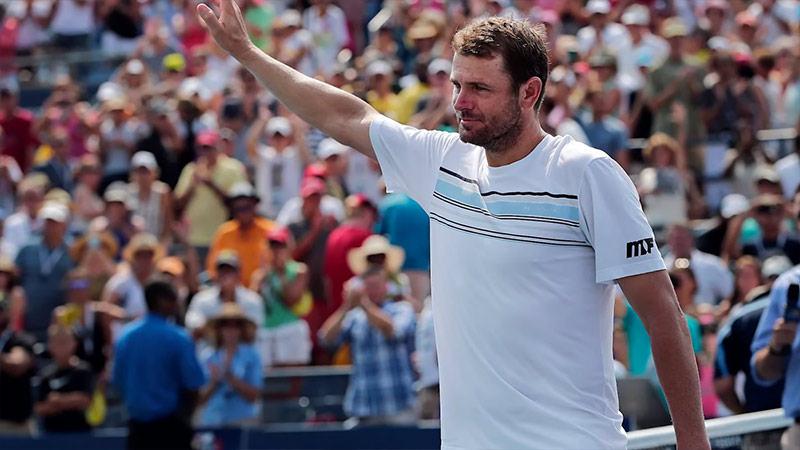
Mardy Fish retired from professional tennis in 2015 primarily due to a severe anxiety disorder and debilitating panic attacks. These mental health struggles were triggered by a terrifying 2012 cardiac arrhythmia diagnosis and subsequent heart surgery.
Although the physical procedure successfully corrected his irregular heartbeat, the psychological trauma led to a state of constant hyper-vigilance and dread.
Fish reached a career-high ranking of World No. 7 before his health crisis forced him to step away from the tour. His journey from the baseline to becoming a leading mental health advocate redefined success and resilience in modern professional sports.
The Medical Catalyst: From Heart Palpitations to Anxiety
Mardy Fish’s journey toward retirement began not with a standard tennis injury, but with a terrifying physical sensation that changed his life overnight.
In March 2012, while competing at a tournament in Key Biscayne, Florida, he experienced extreme, uncontrollable heart palpitations that required immediate medical attention.
This event marked the onset of a health crisis that would eventually overshadow his athletic achievements.
The Cardiac Diagnosis and Surgical Intervention
The initial scare led to a diagnosis of cardiac arrhythmia, a condition characterized by misfiring electrical pulses in the heart. To address this, Fish underwent a cardiac catheter ablation operation in May 2012.
The goal was to physically stabilize his heart rate and allow him to return to the high-intensity environment of the ATP Tour. While the surgery was medically successful, the mental scars from the experience were just beginning to form.
The Psychological Aftermath of Physical Trauma
While the 2012 surgery physically repaired his heart, the psychological trauma proved far more debilitating. Fish developed a severe form of anxiety manifested through constant dread and a hyper-awareness of his own heart rate.
At the absolute peak of this struggle, he was suffering from paralyzing panic attacks as often as every 30 minutes. This mental state made it nearly impossible for him to function normally, let alone compete against the world’s best athletes.
Timeline of Mardy Fish’s Retirement and Health Crisis
Understanding the progression of Fish’s departure requires looking at the critical years between his peak performance and his final match. The following table outlines the pivotal moments that defined his transition out of professional tennis.
| Year | Event | Impact on Career |
|---|---|---|
| 2011 | Reached Career-High No. 7 | Became the top-ranked American male player. |
| March 2012 | First Heart Scare | Onset of uncontrollable heart palpitations in Florida. |
| May 2012 | Cardiac Surgery | Underwent catheter ablation to correct arrhythmia. |
| Sept 2012 | US Open Withdrawal | Withdrew before a match with Federer due to panic. |
| 2013–2014 | Hiatus from Tour | Played only 10 matches; sought mental health treatment. |
| July 2015 | Retirement Announcement | Announced the 2015 US Open as his final event. |
| Sept 2015 | Final Professional Match | Retired after a five-set match against Feliciano López. |
The 2012 US Open Withdrawal: A Career Turning Point
The most public and painful moment of Fish’s battle occurred during the 2012 US Open. After successfully advancing to the fourth round, he was scheduled to face Roger Federer in a high-profile match at Flushing Meadows.
This was the moment where the pressure of the sport and his internal struggle collided in a way that could no longer be ignored.
The Breaking Point on the Way to the Stadium
On the day of the match, as Fish was being driven to the stadium, he was consumed by an overwhelming sense of dread and the fear of suffering a public panic attack in front of thousands of fans.
The anxiety became so intense that he made the difficult decision to withdraw from the tournament hours before the match started. This withdrawal was a shock to the tennis world and served as a clear signal that his battle was far more than physical.
Choosing Mental Health Over Professional Glory
Choosing to walk away from a match against a legend like Federer was an act of profound self-preservation. Following this incident, Fish stepped completely away from the tour for much of 2013 and 2014.
During this time, he focused on seeking professional mental health treatment, as he could barely bring himself to leave his own home at the height of his disorder.
Why Professional Tennis Became an Impossible Environment
The nature of professional tennis played a significant role in exacerbating Fish’s condition. Unlike team sports where athletes can rely on teammates for support during a game, tennis is famously isolating.
For someone dealing with severe anxiety, this isolation became a major hurdle to his continued participation in the sport.
The Loneliness of the Long-Distance Athlete
Fish later noted that tennis is a sport where you are entirely alone on the court. This environment became an impossible space for him to navigate while managing his condition.
The absence of a support system in the immediate vicinity during a match meant that any spike in heart rate or onset of anxiety had to be managed entirely in the public eye, without reprieve.
Pressure of the National Spotlight
At the time of his crisis, Fish had recently overtaken Andy Roddick to become the top-ranked American male player. The immense pressure of carrying the mantle for American tennis added a heavy layer of mental strain.
This expectation to perform at the highest level while his internal world was fracturing created a perfect storm that eventually necessitated his retirement.
The 2015 Farewell Tour: Retiring on His Own Terms
Despite the years of struggle, Mardy Fish was determined not to let his illness have the final word on his career. He explicitly chose not to retire while hidden away during his hiatus in 2013 or 2014.
Instead, he mounted a brief “farewell tour” in the summer of 2015 to say goodbye to the fans and the sport he loved.
Utilizing the Protected Injury Ranking
To make his return possible, Fish used a protected injury ranking to enter the 2015 US Open. His goal was to exit the sport on his own terms rather than letting his mental health disorder dictate his legacy.
This comeback was not about winning another title, but about reclamation—reclaiming his narrative and ending his 15-year career with dignity.
The Final Match at Flushing Meadows
His final professional match took place on September 2, 2015, against Spain’s Feliciano López. In a display of his former brilliance and sheer grit, Fish pushed the match to five sets.
Although he eventually succumbed to the heat and physical exhaustion—losing 2-6, 6-3, 1-6, 7-5, 6-3—the result was secondary to the fact that he finished the match. It was a cathartic conclusion to a journey that had seen him nearly paralyzed by fear only years prior.
Life After Tennis: Advocacy and New Horizons
Since retiring, Mardy Fish has transformed his personal struggle into a platform for global change.
He has become one of the most prominent advocates for athlete mental health, working tirelessly to de-stigmatize the conversation around anxiety and depression in high-stakes environments.
Untold: Breaking Point and the Power of Storytelling
In 2021, Fish released an acclaimed Netflix documentary titled Untold: Breaking Point. The film provided a raw, unfiltered look at his 2012 crisis and his subsequent retirement.
By sharing the details of his panic attacks and the reality of his mental health journey, he provided a roadmap for other athletes to speak their truth without shame.
Leadership and Continued Athletic Success
Fish’s retirement from tennis did not mean a retirement from leadership or competition. He served as the captain of the U.S. Davis Cup team from 2019 to 2022, guiding the next generation of American players.
Additionally, he pivoted to the celebrity golf circuit, where he has established himself as one of the top players. This transition demonstrates that while one chapter ended due to health challenges, his competitive spirit remained intact.
Frequently Asked Questions About Mardy Fish’s Career
What was Mardy Fish’s highest ranking?
Mardy Fish reached a career-high world ranking of No. 7 in 2011. At this time, he was the top-ranked American male tennis player, surpassing his contemporary Andy Roddick.
Did Mardy Fish win any Olympic medals?
Yes, Mardy Fish won an Olympic Silver Medal in singles at the 2004 Athens Games. This remains one of the highlights of his 15-year professional career.
How many titles did Mardy Fish win?
Over the course of his career, Fish won 6 ATP singles titles and 8 doubles titles. He was a versatile player known for his skill in both formats of the game.
Who was Mardy Fish’s final opponent?
Fish played his final professional match against Feliciano López at the 2015 US Open. The match was a grueling five-set thriller that lasted several hours.
What is Mardy Fish doing now?
Currently, Fish is a prominent mental health advocate and a successful celebrity golfer. He also recently completed a tenure as the U.S. Davis Cup captain.
Conclusion: A Legacy of Courage
The retirement of Mardy Fish remains one of the most significant moments in modern sports history, not because of the trophies he left behind, but because of the conversation he started.
By prioritizing his mental well-being over the prestige of the ATP Tour, he showed that true strength often involves acknowledging one’s vulnerabilities.
His decision to retire on his own terms in 2015 served as an inspiration for future athletes to take control of their own health narratives.
Today, his work continues to break the stigma surrounding mental illness, ensuring that his impact on the world of sports extends far beyond the final score of a tennis match.