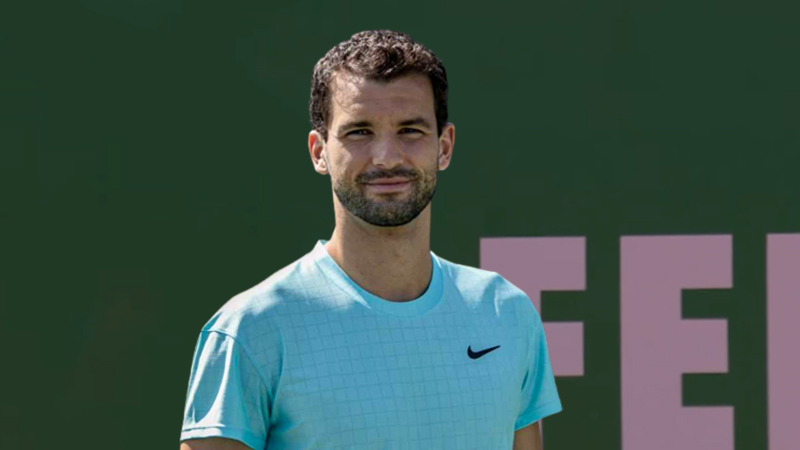
Grigor Dimitrov is a highly competent all-court player on clay, maintaining a solid 61.1% career win rate on the surface.
While statistically his most challenging environment compared to grass or hard courts, his elite athleticism and versatile shot-making have allowed for consistent deep runs at major tournaments. He reached the French Open quarterfinals in 2024 and secured the 2014 Bucharest title.
Despite lacking the relentless baseline grinding of pure specialists, his ability to slide and generate heavy topspin makes him a formidable opponent. Ultimately, Dimitrov is an accomplished, durable competitor on dirt.
Dimitrov’s Clay Performance: A Statistical Breakdown
While many associate the Bulgarian star with the fast-paced conditions of hard courts, his data on the dirt reveals a player of remarkable consistency over more than a decade.
The following table highlights his durability across various professional levels, showcasing that he remains a top-tier threat regardless of the speed of the court.
| Category | Career Metric |
|---|---|
| Overall Clay Wins | 357 |
| Overall Clay Losses | 227 |
| Career Win Percentage | 61.1%, |
| ATP Tour Level Record | 104 Wins / 96 Losses |
| ATP Tour Win % | 52.0% |
| French Open Record | 22 Wins / 15 Losses |
Why Is Grigor Dimitrov So Effective on Clay Surfaces?
Dimitrov’s success on the red dirt is not an accident but the result of a specific technical toolkit adapted for slower conditions. He utilizes his natural agility to neutralize the power of opponents who thrive in these slower environments.
This adaptability is what separates him from players who struggle to transition away from faster hard courts.
Elite Sliding and Athletic Movement
One of his greatest assets on the dirt is his exceptional footwork and ability to slide into corners. This natural ability allows him to defend deep in the court and reset points that would be winners on faster surfaces.
By extending rallies through elite movement, he forces opponents to hit extra balls, which is a core requirement for success in these environments. His athleticism ensures that he remains competitive even when pushed far behind the baseline.
This physical agility is a hallmark of his game that translates well across all surfaces but is particularly vital on the sliding-friendly clay.
Heavy Topspin Forehand and Tactical Variety
The heavy topspin forehand is a cornerstone of his strategy, generating high RPMs that jump off the slow, gripping surface. This weapon allows him to push opponents back, creating openings for his trademark finesse.
Furthermore, he effectively utilizes backhand slices that stay low, forcing heavy baseliners to bend low and strike the ball upwards. His use of dropshots and transitions to the net further disrupts the rhythm of those accustomed to standard baseline rallies.
This diverse tactical approach keeps his opponents guessing and prevents them from settling into a comfortable hitting zone.
What Are the Main Weaknesses in His Clay Court Game?
Despite his technical proficiency, Dimitrov faces distinct challenges that prevent him from reaching the absolute pinnacle of performance on this surface.
These issues often stem from the intersection of his elegant style and the grueling physical reality of the sport. Understanding these limitations is key to analyzing his overall legacy on the dirt.
High Backhand Vulnerability on Slow Surfaces
The use of a one-handed backhand creates a significant tactical disadvantage against heavy topspin specialists. Players often loop high-bouncing balls to his backhand wing, forcing him to strike the ball above shoulder height.
This movement requires immense physical effort and often leads to a breakdown in his rhythm under sustained pressure. Relying on defensive slices in these moments can become predictable over a long match.
It is a persistent technical hurdle that he must navigate whenever facing top-tier specialists who exploit this wing.
Over-Complicating Strategy and Physical Grinding
A vast tactical toolkit can sometimes be a double-edged sword for Dimitrov. He occasionally over-complicates points with dropshots and precise angles when simple, patient baseline striking is required.
Additionally, his preference for quick strike-play means he can struggle to sustain the grueling physical grinds required for multi-hour matches against pure specialists.
As his career has progressed, managing back-to-back high-intensity matches on this surface has become increasingly difficult. The mental and physical energy required to win seven consecutive matches on clay is a high bar for his specific style.
Major Career Milestones on the Red Dirt
Dimitrov has secured several significant achievements that solidify his place among the elite competitors on this surface. His trophy cabinet and deep runs in the most prestigious events provide clear evidence of his competence.
- ATP Clay Title: He captured the 2014 Bucharest Open title without dropping a single set, defeating Lukáš Rosol in the final.
- Grand Slam Peak: He reached the Quarterfinals of the French Open in 2024, completing his career set of reaching the final eight at every Major.
- Monte-Carlo Masters: He reached the final four at this prestigious event twice, in 2018 and 2022.
- Italian Open (Rome): He secured a semifinal finish in 2014, proving his ability to compete on the heavier clay found in Italy,.
- Elite Victories: He holds wins over legendary clay competitors including Novak Djokovic, Stan Wawrinka, and Casper Ruud.
Significant Wins Against Elite Clay Specialists
To understand his level of competence, one must look at the names he has defeated during the European spring swing.
These victories prove that his peak level is capable of toppling the best dirt-ballers in the world. His ability to raise his level for big matches is a defining characteristic of his career.
The 2013 Madrid Victory Over Novak Djokovic
One of the most famous moments of his early career was defeating Novak Djokovic in Madrid in 2013.
This match showcased his ability to use the slower conditions to his advantage, absorbing the pace of the world number one and countering with his own heavy spin.
It remains a benchmark for his potential on the surface when his physical and mental games are perfectly aligned. This victory was a statement to the tennis world that his elegant game had the grit to survive top-level clay matches.
Mastery Over Casper Ruud and Stan Wawrinka
Dimitrov also holds notable wins over Casper Ruud in Monte-Carlo in 2022, a victory against one of the most consistent modern clay players. His record against Stan Wawrinka on this surface is also impressive, with wins in both Monte-Carlo and Madrid in 2015.
These results demonstrate that his variety can effectively dismantle the games of heavy-hitting baseliners who rely on power. By neutralizing their strength through variety and placement, he has carved out a niche as a dangerous underdog on the dirt.
Analyzing the Recent Decline in Clay Court Form
Recent seasons have shown a shift in his performance levels, largely due to physical ailments and the difficulty of maintaining high intensity. While he still produces flashes of brilliance, consistency has become more elusive in the twilight of his career.
Injuries and Early Exits in 2025
During the 2025 season, he showed promise by reaching the quarterfinals at the Monte-Carlo Masters. However, his momentum was halted at the French Open, where he was forced to withdraw in the opening round due to injury complications.
This pattern of physical setbacks has hindered his ability to build a sustained rhythm during the crucial weeks of the season. Managing a veteran body on a surface that demands the most physical effort is an ongoing challenge for the Bulgarian.
The Struggles of the 2026 Season
The 2026 season marked a significant downturn in his results on the dirt. He failed to navigate the qualifying rounds of the French Open, suffering a loss to Jaime Faria.
Additionally, a sound defeat by Nuno Borges at the Nordea Open highlighted his ongoing struggle to match the intensity of lower-ranked opponents in slower conditions.
These results suggest that the physical tax of the surface is becoming a primary barrier to his competitive relevance.
FAQ: Addressing Key Questions About His Clay Career
Is clay statistically Dimitrov’s worst surface?
Yes, while his 61.1% overall win rate is respectable, it remains his most challenging environment compared to hard and grass courts.
His ATP Tour-level win percentage on the dirt drops to 52%, which is significantly lower than his metrics on hard courts (61-62%) and grass (60-63%).
Has Grigor Dimitrov ever won a title on clay?
Dimitrov captured one ATP title on this surface at the 2014 Bucharest Open. He achieved this feat without dropping a single set throughout the tournament, defeating Lukáš Rosol in the final. This remains his crowning achievement on the red dirt to date.
How does he compare to pure clay specialists?
He lacks the relentless baseline grinding capabilities found in pure specialists who thrive on outlasting their opponents.
While his athleticism allows him to compete, his game is built on variety and finesse rather than the suffocating consistency required to dominate this specific surface over long periods.
Verdict: A Highly Competent All-Court Competitor
Grigor Dimitrov may not be a traditional specialist, but his career on the dirt is a testament to his versatility and skill. He has proven that an elegant, all-court game can translate into deep runs and elite victories even in the most physically demanding environments.
While recent form suggests a natural decline due to age and injury, his legacy as a player who can compete at the highest level on every surface is secure.
He remains one of the few players of his generation to possess the movement and variety required to be a threat on the red clay.