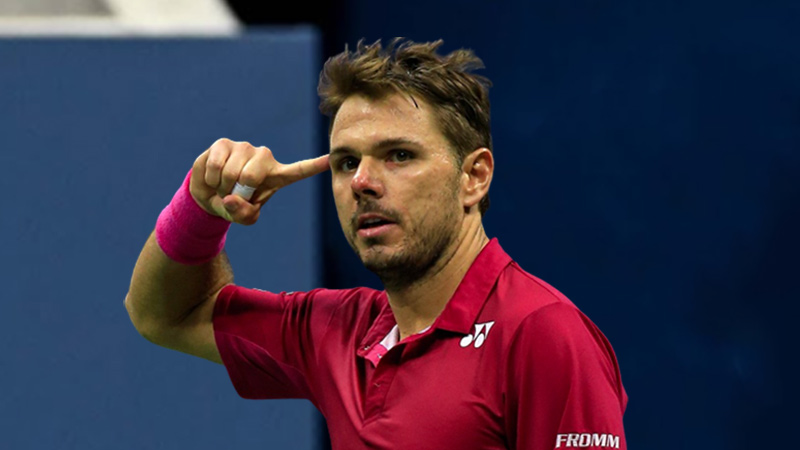
Stan Wawrinka was an elite, Hall-of-Fame-caliber powerhouse who achieved the unthinkable: capturing three Grand Slam titles during the peak dominance of Federer, Nadal, and Djokovic.
Known as “Stan the Man” and “Stanimal,” he possessed a physics-defying one-handed backhand that became the most destructive weapon in tennis history.
While currently ranked World No. 117 during his 2026 farewell season, Wawrinka’s prime was defined by an ability to outmuscle the “Big Three” on the game’s biggest stages.
He remains a rare legend who defeated reigning World No. 1s in every Major final he won, cementing his status as an undisputed giant.
How Good Is Stan Wawrinka at His Absolute Peak?
To understand the magnitude of Wawrinka’s greatness, one must look at the landscape of tennis between 2014 and 2016.
During this window, he was arguably the only player capable of stepping onto a court and physically overpowering the greatest defensive players to ever pick up a racket.
The Triple Crown of Giant-Slaying
Wawrinka belongs to an exclusive class of players who broke the modern “Big Three” monopoly by winning three different Major tournaments. What makes this achievement legendary is the caliber of competition he faced in those finals.
Unlike many who benefited from favorable draws, Wawrinka defeated the reigning World No. 1 in the final of all three of his Grand Slam victories: the 2014 Australian Open, the 2015 French Open, and the 2016 US Open.
This “Triple Crown” of giant-slaying is a feat that few in the history of the sport can claim, proving that “Peak Stan” was not just a top-tier player, but a force of nature.
The Big Three Stat Trick
His elite status is further cemented by a statistical rarity known as the “Big Three Stat Trick.” Wawrinka is one of only three players in history to beat Roger Federer, Rafael Nadal, Novak Djokovic, and Andy Murray at Grand Slam events. This versatility across different surfaces and styles of play highlights his complete game.
Whether it was hitting through Nadal’s heavy topspin in Melbourne or dismantling Djokovic’s impenetrable defense in Paris and New York, Wawrinka possessed the rare raw power required to hit through the defensive walls of the sport’s most dominant figures.
The Magnus Norman Transformation and the Rise of Stanimal
The trajectory of Wawrinka’s career is unique because he was a late bloomer who didn’t reach his full potential until his late twenties. For the first decade of his professional life, he was a solid but overshadowed Top 20 player.
The 28-Year-Old Career Pivot
The turning point occurred at age 28 when Wawrinka began working under the guidance of coach Magnus Norman. Under Norman’s tutelage, he transformed from a talented but mentally fragile competitor into a physical and mental powerhouse.
This evolution allowed him to finally believe he belonged at the same table as the legends of the game. He stopped being a supporting character in the stories of Federer and Nadal and started writing his own chapters as a protagonist on the world’s biggest stages.
Mastering the Mental Zone
“Stanimal” was a nickname earned because of his ability to enter “the zone” during Grand Slams. In this state, his intensity and focus reached levels that few could match. This mental fortitude was most evident in his big-match clutch performance.
Between 2014 and 2016, Wawrinka went on an incredible streak of winning 11 consecutive ATP finals. He did not just reach finals; he won them against all-time greats, displaying a level of poise and aggression that defined his prime years.
This ability to deliver his best tennis when the stakes were highest is a hallmark of his historic legacy.
The Technical Mastery of the Stanimal Backhand
The centerpiece of Wawrinka’s game was his legendary, physics-defying one-handed backhand. It is widely regarded as one of the most lethal and destructive groundstrokes in the history of the sport.
Technical Brilliance from the Baseline
Wawrinka was a destructive baseline shot-maker who could blast winners from deep behind the baseline. His one-handed backhand was not just a shot of beauty; it was a shot of pure, unadulterated power.
While many modern players moved toward the two-handed backhand for stability, Wawrinka’s single-handed stroke allowed for a massive swing path and explosive wrist snap.
This enabled him to create angles and pace that left opponents stranded, effectively turning defensive positions into lethal offense in a single strike.
Piercing the Great Defensive Walls
The true value of Wawrinka’s backhand was its ability to pierce the defense of players like Novak Djokovic and Rafael Nadal. In their many epic encounters, Djokovic’s ability to retrieve almost every ball was neutralized by Wawrinka’s weight of shot.
By consistently hitting heavy, deep, and fast, he forced the “Big Three” into uncomfortable positions where they could no longer dictate play.
This explosive, raw power made him one of the few players the all-time greats genuinely feared meeting in a best-of-five format.
Career Milestones and the Hall of Fame Trajectory
Wawrinka’s resume is not just impressive for his era; it is one of the most decorated in the history of Swiss tennis and the ATP tour.
| Milestone / Achievement | Detail & Historical Weight |
|---|---|
| Grand Slam Singles Titles | 3 (2014 Australian Open, 2015 French Open, 2016 US Open) |
| Career-High Ranking | World No. 3 (Reached in January 2014) |
| ATP Singles Titles | 16 (Includes 1 Masters 1000 in Monte Carlo 2014) |
| Olympic Medals | 1 Gold (Men’s Doubles with Roger Federer, Beijing 2008) |
| Team Trophies | 1 Davis Cup (Led Switzerland to historic victory in 2014) |
| Big Three Stat Trick | Beat Federer, Nadal, Djokovic, and Murray at Slams |
| Hall of Fame Status | Viewed as an absolute lock for induction |
The Paradox of Greatness: Consistency vs. Peak Performance
While his peak was undeniably high, Wawrinka’s career was marked by a fascinating paradox regarding his week-to-week consistency compared to his Grand Slam dominance.
Grand Slam Specialist vs. ATP Tour Struggles
Unlike the “Big Three,” who maintained a nearly perfect winning percentage across all levels of competition, Wawrinka was famously inconsistent in smaller tour-level events. He frequently lost in the early rounds of Masters 1000 and ATP 250 tournaments.
This variance in performance is the primary reason his overall career winning percentage is lower than some of his peers.
However, this inconsistency also served to make his “Peak Stan” performances even more legendary, as he seemed to possess a “switch” that he could only flip when the lights were brightest at a Major.
The Ranking Ceiling of World No. 3
Despite winning three Grand Slams and multiple other prestigious titles, Wawrinka never reached the World No. 1 ranking, peaking at World No. 3 in 2014.
In any other era of tennis history, a player with three Majors and an Olympic Gold medal would likely have spent time at the top of the rankings.
However, competing against Federer, Nadal, and Djokovic simultaneously meant that the points required for No. 1 were often out of reach due to his early-round exits in smaller events.
Nevertheless, his place as a legendary figure remains untouched by the lack of a No. 1 ranking.
Reliving the 2026 Farewell Tour and Final Retirement
As of 2026, the tennis world is celebrating the final year of Wawrinka’s professional career. At 41 years old, he has navigated multiple major surgeries and the natural decline of age, yet his presence on tour remains a draw for fans worldwide.
Emotional Goodbye to Global Fans
During this final season, Wawrinka has received emotional farewell ceremonies at the sport’s most iconic venues, including the Australian Open, Roland Garros, and Wimbledon.
Most recently, he shared a tearful goodbye with his home crowd at the Swiss Open Gstaad. These moments serve as a reminder of the respect he commands from both fans and peers.
While his current win-loss record reflects his physical battles against younger athletes, the appreciation for his historic contributions to the game has never been higher.
One Last Backhand in Geneva
The curtain will officially close on this storied career on December 19, 2026, in Geneva. He is set to headline a star-studded exhibition event titled “One Last Backhand,” providing fans one final opportunity to witness that legendary groundstroke in person.
As he prepares for life after the tour, he does so with the knowledge that his credentials far exceed the typical requirements for the International Tennis Hall of Fame. He is projected for an immediate first-ballot induction five years after his retirement concludes.
FAQs
Is Stan Wawrinka better than Andy Murray?
While Murray has more total titles and spent time at World No. 1, Wawrinka matched him in Grand Slam titles (3 each).
Analytical fans often debate this, but Wawrinka’s ability to defeat World No. 1s in every Major final gives him a unique “peak” argument that few can match.
When will Wawrinka be inducted into the Hall of Fame?
Players are eligible five years after retirement. Since his final year is 2026, he will be eligible for induction in 2031. Given his three Majors, Olympic Gold, and Davis Cup, he is considered an absolute lock for a first-ballot induction.
What was Wawrinka’s most famous match?
Most experts point to the 2015 French Open final against Novak Djokovic. Wawrinka’s performance in that match is often cited as the pinnacle of aggressive baseline tennis, where his backhand consistently overwhelmed the best defender in the world.
Conclusion: The Undying Legacy of the Giant Slayer
Stan Wawrinka’s career serves as a testament to the power of perseverance and the peak of human athletic potential. He was the man who refused to be intimidated by the greatest era in tennis history.
By claiming three Grand Slam titles and an Olympic Gold medal, he proved that even in an age of gods, a mortal with enough power and belief could become a giant slayer.
As he completes his 2026 farewell tour, the tennis world says goodbye not just to a great player, but to a legendary powerhouse whose one-handed backhand will be studied and admired for generations to come.
Wawrinka remains an undisputed Hall of Fame icon who truly was “The Man” when it mattered most.