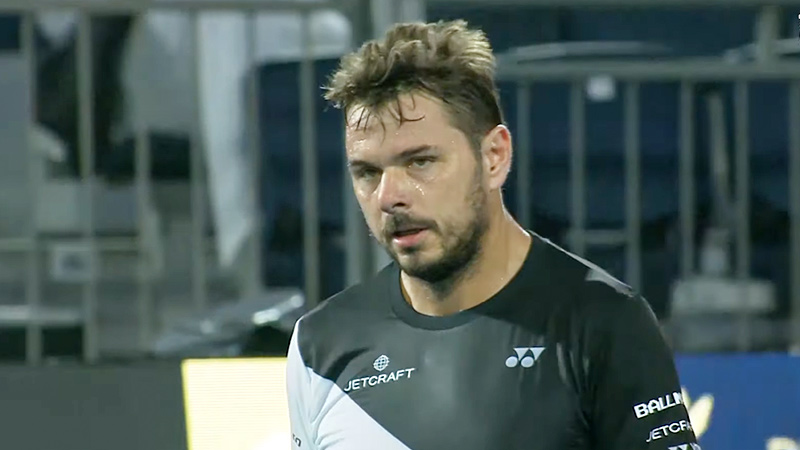
Stan Wawrinka has officially announced that the 2026 season serves as the final chapter of his professional tennis career.
At 41, the three-time Grand Slam winner is currently on a year-long farewell tour titled “One Last Push,” allowing fans to witness his iconic backhand one final time before his October 2026 retirement.
While he briefly returned to the ATP Top 100 in February, the physical demands of the tour have shifted his focus toward celebrating a legacy that disrupted the dominance of legendary peers.
His journey officially concludes on home soil in Basel, marking the end of an elite era.
What Happened to Stan Wawrinka in 2026?
The 2026 season has been a transition from elite competition to a celebratory farewell, as Wawrinka balances his desire to remain competitive with the reality of a 41-year-old body.
A Historic Return to the ATP Top 100
Early in the 2026 season, Wawrinka proved he still possessed the skill set of a world-class athlete. Following a successful second-round appearance at the Rotterdam Open in February, he briefly climbed back to No. 98 in the world rankings.
This achievement was statistically significant; at 40 years old at the time, he became the first player in his 40s to be ranked in the ATP Top 100 since Roger Federer in July 2022.
By March 2026, he peaked as the second-oldest player ever to join the Top 100, trailing only the legendary Ken Rosewall in historical longevity.
Emotional Grand Slam Departures
As the season progressed into the summer months, the focus shifted to emotional goodbyes at the sport’s most prestigious venues. In May, Wawrinka made his final appearance at the French Open—the tournament that originally inspired him to pursue tennis.
Under grueling 33°C heat, he lost a highly emotional first-round match to Jesper de Jong, departing the clay courts to a massive standing ovation and a final “Mexican wave” with the crowd.
In June, he made his 19th and final appearance at Wimbledon, exiting after a hard-fought battle against Matteo Berrettini and leaving the grass courts in tears as the tennis world honored his resilience.
The Path to Retirement: Why 2026 is the End
Deciding to step away from professional tennis was a calculated decision based on physical sustainability and the desire to retire on his own terms.
Managing a 41-Year-Old Professional Body
The primary catalyst for Wawrinka’s retirement is the physical toll of competing at the highest level for over two decades.
Currently ranked No. 117, he is managing a 7–13 match record this year, often finding it difficult to overcome younger opponents during longer, multi-set matches.
He has been forced to adjust his weekly schedule carefully to manage his physical health, focusing on quality of appearances over quantity as he approaches the end of the year.
This strategic reduction in his playing load ensures he can remain healthy enough to complete his “One Last Push” tour across his favorite global stops.
The Final Professional Stop in Basel
Wawrinka has officially confirmed that his legendary career will reach the “end of the line” on home soil at the Swiss Indoors in Basel. This choice is deeply personal, allowing him to retire in the country he has represented with such distinction.
Tournament organizers have already designated Monday, October 26, 2026, as his official retirement tribute evening, ensuring a grand send-off for one of Switzerland’s greatest sporting icons.
Following this official ATP exit, he will host a star-studded exhibition titled “One Last Backhand” in Geneva on December 19, 2026, alongside close friends Roger Federer and Andy Murray.
Understanding the “Stanimal” Legacy and Impact
To understand what happened to Stan Wawrinka, one must look back at his unique ability to break the most formidable stranglehold in the history of the sport.
Disrupting the “Big Three” Dominance
Wawrinka earned the nickname “Stanimal” for his ability to enter a peak “Super Saiyan” mode during the second week of Grand Slams, making him one of the few players capable of snatching multiple titles away from Federer, Nadal, and Djokovic during their primes.
His statistical record in major finals is unparalleled; in every Grand Slam final he won, he defeated the active World No. 1 player in exactly four sets.
This includes his triumphs at the 2014 Australian Open against Rafael Nadal, the 2015 French Open against Novak Djokovic, and the 2016 US Open, again defeating Djokovic.
The Transformation Under Magnus Norman
Wawrinka’s rise to elite status was not immediate. He turned professional in 2002 but spent much of his early career in the shadow of Roger Federer. A pivotal moment occurred at age 28 when he hired former World No. 2 Magnus Norman as his coach in 2013.
This partnership completely transformed his mental approach and tactical style, evolving him from a passive, defensive baseline player into a hyper-aggressive power-hitter.
This shift allowed him to utilize his one-handed backhand—widely considered the most powerful and elegant in the sport—as a devastating weapon that could blast through the defenses of the world’s best players.
The Injury Timeline: Surviving Four Major Surgeries
The latter half of Wawrinka’s career was defined as much by his medical resilience as it was by his on-court victories.
| Period | Type of Injury | Impact on Career |
|---|---|---|
| August 2017 | Double Knee Surgery | Forced him to end his season and effectively ended his run in the Top 10. |
| March/June 2021 | Double Foot Surgery | Left him unable to walk properly until December 2021; sparked retirement rumors. |
| 2022–2025 | Recovery Phase | Clawed back through the Challenger circuit out of pure love for the sport. |
| 2026 | Age-Related Fatigue | Resulted in the official announcement of his final retirement season. |
Despite these setbacks, Wawrinka refused to retire on the operating table. His “Resilient Vet” phase involved spending years fighting through lower-tier events and the Challenger circuit simply because of his deep-seated passion for competition.
This refusal to quit allowed him to reach his 2026 milestone of returning to the Top 100 at age 40, a feat that solidified his status as a warrior of the baseline.
Statistical Deep Dive: 2026 Match Results
Analyzing Wawrinka’s recent performance data illustrates the competitive nature of his final year on the ATP Tour.
| Tournament | Round | Opponent | Result | Score |
|---|---|---|---|---|
| Swiss Open Gstaad (July) | Round of 32 | Jaime Faria | Loss | 7-6, 4-6, 4-6 |
| Wimbledon (June) | Round of 16 | Matteo Berrettini | Loss | 6-7, 7-6, 6-7, 6-7 |
| French Open (May) | Round of 64 | Jesper De Jong | Loss | 3-6, 6-3, 3-3, 4-6 |
| Geneva Open (May) | Round of 16 | Alex Michelsen | Loss | 6-7, 6-7 |
| Geneva Open (May) | Round of 32 | Raul Brancaccio | Win | 6-2, 4-6, 7-6 |
As of July 19, 2026, Wawrinka holds a 7–14 win-loss record for the season. While the wins have become harder to secure, the scorelines indicate that he remains a formidable opponent, often taking matches to deciding sets or tiebreaks against much younger, top-tier competitors.
His final competitive focus remains on his upcoming match at the Millennium Estoril Open in Portugal, scheduled for July 20, 2026, against Román Andrés Burruchaga.
What Is the Future for Stan Wawrinka?
While his professional career ends in October, Wawrinka’s impact on tennis will continue through his various honors and team achievements.
He departs as an Olympic Gold Medalist (2008) and a Davis Cup Champion (2014), titles he shared with his countryman and friend, Roger Federer.
A Celebrated Homecoming
The ceremonies honoring his retirement have already begun. Following his final match at the Swiss Open Gstaad in July 2026, tournament organizers hosted a grand ceremony celebrating his journey that began at that same venue in 2003.
He was gifted a custom pair of skis labeled “The Man”, a tribute to his status as a Swiss sporting giant.
The Final Exhibition and Legacy
The world of tennis will gather one last time in December 2026 in Geneva to celebrate Wawrinka’s career at the “One Last Backhand” party.
This event will serve as a bridge between his competitive life and his next chapter, likely involving mentorship or ambassadorial roles within the sport.
He will step away as the owner of one of the most visually devastating one-handed backhands the sport has ever seen, leaving a void in the tour that few players will ever be able to fill with the same blend of power and elegance.
Frequently Asked Questions (FAQ)
When is Stan Wawrinka’s final match?
Stan Wawrinka will play his final professional match at the Swiss Indoors Basel in October 2026. His official retirement tribute evening is scheduled for Monday, October 26, 2026.
How many Grand Slams did Stan Wawrinka win?
He won three Grand Slam titles: the Australian Open (2014), Roland Garros (2015), and the US Open (2016). In each of these finals, he defeated the active World No. 1.
Why was Stan Wawrinka called “Stanimal”?
The nickname was given to him because of his incredible power and physical resilience, particularly his ability to reach an unstoppable level of play during the most high-pressure moments of Major tournaments.
Is Stan Wawrinka still playing in 2026?
Yes, he is currently active and is scheduled to compete in the Millennium Estoril Open starting July 20, 2026. He will continue to play selected tournaments until his retirement in October.
What is Stan Wawrinka’s current ranking?
As of July 2026, his ranking sits at No. 117 in the world. Earlier in the year, he briefly reached No. 98.
Conclusion: Honoring a Remarkable Journey
The story of “What Happened to Stan Wawrinka” is ultimately one of unparalleled grit and delayed excellence. He proved that a player could emerge from the shadow of a legend like Federer to carve out their own historic niche.
From his tactical evolution under Magnus Norman to his refusal to let four major surgeries end his career prematurely, Wawrinka embodied the spirit of a true competitor.
As he approaches his final matches in Basel, the tennis community celebrates not just the three Grand Slams, but the relentless spirit of a man who played for the love of the game until the very end.