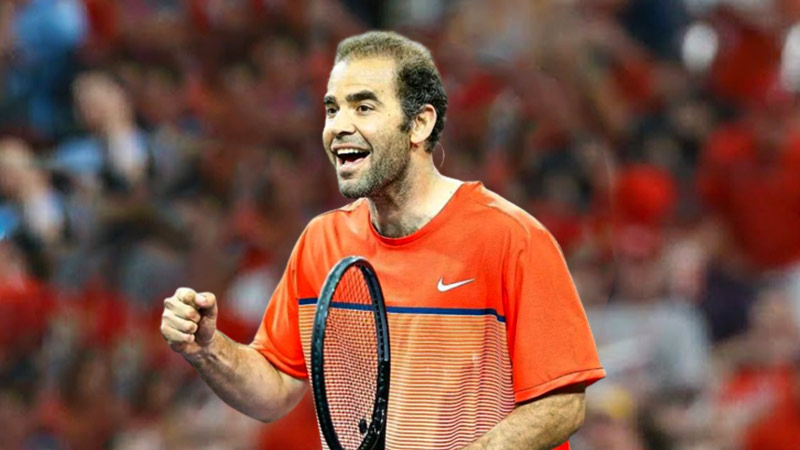
Pete Sampras remains a foundational figure in tennis, having been the undisputed “Greatest of All Time” upon his retirement in 2002. With 14 Grand Slam titles and a record six consecutive year-end No. 1 rankings, his dominance defined the 1990s.
However, the subsequent rise of the “Big Three”—Novak Djokovic, Rafael Nadal, and Roger Federer—has redefined statistical greatness.
While Sampras possessed a peerless serve-and-volley game and a perfect 7-0 Wimbledon final record, his lack of a French Open title and the modern era’s unprecedented longevity have shifted the consensus toward Djokovic.
Analyzing the Dominance of Pete Sampras in the 1990s
To understand if Sampras is the greatest, we must first look at the era he completely controlled through sheer willpower and technical precision.
The Unprecedented 14 Grand Slam Title Benchmark
When Pete Sampras walked away from the sport following his 2002 US Open victory, his 14 major titles were widely considered an unbreakable record.
He dominated the grass courts of London and the hard courts of New York with a consistency that few had ever seen before in the professional era. His collection included seven Wimbledon championships, five US Open titles, and two Australian Open crowns.
During this time, he was universally viewed as the greatest player to ever pick up a racket, setting a gold standard for professional excellence that many thought would last for a century.
Six Consecutive Years as the World Number One
One of the most impressive aspects of the Sampras era was his grip on the top spot of the rankings. He holds a record that remains unmatched in tennis history: finishing as the Year-End No. 1 for six consecutive years between 1993 and 1998.
Throughout his career, he spent a total of 286 weeks at the top of the world rankings, a testament to his ability to maintain elite performance levels week after week.
This period of sustained leadership established him as the primary benchmark for consistency before the modern era redefined these metrics.
Why “Pistol Pete” Remains a Major GOAT Contender
Even with the higher title counts of modern players, the specific way Sampras played the game provides a unique argument for his place at the top of the mountain.
The Lethal Mechanics of the Serve and Volley Game
Nicknamed “Pistol Pete,” Sampras was best known for a heavy, pinpoint serve and a nearly flawless serve-and-volley game.
He possessed what many analysts consider one of the most lethal second serves in the history of the sport, which allowed him to take risks that other players simply could not afford.
His aggressive, net-rushing style was designed to overpower baseline players, forcing them into uncomfortable positions and ending points quickly.
This tactical dominance allowed him to maintain a career match record of 762–222, resulting in a 77.4% winning percentage.
The Perfection of the 7-0 Wimbledon Final Record
While many players have won multiple titles at the All England Club, few have done so with the clinical efficiency of Sampras.
He maintains a perfect 7-0 record in Wimbledon finals, a statistic often cited by peers and analysts as a testament to his mental toughness on grass courts.
In major tournaments, his competitive drive was fierce, leading to a formidable 14-4 overall record in Grand Slam finals. This ability to elevate his game during the most high-stakes moments is a key pillar in the argument for his legendary status.
Comparing Pete Sampras to the Modern Big Three
The debate regarding the greatest ever shifted significantly when three players from the same generation surpassed the 14-title mark once held by Sampras.
| Player | Grand Slam Titles | Career Grand Slam? | Weeks at World No. 1 |
|---|---|---|---|
| Novak Djokovic | 24 | Yes | 428 |
| Rafael Nadal | 22 | Yes | 209 |
| Roger Federer | 20 | Yes | 310 |
| Pete Sampras | 14 | No | 286 |
The Clay Court Gap and Surface Versatility Issues
A significant hurdle in Sampras’s quest for the undisputed top spot is his performance on the slow red clay of Roland Garros.
Technical Challenges of the Slow Red Clay
Despite his dominance on fast surfaces, Sampras struggled significantly on the red clay of the French Open. His aggressive, net-rushing style did not translate well to the slower surface, where baseline grinders could neutralize his powerful serve.
Consequently, he never won the French Open, which remains the only missing piece of his Grand Slam resume.
In contrast, all members of the Big Three achieved a Career Grand Slam by winning every major at least once, showcasing a level of surface versatility that Sampras was never quite able to master.
Overcoming Physical and Health Obstacles
It is important to note that Sampras’s career was not without significant personal hurdles. He faced consistent health challenges due to thalassemia, a genetic blood trait that can impact physical stamina. Despite this condition, he remained dominant across hard and grass courts for over a decade.
When evaluating his legacy against the modern era, his ability to win 14 majors while managing a chronic health condition adds a layer of depth to his achievements that is often overlooked in pure statistical comparisons.
Pete Sampras and the Final Verdict on the Debate
Perhaps the most compelling piece of evidence in the modern discussion comes from Sampras himself, who has publicly commented on his successors.
Why Sampras Named Novak Djokovic the Greatest
In a surprising but respected move, Pete Sampras weighed in on the modern discussion in 2021, publicly stating that he believes Novak Djokovic is the greatest of all time.
Sampras pointed to Djokovic’s incredible longevity and consistency as the primary reasons for this endorsement.
Specifically, he cited Djokovic’s seven years finishing as the year-end World No. 1 and his total major titles—which have since reached 24—as the deciding factors that moved the Serbian legend past his own previous records.
The Enduring Impact of the Sampras Blueprint
While he may no longer hold the most titles, Sampras laid the groundwork for the modern era of tennis dominance.
He set the professional standards for what it meant to be a long-term World No. 1 and showed that a single player could dominate multiple surfaces for years at a time.
His 286 weeks at the top remained a massive mountain to climb until the modern trio eventually scaled it.
For many fans who grew up in the 90s, the “Pistol Pete” era represents the peak of serve-and-volley tennis, a style that has largely disappeared from the contemporary game.
Frequently Asked Questions About the Tennis GOAT
How many Grand Slam titles did Pete Sampras win?
Pete Sampras won 14 Grand Slam singles titles during his career. This included 7 Wimbledon titles, 5 US Open titles, and 2 Australian Open titles. At the time of his retirement in 2002, this was the all-time record for men’s tennis.
Did Pete Sampras ever win the French Open?
No, Pete Sampras never won the French Open. While he was dominant on the grass of Wimbledon and the hard courts of the US and Australia, his serve-and-volley style struggled on the slow red clay of Roland Garros. This remains the only Grand Slam he did not win during his professional career.
Who does Pete Sampras think is the greatest player?
In 2021, Pete Sampras publicly stated that he believes Novak Djokovic is the greatest of all time. He based this on Djokovic’s total Grand Slam count, his 428 weeks at World No. 1, and his record-breaking seven year-end No. 1 finishes.
What was Pete Sampras’s record in Wimbledon finals?
Pete Sampras had a perfect 7-0 record in Wimbledon finals. This undefeated streak in the championship match at the All England Club is one of the most cited statistics in the argument for his greatness on grass courts.
What was the nickname given to Pete Sampras?
Pete Sampras was famously nicknamed “Pistol Pete” due to his heavy and pinpoint accurate serve. His serve was a primary weapon that allowed him to dominate the 1990s and maintain a high winning percentage throughout his career.
Final Thoughts: The Legacy of a Champion
The question of whether Pete Sampras is the greatest of all time often depends on whether you value era-specific dominance or total career statistics.
While the “Big Three” have undoubtedly surpassed his numerical records, Sampras’s impact on the sport is immeasurable. He brought a level of professional focus and serve-and-volley perfection that defined a decade of tennis.
For those who prioritize the era they witnessed, Sampras remains the king of the court. For those who look strictly at the record books, he is the pioneer who cleared the path for the legends of today.
Regardless of the ranking, “Pistol Pete” will always be remembered as the man who made 14 majors look possible, setting the stage for the greatest era the sport has ever seen.