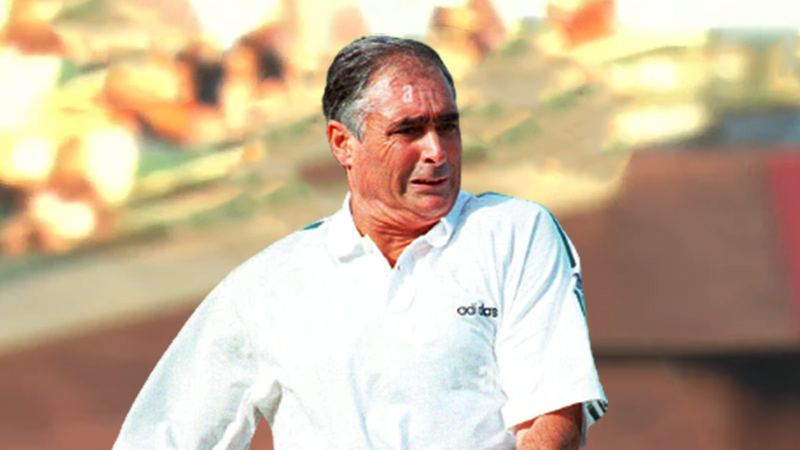
Roger Taylor never won the Wimbledon singles title, but he remains a titan of British tennis history. Between 1967 and 1973, Taylor reached the semi-finals three times, cementing his status as the nation’s premier player.
While he fell just short of the ultimate trophy on the grass of SW19, his 1970 victory over world No. 1 Rod Laver is considered one of the greatest upsets in the tournament’s history.
Beyond his on-court performance, his decision to play during the 1973 boycott earned him the title of “The Man Who Saved Wimbledon,” preserving the event’s prestige.
Did Roger Taylor Win Wimbledon? Examining His Record
To understand Roger Taylor’s impact, one must look past the absence of a singles trophy. He was the premier British player of his era, carrying the weight of national expectation during a time when British success at the All England Club was rare.
Taylor’s career spanned the transition from the amateur era to the Open era, showing a remarkable consistency that allowed him to compete with the greatest legends the sport has ever seen.
The following table provides a comprehensive overview of his most significant performances at the All England Club, highlighting the depth of his runs in both singles and doubles competition.
| Year | Event | Result | Notable Achievement / Context |
|---|---|---|---|
| 1967 | Men’s Singles | Semi-finalist | Defeated Cliff Drysdale; lost to champion John Newcombe. |
| 1968 | Men’s Doubles | Quarter-finalist | Reached the final eight in the first year of the Open Era. |
| 1969 | Men’s Doubles | Quarter-finalist | Maintained high-level consistency in doubles play. |
| 1970 | Men’s Singles | Semi-finalist | Defeated World No. 1 Rod Laver in a massive 4th-round upset. |
| 1973 | Men’s Singles | Semi-finalist | Defeated 17-year-old Björn Borg in the Quarter-finals. |
| 1973 | Men’s Doubles | Quarter-finalist | Reached the final eight during the controversial boycott year. |
The 1970 Giant Slayer: Defeating Rod Laver
The 1970 tournament stands as perhaps the most iconic chapter in the Roger Taylor Wimbledon record. Entering the event, Rod Laver was the undisputed king of tennis, the defending champion, and the world No. 1.
Laver was coming off a historic second Grand Slam and seemed nearly invincible on the grass of SW19. However, the fourth round would provide a result that shocked the international sporting community and solidified Taylor’s place in the history books.
The Match That Stunned the Tennis World
In a performance that combined technical precision with immense mental fortitude, Taylor dismantled the legendary Australian in four sets. The scoreline—4-6, 6-3, 6-3, 6-2—reflected a match where Taylor grew stronger as the pressure increased.
After dropping the first set, the British left-hander found a rhythm that Laver simply could not break, ending the champion’s quest for another consecutive title.
This victory is still discussed today as one of the most significant upsets in the history of the championships.
The Bittersweet Path to the Semi-Finals
Despite the euphoria of defeating the world’s best player, the physical and emotional toll of the victory was substantial. In the semi-finals, Taylor faced another Australian legend, Ken Rosewall.
While Taylor fought valiantly, he was unable to replicate the magic of his fourth-round triumph and fell just short of the final.
Nevertheless, his run in 1970 proved that a British player could not only compete with the global elite but could dominate them on the grandest stage.
1973: The Man Who Saved Wimbledon and the ATP Boycott
The 1973 tournament was unlike any other in history, defined by a massive player boycott that threatened the very existence of the event that year. Over 80 of the world’s top players chose to withdraw to protest the suspension of Nikola Pilić.
As the premier British player, Taylor was placed in an impossible position: support his fellow professionals or play for his home fans. His decision to stay changed the course of the tournament and earned him a unique moniker in the tennis world.
Defying the Boycott for the Fans
Roger Taylor chose to defy the ATP boycott, believing that his duty to the British public and the tournament outweighed the political dispute.
Because of his high profile and status as the British No. 1, his presence ensured that the media and the public remained engaged with the event.
Without Taylor, the 1973 draw would have lacked a recognizable star for the local audience, leading historians to later dub him “The Man Who Saved Wimbledon”.
The Epic Encounter with a Young Björn Borg
The 1973 run was not just famous for politics; it featured a classic quarter-final match against a 17-year-old making his debut—future legend Björn Borg.
The match was a grueling five-set marathon that captivated the crowd, with Taylor eventually winning 6-1, 6-8, 3-6, 6-3, 7-5.
This victory over the young Swede propelled Taylor into his third semi-final, where he was eventually defeated by Alex Metreveli in a match that many felt Taylor could have won as the heavy favorite.
Grand Slam Success Beyond the Grass of SW19
While the question “Did Roger Taylor win Wimbledon?” results in a “no” for the singles title, his career was far from devoid of Grand Slam glory. To fully appreciate his talent, one must look across the Atlantic to the United States.
It was on the courts of the US Open that Taylor reached the pinnacle of the sport, proving his world-class ability in the doubles arena where he captured multiple championships.
Back-to-Back US Open Doubles Titles
Taylor achieved a feat that few players in history can claim: winning back-to-back US Open Men’s Doubles titles. In 1971, he teamed up with John Newcombe to secure his first major trophy.
Proving that this was no fluke, he returned in 1972 and successfully defended his title, this time partnering with Cliff Drysdale. These victories highlight that Taylor possessed the tactical intelligence and skill to win at the highest level of professional tennis.
A Career Defined by Excellence and Longevity
The fact that Taylor found success with different partners like Newcombe and Drysdale speaks to his versatility as a player. He was not just a grass-court specialist; he was a competitor who could adapt to different styles and high-pressure situations.
This success in the United States provides the necessary context to his Wimbledon “heartbreaks,” showing that he was indeed a champion, even if the singles title in London remained elusive.
Why Roger Taylor Remains a Legend in British Tennis
Roger Taylor’s legacy is not built on a single trophy, but on a career of consistent excellence and a deep connection with the fans.
He was only the seventh British man to reach the Wimbledon singles semi-finals following the abolishment of the Challenge Round in 1922.
This statistic underscores how rare his level of success was for a domestic player during that era, making him a beacon of hope for generations of British players who followed him.
The Seventh Man Milestone
Being among the elite group of British semi-finalists placed Taylor in a historical category that remained sparsely populated for decades. His three semi-final appearances (1967, 1970, and 1973) represent a level of sustained performance that few have matched.
For many years, Taylor was the standard-bearer, the player who proved that British tennis could remain relevant on the global stage amidst the dominance of Australian and American athletes.
A Legacy of Integrity and Sportsmanship
Beyond the numbers, Taylor is remembered for his integrity. His choice in 1973 was not about personal gain but about preserving the integrity of the sport for the spectators.
He carried the torch for British tennis with grace, and his victories over legends like Rod Laver and Björn Borg are etched into the memories of those who witnessed them.
Even without a Wimbledon singles title, his contribution to the sport’s history is undeniable and continues to be celebrated today.
Frequently Asked Questions About Roger Taylor’s Career
How many times did Roger Taylor reach the Wimbledon semi-finals?
Roger Taylor reached the singles semi-finals at Wimbledon three separate times: 1967, 1970, and 1973.
Who did Roger Taylor defeat in his famous 1970 upset?
In 1970, Taylor defeated the world No. 1 and defending champion Rod Laver in the fourth round, a match considered one of the biggest upsets in the history of the tournament.
Why was Roger Taylor called “The Man Who Saved Wimbledon”?
He earned this title in 1973 after he chose to defy a mass player boycott by over 80 ATP pros. His participation as the British No. 1 maintained public interest and television coverage for the event.
Did Roger Taylor ever win a Grand Slam title?
Yes. While he did not win a singles title at Wimbledon, he won back-to-back US Open Men’s Doubles titles in 1971 and 1972.
Who did Roger Taylor lose to in the 1973 Wimbledon semi-finals?
Taylor was defeated in the 1973 semi-finals by Alex Metreveli, following an exhausting five-set quarter-final victory over Björn Borg.
Conclusion: The Enduring Legacy of a British Tennis Icon
Roger Taylor’s story at SW19 is defined by the intersection of immense talent and pivotal historical moments.
From the monumental high of defeating world No. 1 Rod Laver in 1970 to his selfless decision to defy the 1973 boycott to play for his home crowd, he consistently remained a professional of the highest caliber.
While he never held the singles trophy at the All England Club across his three semi-final appearances, his back-to-back US Open doubles titles and his status as only the seventh British man to reach the final four in the modern era solidify his standing as a true icon of the sport.
For any tennis fan, Taylor represents a vital bridge between eras and serves as a powerful reminder of a player’s dedication to the fans and the prestige of the game.