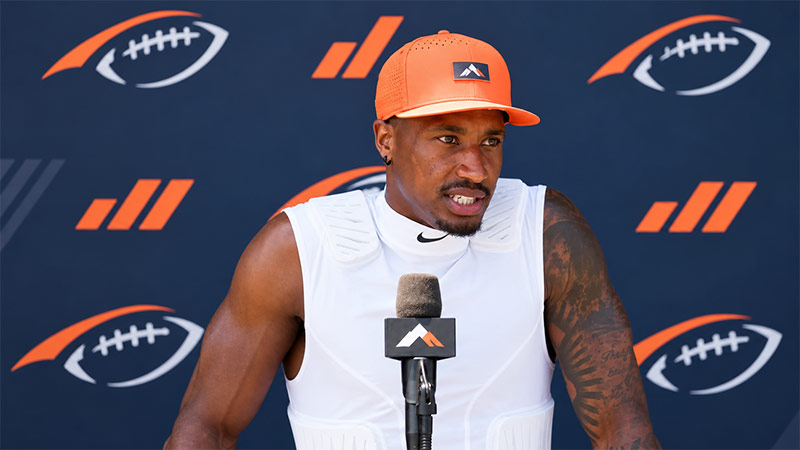
Yes, Courtland Sutton has publicly expressed Christian beliefs and discussed the importance of faith in his life.
In a 2018 Sports Spectrum interview, he talked about growing in his faith in Christ and reading Tony Dungy’s Uncommon Life devotional. His comments provide a clear basis for describing Christianity as part of his publicly expressed identity.
For fans who know Sutton primarily through football, that personal background offers another way to understand him. Questions about an athlete’s religion often go beyond identifying a belief system.
Readers want to know what the player has actually said, how those beliefs relate to everyday choices, and whether the information circulating online is accurate.
With Sutton, there are direct interviews to examine. Those conversations offer meaningful insight while leaving some personal details, including a specific church affiliation, unestablished.
What Religion Does Courtland Sutton Follow?
Sutton’s public discussions point to Christianity. His interview about faith in Christ is more specific than a general reference to spirituality or a passing expression of gratitude. It places his religious comments within a recognizable Christian framework.
That distinction matters when discussing someone’s beliefs. An athlete thanking God does not automatically establish a particular religion. People from many traditions use similar language. More detailed personal statements help readers understand what the individual means.
It is also useful to separate religious identity from religious practice. Knowing that a person has expressed Christian faith does not tell us everything about their worship habits, theological views, or involvement with a congregation.
The most accurate description stays close to what Sutton has chosen to discuss publicly. His comments support an article about Christian faith without requiring guesses about the parts of his religious life he has kept personal.
Courtland Sutton Said About God
One widely reported example came after Denver’s victory over the Minnesota Vikings on November 19, 2023. During an on-field NBC interview, Sutton said, “We serve an amazing God.” He connected the opportunity to play with gratitude for the abilities he believed God had given him.
The context helps explain why fans noticed the statement. Postgame interviews give players a brief opportunity to describe an emotional moment. Their answers can reveal what they are thinking about beyond the result itself.
Still, a short television appearance has limits. It is a public expression of belief, rather than a complete account of someone’s spiritual life. Readers should understand the statement in its setting without expanding it into claims the player never made.
For anyone researching Sutton’s religion, the value of this example is straightforward: it records his own words at a clearly identified moment in his career.
The Bible Verses Sutton Has Discussed
In a January 2018 Forbes interview, Sutton discussed writing 1 Corinthians 15:10 and Psalm 27:1 on his athletic tape before practices and games. He explained the first passage through humility and God working through him, while describing the second in terms of confidence and trust in God.
These references give readers something more substantial than speculation based on a photograph, celebration, or accessory. The interview included an explanation of their personal meaning.
They also illustrate why context matters when interpreting a visible religious reference. Two athletes might wear the same verse while emphasizing different ideas. One might focus on perseverance; another might connect it with gratitude, courage, or responsibility.
Sutton’s own explanation is therefore more useful than assigning a meaning from the outside.
Understanding the Connection Between Faith and Preparation
A personal reminder used before competition can help an athlete focus on priorities. That reminder might involve family, a coach’s advice, a meaningful phrase, or a religious passage.
The broader point is that preparation has a mental dimension alongside its physical demands. Players must manage expectations, attention, pressure, and uncertainty before they compete.
This does not mean a particular routine guarantees a better performance. It means that understanding an athlete’s chosen reminders can help explain how they approach the experience of competing.
Sutton Discussed Christian Devotional
Yes. Sports Spectrum published a July 2018 video interview in which Sutton discussed Tony Dungy’s Uncommon Life devotional and its role in helping him grow in his faith in Christ. The feature also addressed the biblical references he used on his wristbands.
Devotional reading generally combines a short religious passage with reflection or practical application. For readers unfamiliar with the term, it is a way of engaging with faith regularly, often through brief daily readings.
This kind of interview adds useful depth to a public profile. It moves the discussion beyond what someone says during a televised celebration and toward an activity they have described as personally meaningful.
However, the date remains relevant. A documented reading habit from 2018 should be presented as something Sutton discussed then. It should not automatically become a claim about his exact routine today.
What Does “Carry Your Cross Every Day” Mean in This Context?
In another 2018 discussion reported by Sports Spectrum, Sutton spoke about carrying his cross daily. His explanation emphasized that having a positive effect on even one person could matter; reaching an enormous audience was not necessary.
Within Christianity, carrying one’s cross generally refers to the ongoing commitment and sacrifice involved in following Jesus. It is a phrase about how belief is lived, rather than simply announced.
For a professional athlete, that raises an interesting question about public influence. A player may have a large audience, but many meaningful interactions still happen privately and individually.
The practical lesson readers can consider is modest: visibility and influence are different things. A thoughtful conversation, an act of patience, or a helpful decision can matter without becoming a public event.
That is an interpretation of the idea, not a claim that outsiders can measure every aspect of Sutton’s personal conduct.
Is Courtland Sutton Catholic or Protestant?
The interviews reviewed for this article do not establish a specific denomination. There is therefore no adequate basis here to label Sutton Catholic, Baptist, Methodist, or a member of another particular tradition.
Christianity includes many denominations, and references to God, Jesus, or the Bible do not identify one by themselves.
Nor should a denomination be assigned from a player’s hometown, university, teammates, or family background. Those details can invite assumptions that go beyond what the individual has actually disclosed.
The useful answer is precise: Sutton has publicly discussed Christian faith, while his specific denominational affiliation is not established by the material reviewed here.
Why His Own Words Matter Most
Religion is personal, and a public figure’s visibility does not make every detail of their beliefs public knowledge.
A careful discussion should distinguish among three things:
- What the player has directly said.
- What others have said about the player.
- What remains unknown.
This approach is especially helpful when older interviews circulate beside new posts. A genuine statement can still be misleading if it is presented with the wrong date or stripped of context.
It also prevents ordinary expressions of gratitude from being turned into elaborate claims about someone’s theology.
Fans do not need a complete account of Sutton’s private life to answer the central question. They need accurately attributed comments and a clear understanding of what those comments establish.
What Fans Can Take Away
Courtland Sutton has given fans a public basis for understanding faith as part of his personal identity. The strongest discussion stays anchored in his interviews, respects their dates, and leaves undisclosed details open.
That approach produces a fuller picture of the person without turning belief into speculation or a measure of athletic worth.
For readers who want to explore further, watching his complete interviews is the best next step. Hearing the questions, explanations, and surrounding conversation offers a better understanding than relying on a short quotation alone.