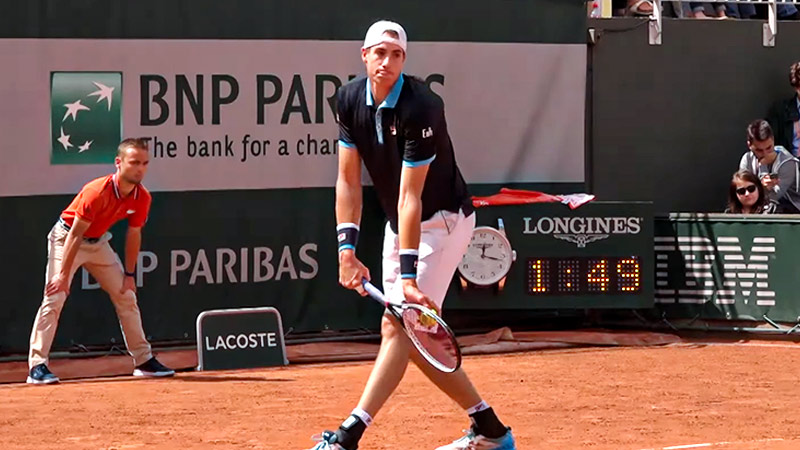
John Isner is most famous for winning the longest professional tennis match in history at the 2010 Wimbledon Championships, which lasted over 11 hours.
Standing 6-foot-10, he is also renowned as the all-time “Ace King,” holding the record for the most career aces at 14,470 and the fastest official serve at 157.3 mph.
Beyond these records, Isner was the leading figure in American men’s tennis for a decade, reaching a career-high of World No. 8 and winning 16 titles before his 2023 retirement. His endurance and serving dominance fundamentally changed the sport’s rules.
What Is John Isner Famous for Regarding the 2010 Wimbledon Marathon?
The 2010 Wimbledon Championships witnessed a feat of human endurance that remains unmatched in the annals of professional sports.
When John Isner faced Nicolas Mahut in the first round, no one anticipated a three-day odyssey that would push the limits of physical and mental capacity.
This match became the defining moment of Isner’s career, cementing his reputation as a “Marathon Man”.
The Three-Day Battle Against Nicolas Mahut
The historic encounter began on June 22 and did not conclude until June 24 due to repeated suspensions for fading light.
Over the course of 11 hours and 5 minutes of active play, the two athletes engaged in a grueling baseline and service duel that captivated the global sporting community.
The sheer duration meant that the match had to be resumed on three separate days, creating a spectacle that transcends traditional tennis reporting.
It remains the longest match ever played, a record that is unlikely to be challenged given subsequent changes to tournament regulations.
Breaking the Scoreboard: The 70–68 Final Set
The most staggering aspect of this marathon was the final set scoreline. Isner eventually triumphed with a fifth-set score of 70–68.
To put this in perspective, the final set alone lasted 8 hours and 11 minutes—a duration longer than any other full match in the history of the sport.
The final scoreboard read 6–4, 3–6, 6–7(7), 7–6(3), 70–68. This statistical anomaly highlighted Isner’s incredible focus and his ability to maintain a high-functioning service game even while under extreme physical duress.
Long-Term Physical and Psychological Impact
Winning a match of this magnitude was a double-edged sword. While it brought Isner immediate global fame, the physical toll was immense. He had to return to the court shortly after this victory, clearly depleted.
However, the psychological fortitude required to keep holding serve for 138 games in a single set proved to the world that Isner possessed a championship mindset.
This match established a standard of resilience that would define his professional trajectory for the next thirteen years.
Why Is John Isner Considered the Greatest Server in Tennis History?
John Isner’s serving statistics are often cited as the gold standard for efficiency and power in the modern era. His height, combined with a technically flawless motion, allowed him to turn his service games into nearly impenetrable fortresses.
Throughout his career, he consistently maintained a service hold percentage that hovered above 90%, often leading the ATP Tour in this category for entire seasons.
The Mechanics of a 6-Foot-10 Frame
Standing at 6 feet 10 inches (2.08 meters), Isner utilized his towering height to create service angles that were virtually impossible for opponents to read.
The steep downward trajectory of his delivery meant the ball would often bounce above a receiver’s shoulder, forcing them into defensive positions immediately.
This mechanical advantage was not just about raw power; it was about the precision and variety of his placement, allowing him to dominate on all surfaces, though his game was particularly lethal on fast hard courts and grass.
Decoding the 157.3 mph World Record
In the realm of raw velocity, Isner holds the official record for the fastest serve ever tracked by the ATP. During a 2016 Davis Cup match, he struck a serve clocked at 157.3 mph (253 km/h). This milestone serves as a testament to his explosive power.
Unlike many other big servers who might hit one fast delivery and lose accuracy, Isner could sustain high speeds throughout five-set matches, making him a nightmare for even the best returners in the game.
The Statistical Dominance of 14,470 Career Aces
Isner retired as the all-time “Ace King,” a title backed by a staggering 14,470 career aces. This record is a reflection of his longevity and consistency.
Averaging double-digit aces in nearly every match he played, he was able to use his serve to escape dangerous situations on his own service games.
This ability to produce “free points” allowed him to stay competitive deep into his thirties, as he could rely on his primary weapon to shorten points and conserve energy during long tournaments.
How Successful Was John Isner’s Professional ATP Career?
While the Wimbledon marathon and his serving records often dominate the conversation, Isner was far more than a statistical anomaly. He was a highly decorated professional who maintained a consistent presence in the upper echelons of the sport.
For over a decade, he was the primary representative of American men’s tennis on the global stage.
| Achievement Category | Career Statistic/Detail |
|---|---|
| Career-High Ranking | World No. 8 (July 2018) |
| ATP Singles Titles | 16 |
| Most Successful Event | Atlanta Open (6 Titles) |
| Biggest Career Title | 2018 Miami Open (Masters 1000) |
| Grand Slam Best | Semifinals at Wimbledon 2018 |
| USA Year-End Top Rank | 8 times between 2012 and 2020 |
Reaching the Elite Top 10 World Ranking
In July 2018, Isner reached a career-high ranking of World No. 8. This peak coincided with the best form of his life, following a spectacular win in Miami and a deep run at Wimbledon.
Maintaining a top-10 ranking in an era dominated by legendary figures is a significant achievement that speaks to his tactical evolution beyond just being a “big server.”
He learned to use his forehand as a secondary weapon to dictate play after his serve opened up the court.
Mastering Hard Courts: Miami and Atlanta
Isner’s most significant title came at the 2018 Miami Open, a prestigious Masters 1000 event. By defeating top-tier opponents to claim the trophy, he proved he could win the biggest events outside of the Grand Slams.
Additionally, he shared a special connection with the Atlanta Open, where he won a record six titles. His dominance in North American hard-court tournaments made him a perennial favorite during the summer swing leading up to the US Open.
How Did John Isner’s Matches Change the Rules of Tennis?
The impact of John Isner’s career extends beyond the trophy cabinet and into the rulebooks of the sport’s governing bodies. His propensity for extended matches eventually led to a fundamental shift in how professional tennis is played at the highest levels.
The End of the “Advantage” Fifth Set
For decades, most Grand Slam tournaments required players to win the fifth set by a margin of two games, with no tiebreak.
Isner’s 70–68 victory in 2010 was the first major signal that this format was potentially unsustainable for player health and television scheduling.
However, it was his 2018 Wimbledon semifinal match against Kevin Anderson—which ended in a 26–24 final set loss for Isner—that finally acted as the catalyst for change.
Both players were so exhausted that the quality of the final was affected, prompting a re-evaluation of the rules.
Standardizing Tiebreaks Across Grand Slams
Directly following the 2018 marathon, major tournaments began to introduce final-set tiebreaks. Today, all four Grand Slams utilize a 10-point tiebreak when the score reaches 6–6 in the deciding set.
This “Isner Rule” ensures that matches can conclude within a reasonable timeframe, protecting the physical well-being of the athletes and ensuring a more predictable schedule for fans and broadcasters. Isner’s career effectively ended the era of the “ultra-marathon” match.
What Was John Isner’s Impact on College Tennis?
Before his rise on the ATP Tour, Isner was already a legend within the American collegiate system.
His path to the pros was somewhat unconventional compared to many international stars who skip college, but it provided him with the competitive foundation needed for a long career.
Leading the Georgia Bulldogs to Victory
Isner played four years for the University of Georgia, where he became one of the most decorated players in the program’s history. His crowning achievement in college was leading the Bulldogs to an undefeated NCAA Team Championship in 2007.
This team success was mirrored by his individual brilliance, as he finished his collegiate career as a multi-time All-American.
Building a Professional Foundation in Athens
During his time in Athens, Georgia, Isner developed the mental toughness and physical conditioning that would serve him well on the professional tour.
He finished as a leader in both singles and doubles wins, demonstrating a versatile game that often surprised opponents who only expected a big serve.
His success served as a blueprint for other American players, proving that the college system could still produce world-class professional talent.
Frequently Asked Questions About John Isner
When did John Isner retire from professional tennis?
John Isner officially retired after the 2023 US Open, ending a career that spanned over 15 years.
How many career aces did John Isner hit?
He holds the all-time ATP record with 14,470 career aces.
What was Isner’s fastest serve ever recorded?
His fastest official serve was 157.3 mph (253 km/h), recorded during a 2016 Davis Cup match.
Did John Isner ever win a Grand Slam?
While he never won a Grand Slam title, his best result was reaching the semifinals of Wimbledon in 2018.
Which Masters 1000 tournament did John Isner win?
Isner won the Miami Open in 2018, which remains the most significant title of his professional career.
Conclusion: The Final Bow and Lasting Legacy
John Isner’s departure from the sport in 2023 marked the end of an era for American tennis. He was a player who maximized every inch of his 6-foot-10 frame to rewrite the record books and force the sport to evolve.
Whether he is remembered for the 11-hour miracle at Wimbledon, his 14,470 aces, or his role as the steady leader of American tennis, his impact is undeniable.
Isner proved that with one great weapon and an unbreakable spirit, a player could not only compete with the best in the world but change the game forever.