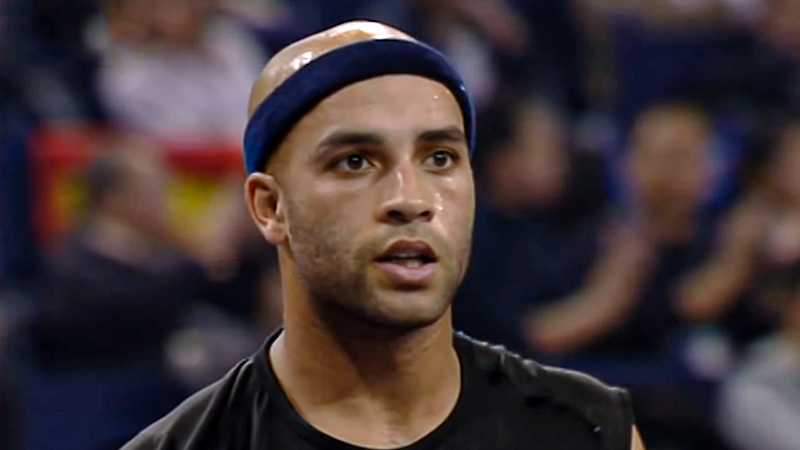
James Blake is famous in tennis for achieving a career-high world No. 4 ranking, possessing a legendary flat forehand, and overcoming unprecedented personal adversity to become a symbol of resilience.
An elite American competitor during the era of Federer and Nadal, Blake captured 10 ATP titles and led the United States to a 2007 Davis Cup victory.
He is equally renowned for his “showtime” playing style and his 2004 comeback from a broken neck and shingles. Today, his influence continues as the Tournament Director of the Miami Open and a leading voice in sports broadcasting.
Why is James Blake Famous for His Professional Achievements?
To understand the impact of James Blake, one must look at the sheer weight of his accomplishments during one of the most competitive eras in the history of the sport.
His rise to the elite levels of the ATP Tour was marked by a series of deep tournament runs and historic victories that solidified his place as the top-ranked American man in 2006.
Reaching the Elite World No. 4 Ranking
The pinnacle of Blake’s career came on November 20, 2006, when he officially became the No. 4 player in the world. This was not merely a statistical milestone; it represented his arrival as a legitimate threat to the “Big Three.”
During this season, he reached the final of the prestigious Year-End Championships (now the ATP Finals), where he defeated high-caliber opponents like Rafael Nadal and David Nalbandian before eventually falling to Roger Federer.
His consistency across various surfaces allowed him to maintain a position among the global elite for several years, finishing his career with a solid 366–256 match record.
The 2007 Davis Cup Triumph
While individual success is the standard in tennis, James Blake is celebrated for his patriotism and team contributions. He was a foundational pillar of the 2007 United States Davis Cup team.
In the championship tie against Russia, Blake delivered a masterclass performance, winning both of his singles matches to ensure the American victory.
This win ended a long drought for the U.S. team and highlighted Blake’s ability to perform under the most intense pressure imaginable on the international stage.
Historic Victory Over Roger Federer at the Olympics
In terms of singular match results, few moments in Blake’s career rival his performance at the 2008 Beijing Olympics. Representing the USA, Blake reached the semifinals, but it was his quarterfinal victory that shocked the world.
He secured a stunning straight-sets win over world No. 1 Roger Federer, marking one of the most famous upsets of that era.
This victory remains a point of pride for American tennis fans and is a primary reason why Blake is remembered as a giant-killer on the court.
How James Blake Overcame a Broken Neck and Personal Loss
The legend of James Blake is inextricably linked to his perseverance. While his trophies are impressive, the “James Blake comeback” is perhaps the most documented and inspirational narrative in modern athletics, stemming from a 2004 season that would have ended most professional careers.
The 2004 Triple Threat: Neck, Father, and Shingles
The year 2004 began with a freak accident in Rome where Blake collided with a net post during a practice session, resulting in a fractured vertebra in his neck.
While immobilised and recovering from this life-altering injury, he faced a devastating personal blow: the death of his father, Thomas Blake Sr., to stomach cancer.
Shortly thereafter, the physical stress triggered a severe bout of shingles that caused facial paralysis and blurred vision.
These three crises occurring in rapid succession saw his ranking plummet outside the top 200, leaving many to wonder if he would ever walk onto a court again.
The Return and “Breaking Back” Legacy
Defying all medical expectations, Blake returned to the tour in 2005 with a renewed sense of purpose. His surge from the bottom of the rankings back into the top 10 earned him the ATP Comeback Player of the Year award.
This grueling journey was later immortalised in his New York Times bestselling autobiography, Breaking Back, which served to extend his fame beyond sports circles and into the realm of general human-interest literature.
His ability to “break back” against life’s hardest serves is a core component of why he remains a household name.
The Explosive Playing Style That Defined an Era
James Blake was never a passive player; he was a “showtime” athlete who relied on a high-octane offensive strategy that kept fans on the edge of their seats. This aggressive philosophy was both a tactical choice and a reflection of his personality on the court.
The Power of the Flat Forehand
The signature weapon in the Blake arsenal was his explosive, flat forehand. Unlike many modern players who rely on heavy topspin, Blake hit the ball with incredible velocity and a low trajectory, often stepping inside the baseline to take the ball early.
This high-risk style allowed him to blister winners from any position on the court, making him one of the most dangerous baseline players of the 2000s.
Even today, tennis analysts often reference the “Blake forehand” when discussing offensive power and baseline aggression.
Cultural Impact and the “J-Block”
James Blake’s fame was amplified by the unique atmosphere he created, particularly at his home Grand Slam, the US Open. A loyal group of childhood friends and supporters formed what became known as the “J-Block”.
This synchronized, rowdy cheering section transformed Arthur Ashe Stadium into an electric environment reminiscent of a college basketball game.
The J-Block not only supported Blake but changed the cultural fabric of American tennis, bringing a more accessible, high-energy feel to the traditionally reserved sport.
Transitioning to the Miami Open and ESPN Commentary
Even after his retirement at the 2013 US Open, Blake has remained a central figure in the tennis ecosystem. His career “second act” has seen him transition from the baseline to the boardroom, ensuring his continued relevance in the 21st-century sporting landscape.
Leading as Tournament Director of the Miami Open
One of the most significant reasons James Blake is currently famous is his role as the Tournament Director for the Miami Open. This is one of the most prestigious events on the ATP and WTA calendars, often referred to as the “Fifth Grand Slam.”
In this capacity, Blake has become one of the few Black directors at the highest level of professional tennis, providing critical leadership and a player-centric perspective to one of the world’s largest sporting events.
Voice of the Sport: ESPN and Analytical Depth
Beyond tournament management, Blake is a staple of sports media. He regularly serves as an on-air analyst and commentator for ESPN, where his deep technical knowledge and firsthand experience against the “Big Three” provide viewers with unparalleled insights.
His ability to articulate the complexities of modern tennis has made him a trusted voice for millions of fans who tune in to major championships annually.
James Blake Career Statistics and Key Milestones
To fully appreciate the breadth of his career, a review of the data reveals a player who was consistently competitive across a decade of professional play. From prize money to title counts, the numbers support his status as an American icon.
| Career Metric | Statistic Details |
|---|---|
| Career-High Ranking | World No. 4 (November 2006) |
| Total ATP Singles Titles | 10 Titles (24 Finals reached) |
| Singles Match Record | 366–256 (58.8% win rate) |
| Total Career Prize Money | $7,981,882 |
| Davis Cup Status | 2007 Champion (Undefeated in Final) |
| Collegiate Achievement | No. 1 Ranked Player at Harvard University |
Frequently Asked Questions About James Blake
Why did James Blake have to wear a back brace?
As a teenager, Blake was diagnosed with severe scoliosis. To manage the curvature of his spine, he was required to wear a full-length back brace for 18 hours a day, a physical challenge that early on instilled the discipline and resilience that would later define his professional career.
Did James Blake ever win a Grand Slam?
While Blake never won a Grand Slam singles title, he reached the quarterfinals on three separate occasions: twice at the US Open (2005, 2006) and once at the Australian Open (2008).
His 2005 quarterfinal against Andre Agassi is frequently cited as one of the most thrilling night matches in the history of the US Open.
When did James Blake retire from professional tennis?
James Blake officially retired in 2013. His final professional match took place at the 2013 US Open, the tournament where he had enjoyed his most significant fan support and legendary “J-Block” atmospheres.
Conclusion: The Enduring Legacy of an American Great
The story of James Blake is more than just a collection of match scores or a high ranking. He is famous in tennis because he represents the possibility of a second chance.
From his “showtime” offensive style and the thunderous flat forehand that intimidated opponents to his leadership as the Miami Open Director, Blake has navigated the complexities of professional sports with grace.
His 2004 journey through injury, illness, and grief remains a blueprint for any individual facing insurmountable odds. James Blake didn’t just play tennis; he showcased the power of the human spirit to “break back” and reclaim a place at the top of the world.