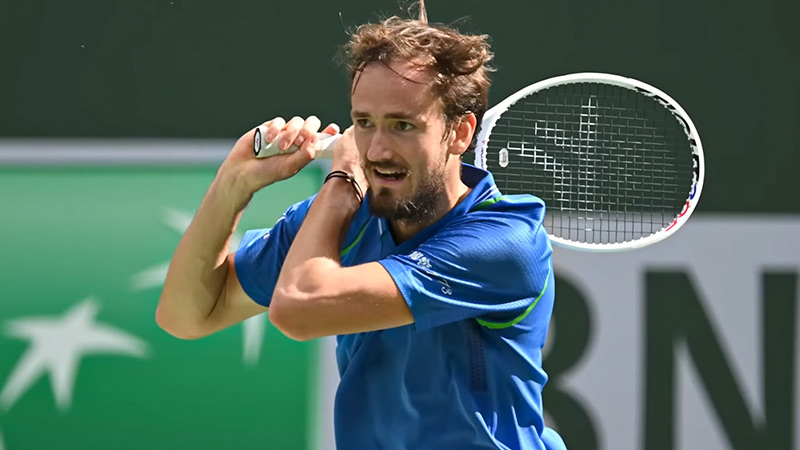
In the world of elite professional tennis, few environments are as atmospheric or as unpredictable as the Internazionali BNL d’Italia. The clay courts of Rome are historic stages where momentum is the most valuable currency a player can possess.
However, during the high-stakes semifinal clash between world-class competitors Daniil Medvedev and Jannik Sinner, that momentum was abruptly halted by the one variable no athlete can control: the Mediterranean climate.
When play was officially suspended, the match had reached a critical inflection point in the deciding third set, with Sinner holding a 4-2 lead.
To understand the gravity of this stoppage, one must look beyond the simple fact of the rain and examine the technical safety requirements of clay-court tennis, the physical condition of the players, and the psychological “reset” that an overnight delay imposes on a semifinal of this magnitude.
The Catalyst: Why the Rain Stopped Play
The primary driver for the suspension was heavy rain pouring down in Rome, which created conditions that were no longer tenable for professional competition.
While tennis fans are accustomed to brief delays, the intensity of this storm forced officials to halt play for the night, with the resumption scheduled for the following day.
The Danger of Slippery Court Lines
From a technical standpoint, the decision to suspend a match on clay is often more complex than on a hard court.
While clay can absorb a certain amount of moisture, the lines themselves—often made of a different material—become incredibly hazardous when wet.
Chair umpire Aurélie Tourte made the final call to stop play specifically due to the worsening weather and slippery court lines, which posed an immediate risk of injury to both athletes.
For a player like Medvedev, whose game relies on lateral movement and deep court coverage, or Sinner, who generates immense power through his footwork, a slippery line can lead to ligament tears or high-ankle sprains. In this context, the suspension was not just a matter of convenience but a fundamental requirement for player safety.
The Physical Context: Sinner’s Race Against Exhaustion
One of the most significant “hidden” factors in this suspension was the physical state of the Italian favorite, Jannik Sinner.
Despite leading 4-2 in the third set, Sinner was reportedly dealing with visible exhaustion and physical discomfort just before the clouds opened.
In professional sports, timing is everything. Had the match continued, Sinner’s physical decline might have allowed Medvedev to claw back into the set.
The rain, in many ways, acted as a reprieve for the leader. It transformed a test of immediate endurance into a test of recovery and medical intervention.
The Medical and Nutritional Window
An overnight suspension allows a player in Sinner’s position to access high-level physiotherapy, controlled rehydration, and optimized sleep—luxuries that are not available during a standard changeover.
For Medvedev, the challenge became purely psychological: how to maintain the competitive fire while knowing his opponent was getting a chance to physically “reset.”
The Medvedev Factor: A Career Defined by Interruption
Daniil Medvedev is a player who has historically navigated the eccentricities of the ATP tour with a mix of frustration and brilliance. While this Roman suspension was driven by weather, it adds another chapter to a career that has seen various forms of outside interference.
Medvedev has experienced brief match stoppages in the past due to bizarre incidents, including photographers disrupting the field of vision or even animals wandering onto the court. However, major multi-hour or overnight delays like the one in Rome are typically reserved for severe weather conditions.
The ability to handle these disruptions is a hallmark of a veteran champion. Medvedev’s experience with “weird” tennis moments may have given him a mental edge in staying composed, even as his opponent gained a physical advantage from the break in play.
The Psychological Mechanics of the “Overnight Reset”
In a third-set decider, the match is often a “mental sprint.” When that sprint is interrupted and turned into a two-day event, the psychological landscape shifts entirely.
- The Leader’s Burden: Sinner had to go to sleep knowing he was only two games away from a prestigious final in his home country. That level of anticipation can lead to “overthinking” and tension upon resumption.
- The Chaser’s Opportunity: Medvedev had the entire evening to analyze the tactical errors that led to the 4-2 deficit. For a strategic mind like Medvedev’s, this extra time is a gift, allowing for a complete recalibration of his return game and court positioning.
Strategic Implications for the ATP Tour
The suspension in Rome also highlights the ongoing debate regarding tournament infrastructure at the Masters 1000 level.
While many major venues are installing retractable roofs to ensure broadcast consistency, the historic nature of the Foro Italico presents unique architectural challenges.
The decision by Aurélie Tourte and the tournament directors reflects the ATP’s commitment to “Safety First,” even at the cost of the evening’s schedule.
For global sponsors and stakeholders, these delays are a reminder of the volatility inherent in outdoor sports, emphasizing the need for flexible programming and robust digital engagement strategies to keep audiences informed during “dead air.”
The Path Forward: Resilience in Rome
The suspension of the Medvedev-Sinner semifinal will be remembered as a moment where the momentum of a generational rivalry was frozen in time by a Roman storm. For the fans, it was a test of patience; for the players, it was a test of professional adaptability.
In the high-stakes environment of these moments of “forced pause,” is where legends are truly tested. It is not just about how you play the points, but how you handle the hours of waiting between them.