The trajectory of a first-overall draft pick is rarely a straight line, particularly when a franchise attempts to redefine that player’s defensive identity from the moment they are selected.
When the Detroit Tigers called Spencer Torkelson’s name with the top pick in the 2020 MLB Draft, the move was expected, but the positional designation was not.
Despite a record-breaking collegiate career at Arizona State where he functioned as a powerhouse at first base, the Tigers officially announced him as a third baseman.
This decision ignited a multi-year conversation regarding defensive versatility, prospect development, and the specific physical demands of the “hot corner.”
Understanding why this experiment happened, how it was executed in the minor leagues, and why it ultimately resulted in a permanent return to first base provides a masterclass in professional player management.
The 2020 Draft: A Strategic Pivot in Detroit
The 2020 MLB Draft was a unique event, occurring amidst global shifts that altered the scouting landscape. For the Detroit Tigers, Spencer Torkelson represented more than just a power bat; he was the cornerstone of a rebuilding era.
However, the organization’s immediate announcement of Torkelson as a third baseman was a calculated risk aimed at maximizing his value.
In professional evaluation, the defensive “floor” of a player significantly impacts their overall utility. A player capable of manning third base while providing elite offensive production is statistically more valuable than a traditional first baseman.
By testing Torkelson at third base, the Tigers’ scouts sought to determine if his athleticism and lateral agility were sufficient to handle a more demanding defensive role than he had occupied in college.
The Athleticism Argument: Why the Experiment Started
The core reasoning behind the “Third Base Experiment” centered on the belief that Torkelson possessed untapped defensive potential.
While he played exclusively at first base during his time at Arizona State, scouts noted a level of athleticism that suggested he might be able to transition across the diamond.
Key Objectives of the Positional Shift:
- Testing Roster Versatility: Determining if Torkelson could provide the Tigers with a high-impact bat at a premium defensive position.
- Athleticism Validation: Assessing his footwork, arm strength, and reaction times in a professional setting.
- Maximizing Draft Value: Transitioning a first baseman to third base increases the team’s flexibility in future free agency and trade markets.
The Technical Demands: Third Base vs. First Base
Transitioning from first base to third base is a significant undertaking for any athlete, regardless of their proficiency at the plate. The two positions require different physiological and cognitive responses.
| Requirement | Third Base (The Hot Corner) | First Base (The Anchor) |
|---|---|---|
| Reaction Time | Extremely high; requires split-second reflexes for line drives. | High; focused on ground balls and pick-off attempts. |
| Arm Strength | Requires a strong, accurate arm for the long throw to first. | Moderate; primarily short-distance throws to second or home. |
| Lateral Agility | Vital for covering the hole and charging bunts. | Important for range, but secondary to footwork around the bag. |
| Primary Duty | Stopping extra-base hits down the line. | Receiving throws from other infielders and recording outs. |
Torkelson’s history at Arizona State provided a solid foundation for the fundamental mechanics of the game, but the move to third base required a complete recalibration of his defensive internal clock.
Minor League Implementation: Taking the Reps
The minor league system serves as the laboratory for professional baseball. It was here that Torkelson began taking defensive reps at third base to see if the theoretical athleticism noted by scouts would translate into functional defensive skill.
During his early development, Torkelson was given consistent opportunities to adapt to the speed of the game at the hot corner.
These reps were not merely ceremonial; they were essential data points for the Tigers’ evaluators to determine if the transition was viable for a Major League environment.
Observations during the Minor League Reps:
- Lateral Range: Evaluators closely monitored his ability to move toward the line and toward the shortstop hole.
- Arm Accuracy: Third base requires a different throwing angle and velocity compared to the shorter, often flipped throws required at first base.
- Footwork: The “prep step” and positioning for a third baseman are distinct, requiring a player to be ready for high-velocity contact immediately.
Despite the effort invested in this transition, the professional game’s speed often reveals the “natural fit” of a player more quickly than practice sessions can.
The Pivot: Returning to First Base
As Torkelson progressed through the Tigers’ developmental system, a consensus began to form among coaches and evaluators. While his athleticism was evident, the long-term health of the roster and Torkelson’s own defensive comfort pointed back to his original position.
The decision to move him back to first base full-time was a strategic acknowledgment that a player’s primary value should not be compromised by defensive over-extension. Evaluators determined that his natural fit and long-term future were best served by anchoring first base.
This transition back to first base allowed Torkelson to focus more heavily on his offensive output, which is the primary driver of his value as a professional athlete.
By removing the mental and physical strain of learning a new, high-intensity defensive position, the Tigers enabled him to settle into the role he had mastered during his collegiate career.
The Major League Reality: Current Role and Status
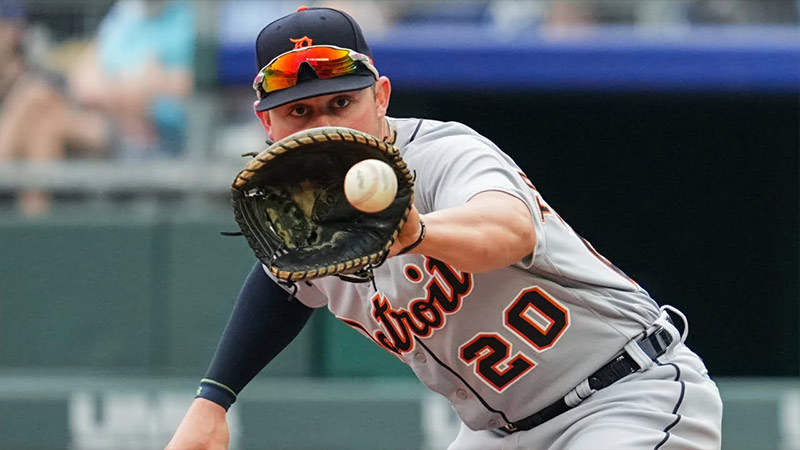
Today, the answer to whether Spencer Torkelson can play third base is definitive: he does not play third base in Major League Baseball. He has established himself as the primary first baseman for the Detroit Tigers, serving as a defensive anchor for the team’s infield.
His current role reflects the culmination of the “Third Base Experiment”—a process that, while it did not result in a permanent position change, provided the organization with the clarity needed to commit to him as their long-term first baseman.
Current Defensive Profile for Spencer Torkelson:
- Primary Position: First Base.
- MLB Experience: Exclusive to first base.
- Defensive Identity: Focused on receiving throws, managing the bag, and providing power from the corner.
Why the Experiment Matters for Future Prospects
The Torkelson journey is a case study in modern player development. It highlights a growing trend in professional sports where organizations refuse to pigeonhole athletes based on their amateur history.
By challenging Torkelson to play third base, the Tigers demonstrated a commitment to exploring every avenue of his potential.
- The “Floor” vs. “Ceiling” Analysis: Teams often try to find the highest defensive ceiling for a player early in their career. If a player fails at a more difficult position, they can always “slide down” the defensive spectrum (e.g., from SS to 3B, or 3B to 1B).
- Risk Management: For a number-one overall pick, the risk of a defensive transition is balanced against the potential reward of creating a more versatile roster.
- Clarity through Failure: In this context, the “failure” to stay at third base was actually a success because it provided the organization with absolute certainty regarding Torkelson’s best fit.
The Analytical Perspective: Impact on the Detroit Tigers Roster
From a roster construction standpoint, Torkelson’s permanence at first base simplifies the Tigers’ long-term planning.
It allows the front office to target specific profiles for the third base position, rather than hoping for a converted first baseman to fill the gap.
Strategic Benefits of Positional Clarity:
- Defensive Stability: The infielders know exactly what to expect from Torkelson at first base, which improves overall team defense.
- Focus on Offense: Torkelson can dedicate his pre-game routine to hitting and first-base-specific drills, rather than splitting time between two vastly different roles.
- Prospect Planning: The Tigers can develop other third-base prospects without the ambiguity of where their star first-overall pick will play.
Evolution of a Cornerstone Athlete
Spencer Torkelson’s professional journey began with a surprise announcement that challenged the status quo of his baseball identity.
By moving him from first base to third base and eventually back again, the Detroit Tigers conducted a thorough evaluation of his athletic limits.
While he did not become the third baseman many initially expected on draft day, the process solidified his role as a professional first baseman.
He has embraced this role, moving beyond the “experiment” phase to become a reliable presence in the Major Leagues.
Summary of the Positional Journey
The following timeline highlights the key phases of Torkelson’s defensive career:
- Collegiate Career (Arizona State): Played exclusively at first base, establishing himself as an elite offensive talent.
- 2020 MLB Draft: Selected #1 overall and surprisingly announced as a third baseman by the Detroit Tigers.
- Early Professional Development: Took defensive reps at third base in the minor leagues to test versatility and athleticism.
- The Professional Verdict: Coaches and evaluators determined his natural fit was first base.
- Major League Status: Currently the primary first baseman for the Tigers, with no third-base duties in MLB.
The Significance of Natural Fit
In the high-stakes environment of professional baseball, “natural fit” is a term used by coaches to describe where a player’s instincts and physical tools align most effectively.
For Torkelson, first base was always that home. The decision to return him there was not a sign of defeat, but a move toward optimization.
By allowing Torkelson to play where he is most comfortable, the Tigers have maximized his potential to contribute to the team’s success.
The experiment served its purpose: it answered the “What If?” that surrounds every elite prospect, ensuring that when Torkelson steps onto the field, he is exactly where he belongs.
The story of Spencer Torkelson and the third-base experiment remains a vital chapter in his career. It serves as a reminder that even the most talented athletes undergo a process of refinement and that sometimes, the best path forward is the one that leads back to where you started.
Today, as the Tigers’ primary first baseman, Torkelson continues to build on the legacy that began at Arizona State, now with the added experience of a professional journey that tested his limits and confirmed his true defensive identity.