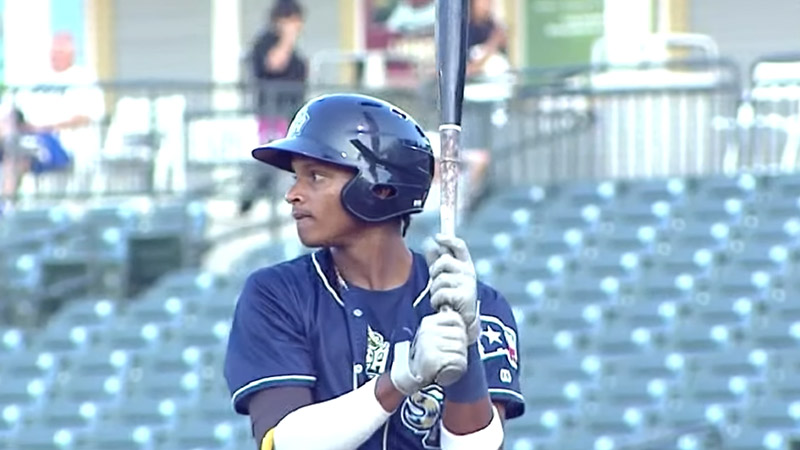
Before he was swiping bags at Nationals Park and anchoring the middle of Washington’s infield, CJ Abrams was one of the most talked-about young players in professional baseball. Scouts raved about his speed.
Rival front offices asked about him in trade talks. And when the biggest deadline deal of 2022 came together, his name sat right at the center of it.
So, was CJ Abrams a top prospect? The answer is a clear yes. The story of how he got there, and what he has done since, also says a lot about how elite talent actually develops at the major league level.
The Short Answer
Yes. CJ Abrams was a premium prospect from the moment the San Diego Padres drafted him sixth overall in 2019.
He spent his minor league years ranked among the best young players in the sport, debuted in the majors at 21, and was a centerpiece of the package Washington received for Juan Soto.
Since then, he has grown into a two-time National League All-Star and the Nationals’ everyday shortstop. In 2026, he put together a 33-homer, 34-steal season, the kind of year scouts imagined when they first saw him play.
The 2019 Draft: A Top-10 Pick Out of Georgia
Abrams entered the 2019 MLB Draft as one of the most athletic high school players in the country. A shortstop from Blessed Trinity Catholic High School in Roswell, Georgia, he had spent years on the showcase circuit flashing the kind of speed that changes games.
The Padres made him the No. 6 overall pick. That slot matters. Top-10 picks are reserved for players a club believes can become impact regulars. High school players taken that early are bets on ceiling: the belief that the player’s best version is a star, not just a solid contributor.
Abrams wasted no time backing up that bet. In his first taste of pro ball in the Arizona League, he hit over .400 across roughly 30 games, showed real extra-base pop, and was named the league’s MVP. For an 18-year-old fresh out of high school, it was about as loud an introduction as a prospect can make.
The Scouting Profile: Why Evaluators Loved Him
Speed was the headline. Scouts graded Abrams’ running ability as high as 75 to 80 on the 20–80 scouting scale, where 80 marks the very top of the sport.
That kind of speed creates value in three places at once: on the bases, in the field, and in the batter’s box, where it turns routine ground balls into infield hits.
But Abrams was never just a runner. His bat-to-ball skills stood out early, built on a smooth left-handed swing and quick hands that produced strong contact rates for his age.
His athleticism at shortstop gave him a path to stay at the most valuable defensive position on the field, with the range and footwork to cover ground in both directions.
His frame offered projection. Long and lean, he looked like a player who would add strength as he matured. Early on, the main question was whether his power would ever catch up to the rest of his game. As his big league numbers show, that concern did not age well.
Climbing the Farm System
Abrams’ path through the minors was short and bumpy, though not because of his performance.
The 2020 minor league season was canceled during the pandemic. Instead of a full year in A-ball, Abrams spent the summer at the Padres’ alternate training site, working alongside big leaguers and upper-level prospects. Earning that invitation at 19 was itself a sign of how much San Diego valued him.
In 2021, the Padres pushed him aggressively to Double-A San Antonio, a level where many college draftees begin their careers. He was just 20 and held his own, hitting close to .300 before a July collision at second base left him with a broken leg and a sprained knee ligament. His season was over.
Even so, his stock held firm. Evaluators had seen what they needed: a player who skipped levels, hit for average against older competition, and kept his elite speed profile intact through every stop.
Where He Ranked Among Baseball’s Best
At his peak as a prospect, Abrams sat among roughly the top 10 to 15 names on the major national top-100 lists. Inside San Diego’s system, which was stocked with young talent at the time, he was at or near the top of the organization’s rankings.
Four factors kept him there.
Draft pedigree: A No. 6 overall pick starts with the benefit of the doubt, and Abrams never gave evaluators a reason to take it away.
Production at every stop: From the Arizona League to Double-A, he hit. Prospects who perform at each level, rather than just flash tools, tend to hold their value.
A premium position: Shortstops who can hit are among the rarest assets in baseball. Teams can move a shortstop almost anywhere on the diamond, but they can rarely move a player the other way.
Age relative to level: Reaching Double-A at 20 and competing there put him well ahead of the typical development curve.
The trade market echoed the lists. His name surfaced in deadline rumors more than once, a reliable sign that front offices valued him as highly as the public rankings did.
Big League Debut and the Juan Soto Trade
Abrams made the Padres’ Opening Day roster in 2022 and debuted in early April at age 21. Like most young players who reach the majors that quickly, he battled inconsistency and split time between San Diego and Triple-A El Paso.
Then came August 2, 2022. The Padres, pushing for a championship, acquired Juan Soto and Josh Bell from the Nationals in one of the biggest deadline deals in baseball history.
Washington’s return was a haul of young talent: Abrams, left-hander MacKenzie Gore, outfielders Robert Hassell III and James Wood, right-hander Jarlin Susana, and veteran first baseman Luke Voit.
Abrams was a centerpiece of that package. He was the most big-league-ready of the young position players, and Washington handed him the shortstop job almost immediately.
The logic is simple. When a team trades a hitter of Soto’s caliber, it demands its partner’s best young talent in return. Abrams’ inclusion tells you exactly where the industry ranked him.
MLB Career by the Numbers (2022–2026)
Since graduating from prospect status, Abrams has climbed from a raw 21-year-old to one of the most productive shortstops in the National League. His slugging percentage rose from .324 in 2022 to .497 in 2026.
| Season | Team | Games | AVG | OBP | SLG | HR | RBI | SB |
|---|---|---|---|---|---|---|---|---|
| 2026 | Nationals | 152 | .261 | .336 | .497 | 33 | 106 | 34 |
| 2025 | Nationals | 144 | .257 | .315 | .433 | 19 | 60 | 31 |
| 2024 | Nationals | 138 | .246 | .314 | .433 | 20 | 65 | 31 |
| 2023 | Nationals | 151 | .245 | .300 | .412 | 18 | 64 | 47 |
| 2022 | Padres / Nationals | 90 | .247 | .281 | .324 | 2 | 21 | 7 |
2022: The adjustment year: A .281 on-base percentage and just two home runs reflected a young hitter learning on the fly. Being traded midseason added another layer of change.
2023: The speed breakout: Abrams stole 47 bases and hit 18 homers in 151 games. He established himself as an everyday shortstop and one of the most dangerous baserunners in the league.
2024: First All-Star nod: He reached 20 homers, pushed his slugging percentage to .433, and earned his first National League All-Star selection.
2025: Proof of consistency: A .257/.315/.433 line with 19 homers and 31 steals showed his 2024 gains were real, not a hot streak.
2026: The full arrival: Abrams set career highs with 33 homers, 106 RBI, a .336 OBP, and a .497 slugging percentage, while still stealing 34 bases. That 30-30 season brought his second All-Star selection and fulfilled the ceiling scouts projected back in 2019.
Did He Live Up to the Hype?
Measured against his original scouting report, Abrams has met nearly every expectation and beaten the biggest one.
The speed showed up right away: His 47-steal season in 2023 confirmed that the 75 to 80 grades were not exaggerations. He has stolen at least 31 bases in every full season since.
The on-base skills took time: His OBP climbed steadily, from .281 in 2022 to .336 in 2026. That 55-point jump is the clearest sign of a hitter who learned to control the strike zone instead of just putting the ball in play.
The power surprised almost everyone: Few evaluators projected a 30-homer shortstop when he was drafted. His home run totals moved from 2 to 18 to 20 to 19 and then 33. The lean frame filled out, and the projection scouts hoped for became reality.
The verdict is clear. Abrams was a top prospect who became a top player, a path far less common than the hype around any draft class suggests.
What Abrams’ Path Teaches Fans About Prospects
Abrams’ career offers a useful playbook for anyone trying to judge the next wave of young talent.
- Development is rarely a straight line: His 2022 season would have worried plenty of fans in real time. Young players often need a full year or two of big league at-bats before their talent shows up in the box score.
- Tools that never slump create a floor: Speed does not go cold the way a swing can. Even when Abrams was still finding his footing at the plate, his legs gave him value every single day.
- Power often arrives last: Lean, athletic hitters frequently add strength in their mid-20s. Writing off a prospect’s power at 21 is one of the most common mistakes in player evaluation.
- Trade value is its own ranking: When a contender gives up a top young player for a superstar, that decision reflects private scouting reports, not just public lists. Abrams’ role in the Soto deal was a strong signal of how highly the industry rated him.
Final Verdict: A Top Prospect Who Became a Star
CJ Abrams was not just a top prospect. He was the kind of prospect clubs build trade packages around, the kind scouts circle on draft boards, and the kind fans hope will one day lead their team.
He went sixth overall in 2019, ranked among baseball’s elite young players, and anchored the return for one of the best hitters of his generation.
Then he did what so many highly ranked prospects never manage: he got better every year. By 2026, the speedster with questions about his power had become a 30-30 shortstop and a two-time All-Star.
For Nationals fans, the payoff from the Soto trade now has a face at shortstop. For everyone else, Abrams is a reminder that prospect rankings are educated predictions, and occasionally the player turns out even better than the forecast.