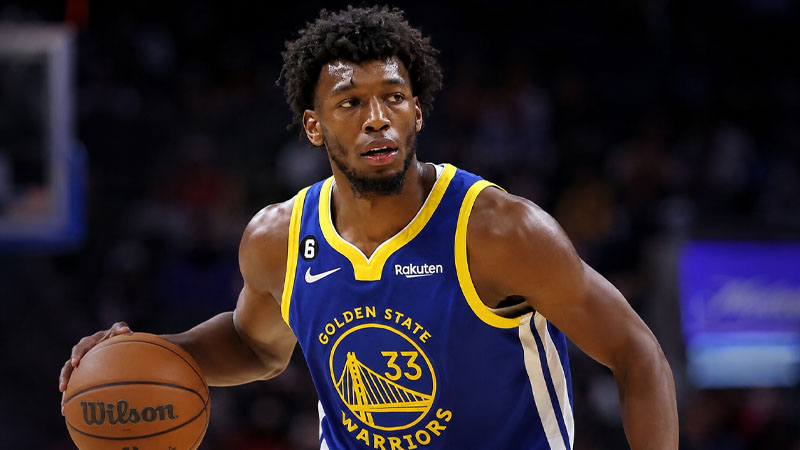
James Wiseman’s struggle in the NBA is primarily defined by a lack of foundational experience, severe defensive lapses, and a devastating injury history.
Despite elite physical tools, including a 7-foot-1 frame and 7-foot-6 wingspan, he entered the league as a “raw” prospect who played only three collegiate games.
This absence of early reps resulted in poor basketball IQ, an inability to process complex defensive rotations, and an offensive preference for low-efficiency jumpers over rim-running.
Combined with a catastrophic torn Achilles and meniscus, these factors prevented Wiseman from evolving into a functional professional, leading to his 2026 exit to Europe.
The Core Statistics Behind James Wiseman’s Decline
The trajectory of James Wiseman’s career is often viewed through the lens of missed opportunities and unfulfilled physical potential.
While he was once projected as a future building block for the post-Splash Brothers era, his on-court impact consistently failed to align with his draft pedigree.
Analytically, he was often a net negative for his teams, struggling to maintain the efficiency required of a modern high-lottery center.
The following table provides a comprehensive overview of the metrics that defined his professional tenure:
| Metric | Detail | Context |
|---|---|---|
| Draft Position | 2nd Overall (2020) | Selected by the Golden State Warriors |
| Career Averages | 9.0 PPG, 5.5 RPG, 0.7 BPG | Spanning 152 total NBA games |
| Physical Profile | 7’1″ Height, 7’6″ Wingspan | Possessed “ridiculous bounce” and linear speed |
| Interior Efficiency | 80% Finishing at Rim | Elite touch when properly positioned in the paint |
| Defensive Impact | -22.8 Net Rating | One of the lowest impacts in the league during 22-23 |
| Availability | 60 games in 2.5 years | Hampered by a flurry of minor and major injuries |
| Current Status | Exiting NBA for Europe | Announced in July 2026 to continue career overseas |
Why Did James Wiseman Struggle with Basketball IQ?
The most persistent criticism of Wiseman involved his “feel” for the game, a cognitive asset that allows elite players to anticipate movements before they happen.
Because Wiseman dominated high school competition through sheer size and athleticism, he never had to develop the nuanced spatial awareness required for the professional level.
The Impact of the Memphis Suspension
The genesis of Wiseman’s developmental stagnation can be traced back to a scandal involving a $1,500 payment from Penny Hardaway to Wiseman’s family. This conflict of interest led to an NCAA ruling of ineligibility, limiting his collegiate career to a mere three games.
By withdrawing from school to prepare for the draft, he missed thousands of foundational repetitions in screen-setting, weak-side rotations, and high-level coaching.
He essentially entered the NBA as an eighteen-year-old with the experience level of a high school senior, forced to learn the world’s most complex offensive and defensive systems on the fly.
The Inability to Read Modern Defenses
Film analysis consistently highlights a “disconnect” in Wiseman’s ability to process live-action information. He was frequently caught “ball-watching,” a habit where a defender focuses solely on the player with the ball while losing track of their own assignment.
This led to a high volume of blown rotations, uncontested backdoor cuts, and offensive rebounds for the opposition.
Despite his physical gifts, his inability to make split-second reads made him an “analytical nightmare” for coaching staffs trying to implement disciplined defensive schemes.
Analyzing Defensive Deficiencies and Mobility Issues
A common misconception was that Wiseman’s elite speed would automatically translate to elite defense. However, modern NBA defense relies less on straight-line sprinting and more on lateral agility and disciplined positioning.
The Paradox of Linear Speed vs. Lateral Slowness
Wiseman was often described as “running like a deer” in the open court, showcasing incredible verticality and transition speed. Yet, in a half-court setting, his feet were notoriously slow when asked to slide laterally against perimeter ball-handlers.
In the Warriors’ switch-heavy defense, this lack of horizontal mobility was exposed; he struggled to contain guards coming off screens, often finding himself a step behind the play.
This forced him into “drop coverage” as a way to hide his lack of quickness, but even then, his timing in the pick-and-roll remained a significant liability.
Discipline Problems and High Foul Rates
Because he lacked the positional discipline to stay grounded, Wiseman relied almost exclusively on his 7-foot-6 wingspan to contest shots. This made him extremely “foul happy,” as he routinely bit on pump fakes and jumped out of position.
At various points in his career, he averaged over 4.5 fouls per 36 minutes, making it impossible for coaches to keep him on the floor for extended stretches.
His lack of a “second jump”—the ability to recover quickly after an initial contest—further limited his effectiveness as a rim protector.
How Offensive Habits Limited His Production
Offensively, Wiseman often played in a manner that conflicted with his physical advantages. While his frame suggested a dominant rim-runner, his playing preferences leaned toward a perimeter-oriented style that killed team efficiency.
The Refusal to Embrace Physicality
One of the most glaring issues in Wiseman’s offensive game was his tendency to set “soft” screens. Rather than making hard contact to free up his guards, he would frequently “slip” the screen early, seeking a path to the basket or the mid-range.
This habit failed to create the necessary advantages for his teammates and disrupted the flow of the offense. Furthermore, instead of dominating the “dunker spot” or crashing the glass for put-backs, he often floated to the perimeter to attempt low-efficiency jump shots.
Catching Issues and Offensive Flow Disruption
Wiseman struggled significantly with “hand-eye coordination” in high-traffic areas. Documentation notes he had difficulty cleanly gathering passes, leading to high turnover rates when trying to finish in the paint.
His assist-to-turnover ratio was often below 0.5, as he would demand post touches only to lose the ball through poor handling or telegraphed moves.
In a dynamic system like Golden State’s, which relies on ball movement and off-ball screens, Wiseman’s tendency to stall the offense made him a “net negative” role player.
The Role of Catastrophic Injuries in His Fall
Even if Wiseman had the mental tools to succeed, his body repeatedly betrayed him during critical developmental windows. Every time he showed a brief flash of potential, a major medical setback would reset his progress to zero.
Missing Critical Developmental Windows
In April 2021, during his rookie season, Wiseman suffered a torn right meniscus. This injury was particularly devastating because it forced him to miss the entire 2021-22 season—a year that should have been dedicated to fixing his defensive footwork and screen-setting.
While his teammates were winning an NBA Championship, Wiseman was rehabbing in the G-League, losing the chance to learn within a winning culture.
These extended absences stripped away the floor time he desperately needed to build a professional-level basketball IQ.
The Final Blow: The 2024 Achilles Rupture
The final chapter of his NBA career was effectively written in October 2024. Just five minutes into his regular-season debut with the Indiana Pacers, Wiseman suffered a catastrophic torn left Achilles tendon.
This second major leg surgery in four years robbed him of his elite “bounce” and athleticism—the only tools that had kept him in the league.
After a lengthy recovery and several short-term 10-day contracts, it became clear that the physical toll was too great, leading to his decision to move to the European circuit.
Was the Golden State Warriors System a Bad Fit?
The debate over Wiseman often centers on whether he was simply a “bust” or if he was drafted into a situation that guaranteed his failure.
The Warriors are known for their “read-and-react” system, which requires high-level decision-making from every player on the floor.
Complexity vs. Raw Talent
For a player with Wiseman’s lack of experience, the Warriors’ offense was a nightmare. The system expects big men to act as playmakers and screen-setters who can read the defense and react instantly.
Wiseman, who was still learning where to stand on a basketball court, was constantly a step behind. A team chasing championships could not afford the massive learning curve he required, leading to his reduced playing time and eventual trade to the Detroit Pistons.
The Pressure of Winning Now
Drafting a project player like Wiseman into a veteran-led dynasty created a fundamental misalignment of goals. The Warriors needed immediate, error-free execution to maximize the prime of their core stars.
Wiseman’s development required hundreds of low-stakes mistakes, which the Warriors simply could not accommodate.
When he was eventually moved to Detroit, he entered a logjammed roster where his minutes were diluted, preventing him from ever finding the consistent rhythm necessary for growth.
Frequently Asked Questions About James Wiseman
Why did the Warriors trade James Wiseman?
The Warriors traded him because his low basketball IQ and defensive struggles made him a significant net negative on a team trying to win championships.
What was James Wiseman’s career-ending injury?
A torn left Achilles tendon suffered in 2024, just five minutes into his debut with the Indiana Pacers, effectively ended his NBA aspirations.
Is James Wiseman still in the NBA?
No. As of July 2026, Wiseman has exited the NBA to continue his professional basketball career in Europe.
How many games did James Wiseman play in college?
Due to an NCAA eligibility scandal, he played only three games for the University of Memphis.
Why is James Wiseman considered a draft bust?
He is considered a bust because he was the 2nd overall pick but failed to become a rotation player, struggling with injuries, defense, and a lack of fundamental skills.