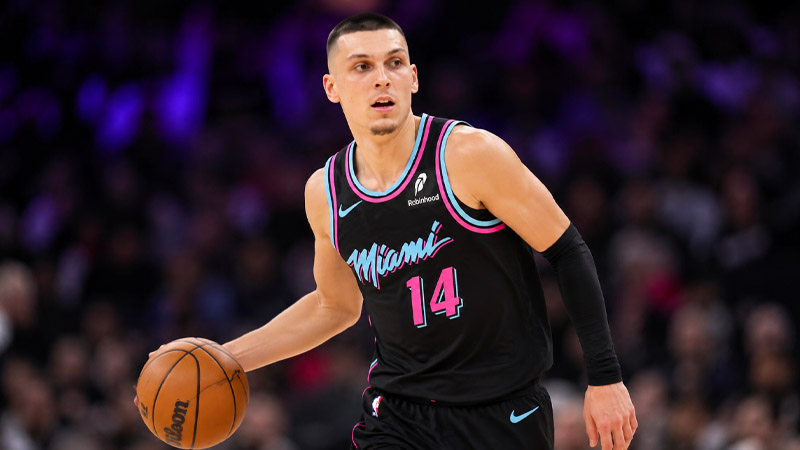
NBA star Tyler Herro is not color blind. No medical evidence or official records suggest he has any vision deficiency.
The misconception primarily stems from a 2019 viral video featuring a boy named Tyler Muhr receiving corrective glasses, which internet algorithms frequently misidentify.
Furthermore, Herro’s public comments regarding his identity and “skin color” have tied his name to the word “color” in online databases.
While he suffered a significant eye injury in 2022, his vision fully recovered. This analysis separates digital fiction from biological facts, confirming Herro’s visual health remains optimal for his professional basketball career.
What Started the Tyler Herro Color Blindness Rumors?
Understanding the origin of this myth requires looking at how disparate pieces of information can be woven into a false narrative by the sheer volume of online interactions.
In the high-stakes world of professional basketball, every physical attribute of a player is scrutinized, and when a term like “color blindness” begins to trend alongside a marquee name, it often gains a life of its own regardless of its accuracy.
The Confusion with Tyler Muhr’s Viral Video
The most significant factor in this ongoing misunderstanding is a deeply emotional video that first surfaced in 2019 and continues to reappear in various social media feeds.
This video features an 11-year-old boy named Tyler Muhr from Colorado who was born with a severe color vision deficiency that limited his perception to shades of grey.
In the footage, his friend Thane surprises him with a pair of corrective EnChroma glasses, leading to a tearful reaction as the young boy sees the world in full detail for the first time.
Because the video is often titled with phrases like “Tyler sees color,” the shared first name has caused casual observers to mistakenly attribute the story to the Miami Heat guard.
The Impact of Semantic Keyword Association
Beyond individual videos, the way large-scale data platforms organize information has played a silent role in perpetuating this myth.
When a name is frequently entered alongside specific terms, the automated systems that provide “related results” begin to assume a connection exists.
In this case, the heavy overlap between “Tyler Herro,” “color,” and “glasses” in historical inquiry logs has created a digital bridge between a professional athlete and a medical condition he does not have.
This phenomenon demonstrates how the structure of the modern web can inadvertently amplify misinformation by prioritizing popular associations over verified medical records.
Comparing Tyler Herro and Tyler Muhr: A Case Study
To clarify the situation for those navigating these conflicting reports, it is helpful to contrast the two individuals who are most often confused in this digital narrative.
By looking at the specific details of each case, the distinction between a heartwarming human-interest story and the medical reality of an NBA athlete becomes undeniable.
| Feature | Tyler Herro (NBA Player) | Tyler Muhr (Viral Video Subject) |
|---|---|---|
| Primary Occupation | Professional Basketball Player | Student / Youth |
| Medical Condition | No color vision deficiency recorded | Born color blind (sees black and white) |
| Use of Corrective Lenses | Not required for color perception | Uses EnChroma glasses to see color |
| Geographic Location | Miami, Florida (Professional) | Colorado (Home) |
| Viral Connection | Mistakenly linked via first name | Subject of the original 2019/2025 video |
| Vision History | Temporary trauma from eye poke (2022) | Lifelong genetic vision deficiency |
How Social Justice Quotes Impacted Digital Identity
The linguistic landscape of the internet is often as influential as visual media in shaping public perception.
For Tyler Herro, several high-profile interviews from his early career have contributed to his name being indexed alongside the word “color,” though the context was entirely unrelated to ophthalmology or biological vision.
The University of Kentucky “Skin Color” Quote
During his collegiate tenure with the Kentucky Wildcats, Herro addressed the racial dynamics of the sport with a level of candor that resonated across sports media.
He famously told reporters that if they looked past his “skin color,” they would see a basketball player defined by skill rather than race. This specific phrasing—”look at my skin color”—is a permanent fixture in sports archives and player profiles.
Because digital discovery systems scan for keywords to determine the relevance of a page, the frequent appearance of the word “color” in his most famous quotes has led to false matches when users look for information on his physical health.
Support for Social Justice and People of Color
In 2020, Herro further solidified his public persona by speaking out on broader social issues. He publicly stated his support for “people of color” and emphasized the importance of equality in treatment across all facets of society.
While these statements are indicative of his personal values and social advocacy, they added another layer of data that connects his name to color-related terminology.
For an automated system, the distinction between “color” as a social identifier and “color” as a medical condition is often blurred, leading to the erroneous grouping of these topics in general informational summaries.
The 2022 Eye Injury: A Real Vision Scare
While the rumors of color blindness are unfounded, Tyler Herro did experience a legitimate and frightening medical event involving his eyesight during the 2022-2023 NBA season.
This event provided a factual basis for fans to express concern about his vision, though the nature of the injury was acute and mechanical rather than genetic.
| Event Detail | Description of the 2022 Incident |
|---|---|
| Opponent | Golden State Warriors |
| Action | Severe eye poke during active play |
| Initial Symptom | Total temporary blackness in the affected eye |
| Medical Response | Immediate locker room evaluation and iodine testing |
| Diagnosis | Potential corneal scratch screening |
| Recovery Time | Returned to play within several days |
| Long-term Impact | No permanent vision loss or color deficiency |
The Science of Color Blindness in Elite Athletics
To understand why a professional athlete of Herro’s caliber would be unlikely to hide a condition like color blindness, one must look at the physiological demands of the game.
Professional basketball requires immense visual acuity, particularly in the areas of depth perception and contrast sensitivity, which are often compromised in those with color vision deficiencies.
Genetic Vision vs. Acute Physical Trauma
Color blindness is typically a genetic condition present from birth, caused by the absence or malfunction of specific cone cells in the retina. These cells are responsible for detecting red, green, and blue light waves.
In contrast, the injury Herro sustained in November 2022 was an example of acute physical trauma. When he was poked in the eye, the vision loss he experienced was a protective reaction of the eye globe and the optic nerve, not a breakdown of his ability to process color pigments.
The rapid recovery he demonstrated is typical of surface-level ocular trauma, whereas genetic color blindness is a lifelong trait that does not fluctuate or heal.
Why His Shooting Ability Disproves the Rumor
Elite shooting in the NBA relies on “quiet eye” periods and the ability to track an orange ball against the high-contrast background of the court and jerseys.
While some athletes have found success despite vision issues, there is no indication that Herro utilizes the specialized corrective technology required for those with color blindness.
His performance data, characterized by high-percentage shooting and exceptional spatial awareness, aligns with a visual system that is functioning at 20/20 capacity.
If he were viewing the game in the muted tones described in the Tyler Muhr video, his ability to react to the subtle color-coded cues of modern coaching and court markings would be significantly hindered.
Navigating Information in the Digital Sports Era
The persistence of the Tyler Herro myth serves as a masterclass in how information travels through the modern digital ecosystem.
It highlights the necessity for fans and analysts to look beyond the immediate results of an inquiry and investigate the context of the claims being made.
The Mechanism of the Online “Telephone Game”
Misinformation in the sporting world often follows a predictable pattern where a small nugget of truth is distorted as it moves through different platforms. In Herro’s case, the truth was a shared first name with a viral video subject and a series of quotes about “skin color”.
As this information was processed by various social media users, the nuance was lost, and the simplified—but incorrect—narrative that “Tyler is color blind” took hold.
This “telephone game” is exacerbated by the speed of digital sharing, where a user might share a post based on a headline without ever watching the video or reading the full interview.
Verifying Facts Beyond the Headline
For those seeking to maintain a high level of accuracy in their understanding of athlete health, the best approach is to rely on official team medical reports and direct player statements.
The Miami Heat organization is known for its rigorous health protocols and transparency regarding player injuries. Throughout the many discussions surrounding Herro’s vision, there has never been a medical filing that mentions color blindness.
By prioritizing primary documentation over viral trends, one can avoid the pitfalls of digital myths that often target high-profile individuals.
Essential FAQ Regarding Tyler Herro’s Eyesight
Is there any footage of Tyler Herro using color-corrective glasses?
No. All footage circulating that depicts a “Tyler” using EnChroma glasses features Tyler Muhr, a young boy from Colorado who became a viral sensation for his reaction to seeing color for the first time.
Did the eye injury in 2022 leave any permanent damage?
No. After being poked in the eye during a game against the Warriors, Herro underwent immediate medical testing, including iodine drops to check for corneal scratches. He made a full recovery and regained his clear vision within days.
Why do some websites claim Herro sees in black and white?
This claim is a direct result of confusing Herro with Tyler Muhr. Muhr’s story specifically highlighted his inability to see color before receiving his glasses, a detail that was incorrectly transferred to Herro by automated digital systems and misinformed social media posts.
What did Tyler Herro mean when he talked about “skin color”?
Herro was referring to his racial identity and the stereotypes he faced as a white player in basketball. He was advocating for being judged on his athletic merit rather than his appearance, a sentiment he echoed during his support for social justice movements in 2020.
Can color blindness be acquired from an eye poke?
In almost all cases, no. Color blindness is a genetic condition. While severe trauma can sometimes damage the optic nerve or retina, the specific type of injury Herro sustained in 2022 resulted in temporary blurriness and has no medical link to color vision deficiency.
The Final Word on Tyler Herro’s Vision
The narrative surrounding Tyler Herro’s eyesight is a compelling example of how a player’s digital footprint can be shaped by factors entirely outside their control.
Through a combination of viral videos involving other individuals, semantic overlap in historical interviews, and a temporary on-court injury, a myth was created that contradicted the medical reality of one of the NBA’s brightest stars.
The evidence is clear: Tyler Herro possesses normal color vision and continues to perform at an elite level without the need for corrective visual technology for color perception.
As we move forward in an increasingly connected world, the ability to discern fact from viral fiction remains a vital skill for every sports enthusiast. Herro’s focus remains on the court, where his vision for the game continues to be his greatest asset.