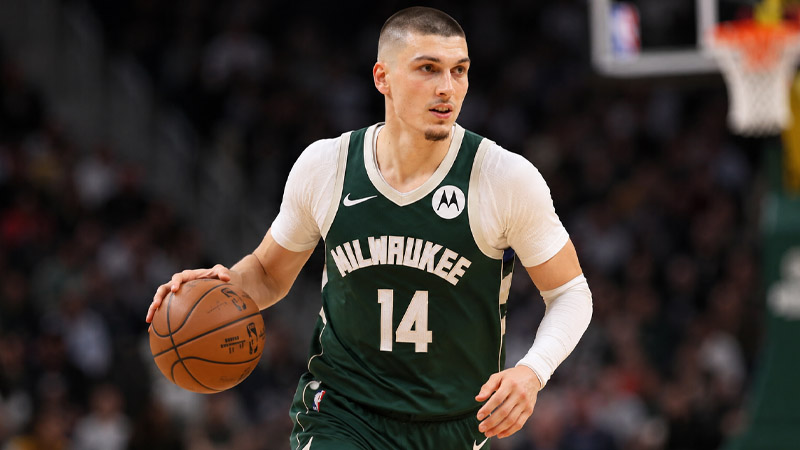
Tyler Herro is often unfairly labeled a liability, but he is a “good” defender within a specific team context. His value stems from elite guard rebounding (4.51 per game), high-IQ rotational discipline, and exceptional effort that minimizes his physical limitations.
While he lacks the wingspan of a traditional stopper, his ability to execute complex zone schemes and secure defensive stops through rebounding makes him a functional component of a top-tier defense.
By understanding his role as a system-oriented player rather than an individual lockdown artist, his true defensive contributions to winning basketball become clear.
Why Tyler Herro’s Rebounding is a Defensive Weapon
While most fans associate defense solely with on-ball pressure, the ultimate goal of any defensive possession is to secure the ball. Tyler Herro excels in this final, crucial stage of the defensive process.
Unlike many offensive-minded guards who leak out for fast breaks, Herro remains engaged until the ball is in his hands. This commitment provides his team with a functional outlet and ensures that opposing offenses do not get second-chance opportunities.
The Impact of 4.51 Defensive Rebounds per Game
Statistically, Herro’s rebounding numbers are not just good for a guard; they are elite. Throughout his career, he has averaged 4.51 defensive rebounds per game, maintaining a defensive rebound percentage of approximately 13.5%.
This level of production is rare for a combination point and shooting guard and serves as a stabilizing force for his team’s interior defense.
By utilizing excellent timing and a running head start, he consistently clears the defensive boards even against larger opponents.
Denying Second-Chance Opportunities
The tactical value of a rebounding guard cannot be overstated. When Herro secures a rebound, he effectively “kills” the opposing team’s possession, preventing the “kick-out” three-pointers or put-back layups that often demoralize a defense.
His ability to read the rim incredibly well allows him to predict where a missed shot will land, often out-positioning wings who are physically larger but less attentive to the glass.
This skill transforms him from a passive defender into an active participant in ending the opponent’s offensive flow.
How Defensive IQ Overcomes Physical Constraints
Effective defense in the modern era is as much about mental processing as it is about physical tools. Herro operates as a disciplined system component, meaning he rarely makes the catastrophic mental errors that break a team’s structure.
Under elite coaching, he has developed a baseline of off-ball awareness that allows him to contribute positively even when he is not the primary point of attack.
Mastering the Weak-Side Rotation
One of Herro’s most underrated skills is his rotational discipline. He executes weak-side rotations cleanly, ensuring that if a teammate is beaten, he is in the correct position to provide help or “tag” the rolling big man.
This off-ball intelligence prevents the defense from collapsing entirely. Because he understands the geometry of the court, he can anticipate where the next pass is going, allowing him to close out on perimeter shooters with high-activity contests.
Functional Utility in Zone Schemes
In complex defensive systems, such as the zone defenses frequently used by his team, Herro’s role is vital. He handles pre-rotations and maintains the integrity of the team’s containment strategies.
Even though his short wingspan limits the number of deflections or steals he generates—averaging just 0.66 steals per game—his adherence to the scheme ensures that the five-man unit remains cohesive.
He is a player who understands that his job is not to be a “hero” on defense, but to be a reliable cog in a larger machine.
Is Tyler Herro a Liability in Isolation Situations?
The primary criticism of Herro’s game is his susceptibility to being targeted by elite scorers in isolation. While it is true that playoff teams often run pick-and-rolls specifically to switch him onto primary ball-handlers, the narrative that he is a “complete liability” is increasingly outdated.
Recent data suggests that his individual containment has seen significant growth as he has matured.
Growth in One-on-One Containment
Tracking data from recent seasons reveals a surprising level of competency in isolation defense. During the 2025–26 season, for instance, Herro ranked in the 72nd percentile in isolation defense.
This indicates that when he is forced to “guard his yard,” he can hold his own against many of the league’s perimeter players.
While he may struggle with exceptionally quick “twitchy” guards, his ability to stay in front of standard wings has improved through better footwork and leverage.
The Effort-Based “Highlight Block” Factor
What Herro lacks in natural length, he attempts to compensate for with sheer hustle and maximum effort. He rarely takes a play off, often utilizing his vertical leap to contest shots that more passive defenders would concede.
This energy leads to “unexpected highlight blocks” from behind, proving that his defensive impact is fueled by a refusal to give up on the play regardless of the physical mismatch.
This high-energy approach serves as a contagious element for his team’s overall defensive identity.
Statistical Analysis: Comparing Herro to Elite Benchmarks
To understand where Herro stands in the hierarchy of the league, we must look at both his internal progress and how he compares to all-time defensive greats. The following table illustrates his career defensive statistical reality:
| NBA Season | Defensive Rebounds (RPG) | Steals (SPG) | Blocks (BPG) |
|---|---|---|---|
| 2019–20 | 3.78 | 0.62 | 0.16 |
| 2020–21 | 4.50 | 0.65 | 0.31 |
| 2021–22 | 4.50 | 0.67 | 0.12 |
| 2022–23 | 4.97 | 0.76 | 0.24 |
| 2023–24 | 4.83 | 0.71 | 0.07 |
| 2024–25 | 4.73 | 0.90 | 0.22 |
| 2025–26 | 4.36 | 0.70 | 0.36 |
| Career Total | 4.51 | 0.66 | 0.21 |
When compared to historic defensive locks, Herro’s numbers in traditional “playmaking” stats are modest. For context, John Stockton leads all-time steals with 3,265, and Hakeem Olajuwon leads blocks with 3,830.
Herro’s 256 career steals and 82 blocks place him far below these elite thresholds, reinforcing the idea that his value is not found in disruptive playmaking but in positional reliability and rebounding.
Why Do Offensive Coaches Target Tyler Herro?
Despite his improvements, Herro remains a focus of opposing coaching staffs. This strategic targeting is rarely a reflection of his effort and more a consequence of unchangeable physical traits.
In the high-stakes environment of professional basketball, offenses will always look for the “weakest link” in a chain, and for a team with elite defenders like Bam Adebayo, that link often defaults to the smaller guard.
The Switch-Hunting Strategic Reality
Opposing teams routinely utilize the pick-and-roll to force a switch, placing Herro on an island against physical ball-handlers.
Because of his 195-pound frame and 6’5″ height, he can be overpowered by “bully-ball” wings who use their weight to create space in the paint. This is not a failure of technique, but a biological reality.
When he is backed up by an elite rim protector, he can be effective in “drop” or “hedge” coverages, but in a pure switch-all scheme, his physical limitations are exposed.
Biological Barriers to Playmaking
The most significant hurdle for Herro is his short wingspan. Length is a primary tool for disrupting passing lanes and altering shots. Without this reach, Herro struggles to generate “chaotic events” like deflections or intercepted passes.
This explains his low steal percentage of 1.0% and block percentage of 0.6%. He must play “perfect” positional defense because he does not have the length to recover if he is initially beaten by a quicker opponent.
Frequently Asked Questions About Tyler Herro’s Defense
Is Tyler Herro considered a “lockdown” defender?
No. Herro is not a lockdown defender in the traditional sense. He is a system defender whose value is found in his ability to rebound at an elite level for his position and follow complex team schemes without making mental errors.
What is Tyler Herro’s defensive rating?
His career defensive rating sits at approximately 113.7. It is important to note that this metric is often influenced by the fast pace and high offensive volume of the lineups he plays in, rather than being a pure reflection of his individual defensive skill.
How does his defense change in the playoffs?
In the playoffs, his defensive role becomes more challenging as teams “switch-hunt” to isolate him against their best scorers.
However, his high-effort contests and rebounding remain consistent, helping his team finish possessions even under intense pressure.
Does he play better defense in a zone or man-to-man?
Herro often thrives in zone schemes where his off-ball awareness and rotational discipline can be maximized. In man-to-man, he is more susceptible to being beaten by “twitchy” guards with elite lateral quickness.
Conclusion: Redefining “Good” Defense for Tyler Herro
The verdict on Tyler Herro’s defense is more nuanced than a simple “good” or “bad” label. While he will likely never be an All-Defensive talent, he has successfully transitioned from being a perceived liability to a functional, high-effort component of a winning system.
His elite rebounding (4.51 per game) and 72nd-percentile isolation defense during the 2025-26 season prove that he can contribute to a championship-level defense when utilized correctly.
Ultimately, his value lies in the “Paradox of Effort.” By acknowledging his physical constraints—his 195-pound frame and short wingspan—and choosing to maximize his energy and IQ, he has carved out a role as a reliable team defender.
For any organization looking for a guard who will battle on the boards and execute a game plan to the letter, Tyler Herro offers significant defensive value that goes far beyond the box score.