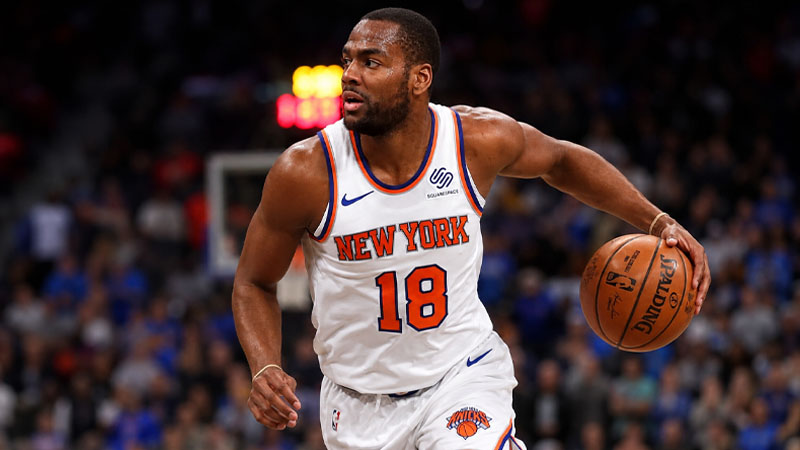
Alec Burks is generally categorized as a below-average to mediocre defender in the NBA, valued primarily for his offensive versatility rather than his defensive stops.
Despite possessing an ideal physical frame for a modern wing—standing 6’6” with a 6’10” wingspan—his on-court impact often tells a different story. Advanced metrics consistently show him as a net-negative on the defensive end, with a career defensive rating of 111.7.
While he can be serviceable within a disciplined team scheme, his lack of off-ball awareness and low turnover generation define his career defensive profile.
Is Alec Burks a Good Defender?
To understand the defensive standing of Alec Burks, one must look past his impressive physical attributes and evaluate his actual contributions to team success on that end of the floor.
Over a 15-year career, the consensus among analysts and coaching staffs is that Burks is a net-negative defensive player.
While he is not a “liability” in the sense that he is unplayable, he lacks the consistency and playmaking ability required to be considered a “good” or even “average” defender by modern NBA standards.
The Gap Between Physical Potential and Execution
The primary reason there is often a debate about his defensive utility is the “theoretical” player suggested by his measurements. At 6’6″ with a significant wingspan, Burks looks like a player who should be an elite multi-positional stopper.
However, his execution often lags behind these tools. He does not use his length to disrupt passing lanes effectively, nor does he use his size to crash the defensive glass at a high rate, averaging only 2.7 defensive rebounds per game throughout his career.
Positional Utility and Switchability
If there is a bright spot in his defensive evaluation, it is his ability to switch across multiple positions on the perimeter. Because of his frame, he isn’t easily bullied by larger shooting guards or small forwards.
This allows coaches to utilize him in “switch-all” schemes where he can transition between defending positions 1 through 3 without instantly surrendering a physical mismatch.
This specific utility prevents him from being a massive liability that teams can target relentlessly in a playoff setting.
The Numbers: Analytics and Traditional Box Scores
The defensive profile of Alec Burks is heavily supported by data that spans over a decade of play.
While traditional box score stats like steals and blocks (often referred to as “stocks”) provide a surface-level look, advanced impact metrics offer a more nuanced view of how his presence affects his team’s efficiency.
The following data highlights the statistical reality of his defensive performance.
| Metric | Career Average / Rating | Performance Insight |
|---|---|---|
| Defensive Rating | 111.7 | Indicates points allowed per 100 possessions. |
| Steals per Game | 0.7 | Below average for a wing with his length. |
| Blocks per Game | 0.2 | Negligible impact as a rim protector or weak-side helper. |
| Defensive Box Plus-Minus | -0.9 | Confirms he reduces team defensive efficiency. |
| Defensive Win Shares | 11.4 (Total) | Low accumulation of defensive value over 15 years. |
| 2024–25 Def. Rating | 114.2 | Notable decline in recent seasons. |
Scouting the Weaknesses: Mental and Physical Hurdles
Evaluating why a player with Burks’ physical profile struggles on defense requires a deep look at his scouting report. Defensive success in the NBA is as much about mental focus and reaction time as it is about physical agility.
Burks faces significant challenges in both areas, which often results in him being “hidden” by his coaching staff on the opponent’s least threatening offensive player.
The Challenge of Off-Ball Awareness
The most glaring weakness in his defensive game is a consistent lack of off-ball awareness. Burks is frequently prone to “ball-watching,” a technical flaw where a defender focuses too much on the player with the ball and loses track of their own assignment.
This leads to him surrendering easy backdoor cuts or failing to tag rollers in pick-and-roll situations. These mental lapses can compromise an entire team’s defensive rotation, making it difficult for teammates to compensate for his positioning errors.
Declining Lateral Speed with Age
As Burks has moved into his mid-30s, the physical advantages he once possessed have begun to wane. Specifically, a decline in lateral quickness has made him more vulnerable in isolation scenarios.
Shifty, high-speed point guards are now more likely to blow past him on the perimeter. While he remains a serviceable on-ball defender when he can use his body to contest shots, his ability to stay in front of elite ball-handlers has diminished over time.
Lack of Defensive “Event” Generation
A “good” defender typically provides value by creating turnovers or “events” that disrupt the opposing offense’s flow. Burks is remarkably quiet in this department, averaging just 0.7 steals and 0.2 blocks per game.
Even during his highest-usage seasons, such as his time with the New York Knicks, these numbers remained stagnant.
Without the threat of a steal or a blocked shot, opposing offenses can pass and dribble around him with very low risk, allowing them to execute their sets without fear of a defensive disruption.
Defensive Context: How Coaches Manage Burks’ Performance
While the individual metrics are underwhelming, the way NBA coaches deploy Burks tells us a lot about his functional utility. Teams don’t sign Burks for his defense; they sign him for his ability to provide instant offense and elite floor spacing.
Consequently, his defensive role is usually designed to minimize his exposure while keeping his offensive gravity on the floor.
Integration into Elite Defensive Schemes
Interestingly, Burks has spent significant time playing for defensive-minded coaches like Tom Thibodeau and Erik Spoelstra. In these systems, his deficiencies are often masked by a highly disciplined team infrastructure.
When tucked into an elite scheme, Burks can focus on basic on-ball assignments—putting a hand up, fighting over screens, and contesting jump shots.
His size allows him to hold his own in these isolated moments, provided he is not required to carry the burden of being a primary stop option.
The Strategy of Defensive “Hiding”
A common tactic used by coaching staffs is to assign Burks to the opponent’s weakest offensive perimeter player.
By doing this, teams can largely negate his poor off-ball awareness because his primary assignment is less likely to be involved in complex offensive actions.
This strategy allows him to remain on the floor for extended periods to provide his valued 3-point shooting—often exceeding 40% from deep—without his defensive shortcomings becoming a fatal flaw for the team.
Comparing the Regular Season to the Playoffs
A player’s defensive value is truly tested in the postseason, where teams have the time to scout and exploit specific weaknesses over a seven-game series.
Burks’ playoff career offers a window into how his defensive profile holds up when the intensity increases and the margins for error shrink.
Stability in Playoff Metrics
Data from his 29 career playoff appearances suggests that his defensive output remains remarkably consistent with his regular-season marks.
He averages roughly 0.6 steals and 0.2 blocks in the postseason, showing that he does not magically become more disruptive under pressure. Similarly, his defensive rebounding stays at a modest 2.9 per game.
This stability suggests that coaches know exactly what they are getting: a player who won’t lose you the game defensively if managed correctly, but certainly won’t win it for you on that end.
Viability in High-Stakes Environments
The fact that Burks continues to receive rotation minutes in the playoffs for competitive teams proves that he is not a “massive liability”.
While he is a net-negative, his ability to switch and his veteran understanding of where he needs to be on the floor (even if he occasionally fails to get there) makes him “serviceable” enough to stay on the court.
In the modern NBA, if you shoot the ball as well as Burks does, being a “below-average” defender is an acceptable trade-off for most championship contenders.
Frequently Asked Questions About Alec Burks
What is Alec Burks’ career defensive rating?
Alec Burks has a career defensive rating of 111.7. This metric suggests that throughout his career, his teams have allowed approximately 111.7 points per 100 possessions while he is on the floor.
In recent years, this number has trended upward, reaching as high as 114.2 during the 2024–25 season.
Is Alec Burks a versatile defender?
Physically, yes; practically, less so. Burks possesses the 6’6″ height and 6’10” wingspan to switch across positions 1 through 3 on the perimeter.
While this “theoretical” versatility allows him to function in various defensive schemes, his actual impact is often limited by his lack of lateral quickness and mental lapses when playing off the ball.
Does Alec Burks generate many steals or blocks?
No, he is not considered a defensive playmaker. Burks averages only 0.7 steals and 0.2 blocks per game over his long career. These low “event” rates mean he rarely disrupts the opposing offense’s flow or creates transition opportunities for his team.
Why do teams keep playing him if his defense is below average?
Teams value Burks primarily for his offensive contributions. He is an “offensive sparkplug” who provides elite three-point shooting and bench scoring.
His ability to space the floor—often shooting above 40% from beyond the arc—far outweighs his defensive deficiencies in the eyes of most NBA coaches.
Final Verdict: Balancing Offense and Defense
When answering the question “Is Alec Burks a good defender?”, the objective answer based on 15 years of data and scouting is no.
He is a below-average individual defender who struggles with awareness and lateral movement. However, the nuance of the NBA suggests that defensive “goodness” is often situational.
While he will never be a lockdown defender, his combination of size and shooting makes him a valuable asset. He is a player who can be “hidden” within a strong defensive system, allowing his elite offensive skills to shine without the team suffering catastrophic defensive consequences.
For a bench player in the modern NBA, being a “serviceable” part of a larger defensive machine while providing high-level spacing is more than enough to sustain a long and successful career.