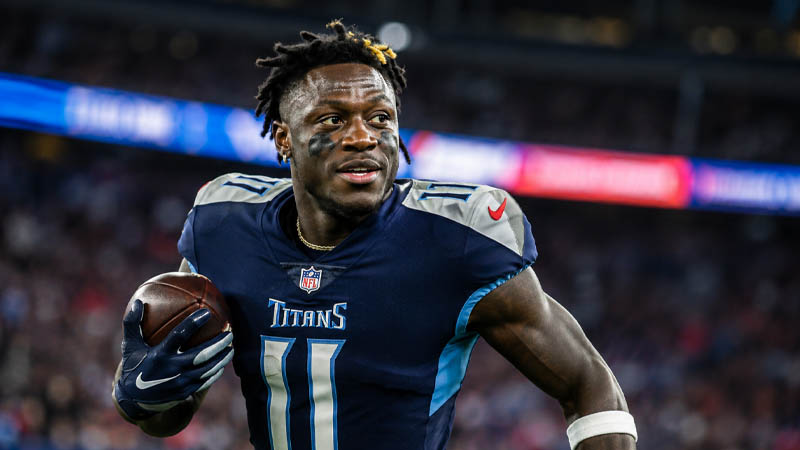
Why did A.J. Brown leave the Titans? He left because Tennessee refused to offer him a market-value contract extension, presenting a base salary of just $16 million per year while the wide receiver market exploded.
While Brown was willing to stay for $22 million annually, his agent sought up to $29 million. Combined with front-office anxieties regarding his long-term knee health, negotiations collapsed.
This financial disconnect and subsequent communication freeze forced a blockbuster draft-day trade to the Philadelphia Eagles on April 28, 2022, altering the trajectory of both franchises.
Understanding the Financial Disconnect in Tennessee
To understand why negotiations between the star receiver and the front office deteriorated so rapidly, we must examine the specific contract figures and market pressures that drove a wedge between both parties.
The Exploding Wide Receiver Market and Rookie Pay
Brown was entering the final year of his rookie contract, scheduled to make just under $4 million in 2022. As wide receiver contracts skyrocketed across the league, his camp demanded an extension reflecting his elite production.
This created immediate tension, as Tennessee hesitated to match the rapidly expanding salary trends.
The Lowball Base Offer From Tennessee Management
The front office offered a contract that topped out at a $16 million base salary per year. This proposal could only reach $20 million annually through difficult incentive milestones.
Brown and his agent considered this a lowball offer that failed to respect his status as a premier offensive weapon.
The Staggering Gap in Contract Valuation Demands
The receiver later revealed he would have signed an extension to stay in Tennessee for $22 million annually.
However, reports indicated his agent initially demanded between $25 million and $29 million per year with $80 million guaranteed. This vast gap made bridging the financial divide virtually impossible.
The Hidden Medical Doubts Facing the Front Office
While financial negotiations dominated public headlines, deeper organizational anxieties regarding physical durability and career longevity played a silent, critical role in shaping the team’s long-term contract offers.
Physical Playstyle and Long-Term Knee Health Concerns
Management held underlying hesitations regarding the receiver’s long-term knee health. His highly physical, run-after-the-catch playstyle led to minor injuries early in his career.
These physical setbacks prompted executives to doubt his career longevity and hesitate during extension talks.
Risk Management of Long-Term Guaranteed Capital
Because of these physical concerns, Tennessee’s front office resisted tying up substantial guaranteed capital.
They were reluctant to commit heavy, multi-year guarantees to a player they feared might break down, choosing instead to prioritize salary cap flexibility over player retention.
The Break in Communication and Draft-Day Execution
With contract negotiations reaching an absolute standstill, the relationship severed completely behind the scenes, leaving a trade as the only viable path forward for the organization.
The Silent Standoff and Offseason Boycott
Faced with an unyielding front office, the receiver’s agent advised him to cut off all communication with the team.
He skipped voluntary offseason programs, cementing a negotiation deadlock that left management feeling boxed into a corner weeks before the draft.
Executing the Blockbuster Draft-Day Trade Deal
On April 28, 2022, General Manager Jon Robinson finalized a trade during the first round of the NFL Draft.
The star receiver went to the Philadelphia Eagles, who immediately handed him a four-year, $100 million deal featuring $57 million in guaranteed salary, securing his market value.
Rebuilding the Roster With Trade Assets
Tennessee attempted to navigate the departure of their elite pass-catcher by leveraging their newly acquired draft assets to build a younger, more cost-effective core.
In exchange for their star player, the team received the 18th overall pick and a 101st overall pick in the third round. They used these draft picks to execute the following roster moves:
- Treylon Burks (WR): Selected with the 18th pick, the Arkansas rookie was drafted to directly replicate his predecessor’s physical, run-after-the-catch playstyle on a cheap rookie salary.
- Nicholas Petit-Frere (OL): Tennessee traded the 101st overall selection to the Jets to slide down, eventually acquiring this rookie offensive lineman.
- Kyle Philips (WR): Secured as part of the trade-down package, adding another young receiving option to the roster.
Conflicting Narratives and Public Blame Games
Following the trade, a wave of public finger-pointing emerged, revealing deep internal divisions between the coaching staff and the executive front office.
Social Media Defenses and Player Frustration
The receiver took to social media to defend his stance, tweeting that he wanted to stay and the split was not his fault. He maintained that the front office’s refusal to offer a fair market contract forced his hand.
Coaching Staff Discontent and Executive Tension
Head coach Mike Vrabel was visibly upset on camera during the live draft broadcast. Vrabel had publicly promised weeks earlier that his star receiver would not be traded, exposing a massive, painful misalignment within the organization’s leadership hierarchy during that fateful draft night.
The Long-Term Fallout of a Historic Miscalculation
The divergent paths of both teams following this transaction highlight how a single roster decision can alter franchise trajectories. While Philadelphia flourished, Tennessee experienced immediate regression. The table below compares the direct results of this decision:
| Roster Metric | Tennessee Titans | Philadelphia Eagles |
|---|---|---|
| Contract Provided | Offered $16M/year base (max $20M with incentives) | Offered $100M over 4 years ($25M/year) |
| Immediate Results | Treylon Burks struggled with injuries and failed to match production | Brown broke the franchise single-season receiving yards record in 2022 |
| Post-Trade Success | The offense collapsed, initiating a painful roster teardown | Brown helped lead the Eagles to a Super Bowl LVII appearance |
| Leadership Impact | GM Jon Robinson was fired mid-season; Coach Vrabel was let go later | Brown secured another massive 3-year, $96M extension in 2024 |
Enhanced FAQ: Key Inquiries Surrounding the Trade
When did A.J. Brown officially leave the Titans?
He officially left on April 28, 2022, when he was traded during the opening round of the NFL Draft. This trade brought a sudden, shocking end to his productive tenure in Tennessee and immediately initiated his historic, record-breaking run in Philadelphia.
Who did the Titans get from the A.J. Brown trade?
The Titans received the 18th overall pick and the 101st overall pick. They drafted rookie wide receiver Treylon Burks with that first-round pick, and subsequently traded the third-round pick to acquire rookie offensive lineman Nicholas Petit-Frere and rookie receiver Kyle Philips.
Why did the contract extension negotiations fail?
Negotiations failed because Tennessee offered a $16 million base salary per year, while the market demanded $22 million to $25 million.
A complete communication freeze from his agent and organizational concerns about the player’s long-term knee health sealed the negotiation breakdown.
Conclusion: The True Cost of NFL Asset Management
The decision to trade a superstar wide receiver rather than paying market value remains a cautionary tale of modern NFL asset management.
While Tennessee tried to replicate elite talent on a cheap rookie contract with Treylon Burks, the gamble backfired spectacularly, resulting in offensive collapse, executive firings, and a complete organizational reset.
Conversely, the Eagles demonstrated that paying premium capital for proven superstar talent yields massive competitive returns. In the end, the valuation gap didn’t just cost the Titans a star player—it cost them their entire competitive window.