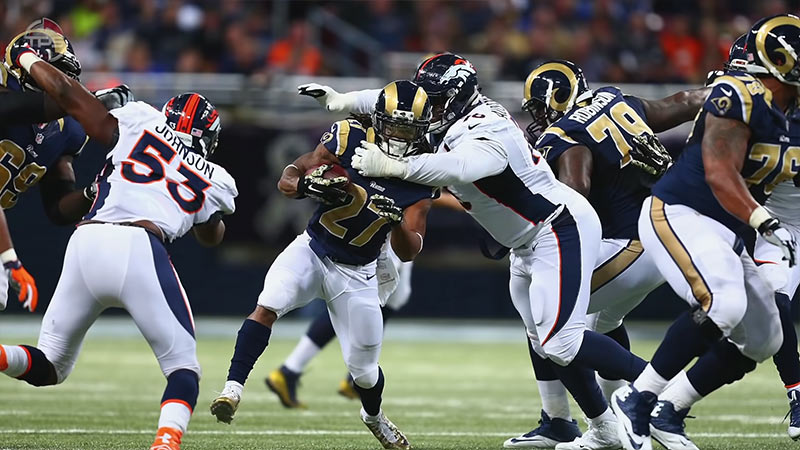
The visual landscape of the National Football League has undergone a radical transformation over the last two decades.
If you look at archival footage from the 1990s, players resembled gladiators encased in heavy, articulated armor.
Today, the modern NFL athlete looks more like a high-performance track star. This shift is most visible from the waist down, where the once-standard, bulky knee pads have seemingly vanished, replaced by sleek, form-fitting pants that often end well above the joint.
This trend has sparked significant debate among fans, safety advocates, and sports analysts. Why would athletes in the most physical professional league in the world choose to leave one of their most vulnerable joints exposed?
The answer is a complex intersection of biomechanics, psychological performance theory, and an evolving culture of professional aesthetics.
The Regulatory Paradox: What the Rulebook Actually Says
To understand why players appear to be bypassing protection, one must first understand the legal framework of the league. According to the official NFL rulebook, knee pads are not optional; they are a mandatory component of the uniform.
The league requires that players wear both knee and thigh pads during every game to maintain a baseline of safety. Furthermore, the rules dictate that the uniform pants must cover the knees entirely.
Despite these clear directives, a cursory glance at any Sunday afternoon broadcast reveals a different reality. Skill-position players—specifically wide receivers, defensive backs, and running backs—frequently pull their pants up high, exposing the knee or keeping the padding minimal.
While referees have the authority to pull a player off the field for a single play if their uniform violates this code, and the league can issue financial penalties exceeding $14,000 for non-compliance, the enforcement of these rules remains inconsistent.
Many high-earning athletes have come to view these fines simply as a routine cost of maintaining their preferred professional image.
The Biomechanics of Speed: Why Fractions of a Second Matter
The primary driver behind the move away from traditional padding is the pursuit of maximum velocity.
In an industry where a tenth of a second in the 40-yard dash can be the difference between a multi-million dollar contract and a practice squad spot, players are hyper-sensitive to anything that might impede their movement.
Range of Motion and Resistance
Many players feel that even thin foam padding adds unnecessary weight and, perhaps more importantly, creates mechanical resistance. During a full sprint, the knee joint undergoes rapid flexion and extension.
Traditional padding, no matter how light, creates a physical barrier that can slightly restrict this range of motion.
For a wide receiver trying to create separation from a cornerback, that marginal restriction is often viewed as a greater risk to their career than the potential for a bruised knee.
Psychological Performance
There is also a significant psychological component to this choice. If an athlete believes they are faster and more agile without pads, that belief often translates into actual on-field performance.
Some analysts argue that the perceived speed gain from exposed knees is more of a “self-fulfilling prophecy” than a biological reality, yet in professional sports, the mental edge is paramount.
This mirrors historic trends in the league, such as Super Bowl winner Ed McCaffrey opting for the smallest possible shoulder pads because he felt they made him more explosive.
The “Placebo” of Padding: Addressing the Safety Gap
A common misconception among casual viewers is that a knee pad is designed to prevent catastrophic injuries like ACL or MCL tears. However, the engineering reality of a standard football knee pad is much more modest.
Blunt Force vs. Structural Damage
Traditional football knee pads are typically composed of roughly half an inch of foam. While this material is effective at cushioning blunt force—guarding against minor scrapes, turf burn, and “road rash”—it offers virtually zero protection against structural joint damage.
Most serious NFL knee injuries occur due to “non-contact” incidents or “dynamic loading,” where the joint is forced to twist in a direction it isn’t meant to go.
Because these injuries involve the internal ligaments and the rotational mechanics of the leg, an external foam pad provides no stability or preventative benefit.
Scientific data suggests that while pads can prevent rare injuries like a fractured patella (kneecap) caused by a direct hit from a helmet, they cannot save a ligament from a high-velocity twist.
The Trade-off
From the perspective of a veteran player, the risk-reward calculation is clear. The injuries that pads actually prevent (bruises and scrapes) are viewed as minor inconveniences that rarely sideline a player. Conversely, the injuries players fear most (ligament tears) are not prevented by the pads anyway.
Consequently, many choose to sacrifice that small layer of “blunt force” protection in exchange for the unhindered mobility they believe helps them avoid getting hit in the first place.
The Evolution of “The Look”: Fashion and Tradition in the NFL
While performance is a major factor, the influence of aesthetics cannot be overstated. The NFL is as much a media product as it is a sport, and players are acutely aware of their brand.
The Influence of the “Skill-Position” Aesthetic
The trend of minimal padding was largely popularized by prominent wide receivers and defensive backs who wanted a “sleeker” and “cooler” appearance on camera. This aesthetic has since trickled down to almost every position on the field.
In the modern league, looking “fast” is synonymous with professional competence. Players often feel that bulky pads make them look “gimpy” or slow, which can affect how they are perceived by fans, scouts, and even opposing players.
The Technical Workaround
To stay within the technical letter of the law while maintaining their desired look, many players have adopted a compromise.
They wear the mandatory pads but shift the placement. Instead of the pad sitting over the kneecap, they pull their pants and pads upward so the “knee” pad essentially becomes a second thigh pad.
This allows them to satisfy the requirement of having the equipment on their person while keeping the actual knee joint free for maximum movement.
The Financial Reality: Fines as a Strategic Expense
The NFL’s enforcement mechanism for uniform violations is primarily financial. For a rookie or a player on a league-minimum salary, a $14,000 fine is a significant deterrent.
However, for a star athlete earning millions per year, these penalties are often viewed as a minor “subscription fee” for their preferred equipment setup.
This creates a tiered system of compliance. You will often see younger players or those fighting for a roster spot adhering strictly to the uniform code to avoid drawing negative attention from the league office or their coaching staff.
Meanwhile, established veterans with significant “brand equity” are more likely to push the boundaries of the rulebook, knowing that the league is unlikely to escalate the situation beyond a standard fine.
Comparisons Across the Field: Linemen vs. Skill Positions
The “no pad” trend is not universal across all positions. The requirements and risks of an offensive lineman are vastly different from those of a breakaway threat.
The Trenches
Linemen often operate in “the trenches,” where the risk of getting a stray helmet or a 300-pound teammate falling onto their legs is much higher. In these tightly congested areas, even a small amount of foam can be the difference between a painful bone bruise and staying in the game.
Interestingly, many linemen who do wear significant knee protection aren’t using foam pads; they are wearing heavy, articulated metal braces.
These braces are designed to provide the structural support that foam cannot, specifically to prevent the lateral collapses that lead to MCL and ACL tears.
The Speed Positions
For receivers and defensive backs, the game is played in space. Their safety is often predicated on their ability to avoid contact entirely or to dictate the angle of a tackle.
For these athletes, the ability to “cut” and accelerate is their primary safety mechanism. If a pad slows that cut by even a fraction of an inch, it could theoretically put them in a more dangerous position during a tackle.
The Future of NFL Protective Gear
As technology advances, the league may eventually reach a point where the conflict between speed and safety is resolved through material science.
- Smart Textiles: Development is underway for fabrics that remain flexible during normal movement but harden instantly upon impact. This could provide the “sleek” look players crave while offering legitimate protection when a hit occurs.
- 3D-Printed Customization: The future may hold 30-printed pads that are custom-molded to an individual athlete’s anatomy, reducing the “bulk” while maximizing the effective surface area of protection.
- Revised Regulations: There is ongoing discussion within league circles about whether the uniform rules should be updated to reflect the reality of modern play. If the pads are truly ineffective at preventing major injuries, the league may eventually move toward a model where certain types of padding are recommended rather than mandatory, similar to how mouthpieces are handled by some players.
Conclusion: The Strategic Trade-off
The decision to forego or minimize knee pads in the NFL is a calculated business and performance move. It represents a shift in the philosophy of professional football—one that prioritizes agility, speed, and brand image over the prevention of minor impact injuries.
While the league continues to mandate these safety measures on paper, the culture of the field has largely decided that the “price of style” and the “need for speed” are worth the risk of a fine or a bruise.
As long as the primary threats to an athlete’s career remain structural ligament tears—which pads cannot prevent—the trend toward a sleeker, less-armored uniform is likely to persist.