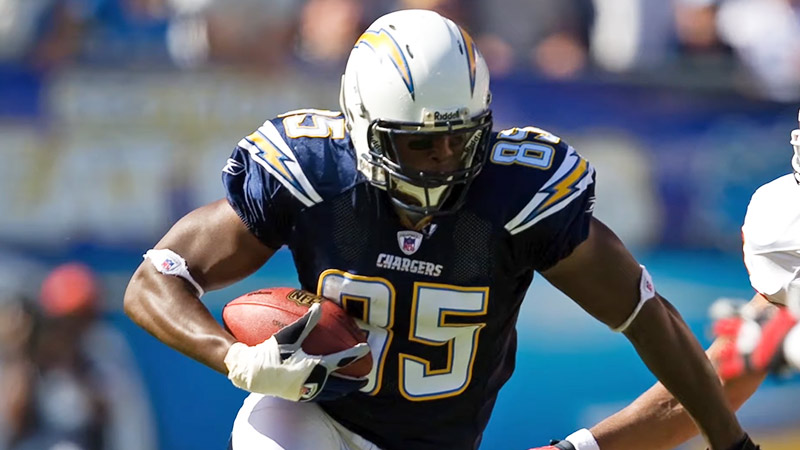
The enshrinement of Antonio Gates into the Pro Football Hall of Fame as a member of the Class of 2025 represents more than just a personal milestone; it marks a definitive shift in how the league evaluates talent and defines the tight end position.
For years, the question of whether an undrafted basketball player could reach the pinnacle of professional football was a matter of debate.
Today, that debate is settled. Gates is not only a Hall of Famer but a foundational figure whose career reshaped the architecture of modern offensive strategy.
The Definitive Answer: A Legacy Cemented in Canton
Antonio Gates was officially elected and enshrined into the Pro Football Hall of Fame in 2025. This induction serves as the ultimate validation of a 16-season career spent entirely with the San Diego and Los Angeles Chargers.
While many players reach the Hall through traditional routes—high-profile collegiate programs and early-round draft selections—Gates took a path that was, at the time, considered nearly impossible.
His journey from a college basketball standout to a professional football icon is a case study in raw athletic potential being honed into specialized excellence.
By the time he retired, he had amassed 955 receptions and 11,841 receiving yards, figures that place him in the upper echelon of all receivers, regardless of position.
However, his most significant achievement remains his 116 career receiving touchdowns, a record for tight ends that highlights his efficiency and dominance in the red zone.
The Anomaly: Transforming Basketball Skills into Gridiron Gold
One of the most remarkable aspects of Gates’ Hall of Fame resume is his lack of collegiate football experience.
He made history as the first modern player inducted into the Hall of Fame without playing a single down of college football. Instead, Gates was a star on the basketball court at Kent State.
This background was not a hindrance but a competitive advantage. The mechanics of post-play in basketball—using one’s body to shield a defender, high-pointing the ball, and understanding spatial positioning—became the blueprint for his success on the football field.
When the Chargers signed him as an undrafted free agent, they weren’t just signing a football player; they were acquiring a new type of athlete who could “box out” linebackers and safeties as if he were grabbing a rebound in the paint.
Traditional scouts originally viewed the lack of football film as a risk. However, Gates proved that the cognitive and physical overlap between an elite power forward and a modern tight end was substantial.
His success opened the doors for a wave of cross-over athletes, forever changing the way NFL front offices evaluate tight end prospects.
Statistical Dominance: The King of the End Zone
To understand why Gates was a lock for the Hall of Fame, one must look at the sheer volume of his production. Over 16 seasons, he became the most prolific touchdown-scoring tight end in the history of the league.
His 116 receiving touchdowns are a testament to his longevity and his ability to remain a primary target even as defensive schemes evolved specifically to stop him.
Statistically, Gates was a model of consistency. His career highlights include:
- 116 Touchdowns: The all-time NFL record for tight ends.
- 955 Receptions: Highlighting his role as a reliable chain-mover and a frequent target for quarterback Philip Rivers.
- 11,841 Yards: Placing him among the most productive offensive weapons in the history of the Chargers franchise.
- Accolades: Eight Pro Bowl selections and six All-Pro nods, reflecting his status as a top-tier player for nearly a decade and a half.
These numbers are not merely high totals; they represent a sustained level of excellence that few players can match.
In the context of the Hall of Fame, Gates’ statistics provide the objective “floor” for induction, while his impact on the game provides the “ceiling.”
Loyalty and the “Charger for Life” Philosophy
In an era defined by free agency and frequent player movement, Gates’ 16-season tenure with a single organization is an anomaly.
He remained with the Chargers through their transition from San Diego to Los Angeles, providing a sense of continuity and leadership during periods of organizational change.
His loyalty to the franchise solidified his status as a regional icon. For Chargers fans, Gates was more than just a pass-catcher; he was the face of the team’s offensive identity.
His partnership with Philip Rivers became one of the most productive duos in league history, characterized by a near-telepathic understanding of timing and defensive weaknesses.
This “Charger for Life” narrative adds a layer of character and institutional importance to his Hall of Fame case, emphasizing his role as a cornerstone of the franchise.
Redefining the Tight End Archetype
Before Gates, the tight end position was often viewed through a binary lens: you were either a “blocking” tight end who helped the offensive line or a “receiving” tight end who functioned as a slower wide receiver. Gates helped pioneer the “hybrid” or “move” tight end.
Because of his basketball footwork, Gates could line up in the slot, out wide, or in the traditional three-point stance. This flexibility created a logistical nightmare for defensive coordinators.
If they used a linebacker to cover him, Gates was too fast; if they used a safety, he was too large and strong. This “mismatch” philosophy is now a staple of every high-powered NFL offense, but it was perfected by #85 in San Diego.
The Class of 2025: A Moment of Historical Significance
The Class of 2025 will be remembered for its diversity of talent, but Gates stands out as its most unique member. His induction serves as a bridge between the old-school physical game and the new-school emphasis on specialized athleticism.
As he was enshrined, the league didn’t just celebrate a great player; it celebrated the success of the undrafted underdog.
His journey from an undrafted free agent to a Hall of Famer is a powerful narrative of self-belief and adaptation.
It serves as a reminder that talent can come from non-traditional backgrounds and that the “undrafted” label is often just a starting point, not a destination.
Conclusion: The Immortal Impact of Antonio Gates
The legacy of Antonio Gates is defined by the number 116—the touchdowns that broke records—but it is also defined by the number 85, the jersey that became synonymous with excellence in Southern California.
His induction into the Pro Football Hall of Fame in 2025 was a foregone conclusion for anyone who witnessed his dominance.
By excelling without a collegiate football background, Gates expanded the boundaries of what is possible for professional athletes.
He proved that specialized skills are transferable and that a basketball-first mentality could conquer the most physical league in the world.
As a 16-season veteran, a touchdown king, and a pioneer of the hybrid tight end, Antonio Gates has earned his place among the immortals in Canton.
His story will continue to inspire undrafted players and multi-sport athletes for generations, serving as a permanent reminder that greatness is not reserved for those who follow the traditional path.