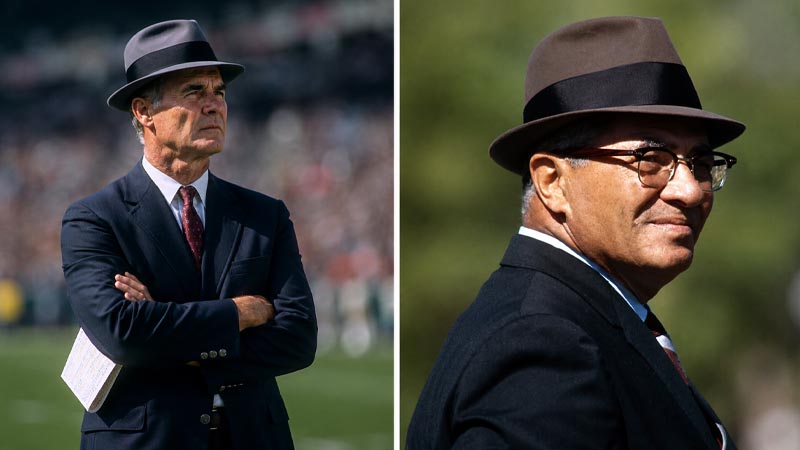
Picture a crisp autumn Sunday in the 1960s. The crowd at Lambeau Field is wrapped in heavy wool blankets, breath freezing in the sub-zero air.
On the sideline stands Vince Lombardi. He isn’t wearing a high-tech thermal sideline parka or a moisture-wicking fleece. Instead, he wears a tailored topcoat, a sharp fedora, a crisp dress shirt, and a neatly knotted tie.
Across the league, legendary minds like Tom Landry of the Dallas Cowboys commanded football games looking more like high-powered executives stepping out of a Manhattan boardroom than gridiron tacticians.
Today, seeing an NFL coach in anything other than corporate-sponsored athletic quarter-zips, weather-resistant jackets, and team-branded caps is entirely unthinkable. The modern sideline is a multi-million-dollar runway for athletic wear manufacturers.
How did we transition from bespoke tailoring to high-performance polyester? The evolution of NFL sideline fashion is a story driven by marketing genius, lucrative corporate sponsorships, and a single family legacy that cracked the system for one final, glorious hurrah.
The Golden Era: When the Sideline Was a Boardroom
For the first several decades of professional American football, head coaches dressed to reflect authority, professionalism, and status.
In an era before massive television contracts transformed the sport into a global entertainment empire, football was perceived as a rugged, cerebral game akin to corporate management.
Coaches were viewed as master strategists running complex organizations. Wearing a suit and tie was a statement of seriousness. It distinguished the leadership from the players on the field.
The Icons of Tailored Excellence
Tom Landry
Known universally for his immaculate three-piece suits and signature fedora, Landry cut a remarkably calm, collected, and sophisticated figure on the Dallas Cowboys sideline.
His appearance matched his precise, calculating “Doomsday Defense” and revolutionary offensive schemes.
Vince Lombardi
The ultimate symbol of grit and discipline, Lombardi famously commanded the Green Bay Packers in sharp topcoats, wool trousers, and ties. Despite the freezing Wisconsin winters, the tie stayed knotted, projecting unwavering command.
Paul Brown
The mastermind behind the Cleveland Browns treated coaching like an executive position, firmly establishing the expectation that professional coaches looked the part of modern business leaders.
This era lasted through the mid-20th century. Sidelines were populated by men dressed for Sunday mass or a corporate merger rather than an athletic contest.
But as television technology advanced and color broadcasts entered every American living room, the visual landscape of professional sports began to shift.
The Catalyst: Realizing the Power of “Walking Billboards”
The transformation from private bespoke tailoring to mass-market retail apparel did not happen overnight. It was sparked by a subtle wardrobe choice on a Monday night in 1986.
1. The 1986 Turning Point
During a high-profile Monday Night Football broadcast, New York Jets head coach Joe Walton walked the sideline wearing an officially licensed, prominent team sweater. It was a clean, recognizable piece of merchandise featuring the team’s colors and logo.
The reaction caught the league entirely off-guard. By the following morning, thousands of enthusiastic fans flooded the Jets’ telephone lines asking where they could buy the exact sweater Walton had worn.
League executives had a lightbulb moment. They realized that head coaches were not just tactical leaders; they were prime marketing tools.
Every weekend, millions of viewers locked their eyes onto the head coach during crucial timeouts and close-ups.
If coaches wore retail gear instead of private suits, they functioned as walking billboards, capable of driving massive merchandise sales overnight.
2. The “Coaches Club” Mandate of 1993
Capitalizing on this retail potential, the NFL formalized its marketing strategy in 1993 by launching the “Coaches Club.”
Under this new initiative, the league signed strict licensing agreements requiring all head coaches to wear officially approved, branded team apparel on the sidelines during games.
Suits were quietly pushed aside in favor of branded windbreakers, polo shirts, and pullovers.
As this mandate took hold, the old guard of suited coaches faded into retirement. Dan Reeves, who finished his legendary coaching career with the Atlanta Falcons in 2003, is widely celebrated as the final head coach to routinely wear a traditional shirt and tie on a regular basis. An era was officially coming to a close.
3. The Athletic Apparel Monopolies (2002–Present)
The final nail in the coffin for sideline tailoring came in 2002, when Reebok signed an exclusive, multi-year deal to supply all NFL on-field apparel.
Under the terms of exclusive league contracts, coaches were legally bound to wear apparel exclusively manufactured by the official corporate partner.
Because athletic brands did not manufacture business suits or silk ties, traditional formal wear became entirely incompatible with league rules.
When Nike took over the massive apparel contract in 2012, this policy continued uninterrupted.
Today, sideline attire is tightly regulated down to the exact hat, jacket, and shoes a coach wears during pre-game warmups, regular-season matchups, and post-game press conferences.
The Famous Loophole Exception: Mike Nolan and the 2006–2007 Suit Revival
Every rigid rule has an exception, and the ban on sideline suits featured a brief, highly publicized loophole in the mid-2000s.
Honoring a Legacy
In 2005, San Francisco 49ers head coach Mike Nolan approached the league office with an unusual request.
He wanted permission to wear a custom suit on the sideline to honor his father, Dick Nolan, who had successfully coached the 49ers in a sharp suit and tie decades earlier.
Initially, the league and its exclusive apparel partner, Reebok, resisted. The primary hurdle was simple: they didn’t manufacture suits, and existing contract terms strictly prohibited outside apparel brands from appearing on the field.
However, after continuous petitioning and emotional appeals, a creative compromise was struck.
The Custom Reebok Solution
Reebok agreed to custom-design a specific, high-end line of formal suits, dress shirts, and blazers specifically for Nolan.
Because these garments were manufactured under the corporate umbrella of the official league partner, they technically satisfied the legal requirements of the apparel contract.
Between 2006 and 2007, Mike Nolan—along with Jacksonville Jaguars head coach Jack Del Rio, who also secured permission—wore these sponsor-created suits for a limited number of high-profile home games.
The experiment generated immense media coverage, delighting traditionalists who missed the old-school aesthetic of the Landry and Lombardi eras.
The End of the Line
The revival was short-lived. When Mike Nolan was dismissed by the 49ers during the 2008 season, the special arrangement dissolved.
With Nolan’s departure, the custom suit program ended, making him the last head coach in NFL history to command a regular-season sideline in a full business suit.
Why NFL Coaches Will Likely Never Wear Suits Again
While fans occasionally reminisce about the sharp, cinematic aesthetic of mid-century football coaches, a return to suits and ties is virtually impossible in the modern era.
The economics and logistics of contemporary professional sports have permanently closed the door on tailored sidelines.
1. Multi-Billion Dollar Merchandise Ecosystem
Sideline apparel represents a massive revenue stream for both the league and individual franchises.
When millions of viewers watch a game, seeing the coaching staff outfitted in the latest weather-resistant sideline gear directly drives retail sales. Fans want to look like the team they support, creating a powerful loop of visual marketing.
2. Extreme Weather and Comfort
Modern coaching requires intense physical mobility, endurance, and protection against the elements. Coaches frequently work in pouring rain, freezing snow, and blistering heat.
Advanced athletic gear utilizes high-performance fabrics engineered to wick moisture, retain heat, or provide lightweight breathability.
A wool three-piece suit is entirely impractical for a coach running up and down a damp sideline for three intense hours.
3. Corporate Integration and Brand Consistency
Today’s NFL is a tightly integrated entertainment product. Every visual element—from the logos on the turf to the patches on the coaches’ sleeves—is governed by precise brand guidelines.
Athletic apparel provides a uniform, cohesive look that aligns seamlessly with corporate partnerships and broadcast standards.
Summary: A Look Back at Gridiron Elegance
The history of NFL sideline fashion reflects the broader commercial evolution of professional sports.
What began as a reflection of boardroom authority and mid-century elegance transformed into a high-performance marketing machine.
While icons like Tom Landry and Vince Lombardi forever defined an era of fedoras and tailored topcoats, and coaches like Mike Nolan provided a brief nostalgic echo in the mid-2000s, the era of the suited sideline coach belongs firmly to the history books.
Today’s coaches may trade classic tailoring for high-tech pullovers, but the pursuit of excellence on the field remains as sharp as ever.