In the modern era of professional football, the metric of “yards allowed” has become the gold standard for evaluating the efficacy of a perimeter defender.
For years, the conversation surrounding elite cornerbacks was dominated by interception totals and pass breakups.
However, as advanced analytics have matured, the focus has shifted toward a more grueling reality: the ability to exist on an island against the league’s most prolific scoring threats and emerge with the statistical upper hand.
Few players in the history of the position have managed this balance with the consistency of Darius Slay.
Often referred to by his moniker, “Big Play Slay,” his career provides a comprehensive case study in defensive sustainability, technique-driven coverage, and the statistical nuance required to shut down elite wideouts.
As we look back at his journey from an “underrated” talent in Detroit to a six-time Pro Bowl veteran who concluded his career in 2026, the numbers tell a story of high-stakes matchups and historical efficiency.
The 2017 Gauntlet: The 348-Yard Masterclass
The centerpiece of any discussion regarding Slay’s efficiency is his legendary 2017 campaign. During this season, a specific statistical threshold became the benchmark for defensive excellence: Slay allowed only 348 total yards when targeted.
To the casual observer, 348 yards might seem like a standard mid-season total, but the gravity of this figure is revealed when examining the caliber of opponents he neutralized.
The list of receivers Slay faced during this stretch was essentially a “Who’s Who” of elite pass-catchers:
- Antonio Brown: At the height of his powers, Brown was the most difficult cover in the league due to his route-running precision.
- Julio Jones: A physical anomaly who could overpower smaller defenders with ease.
- Michael Thomas: The league’s most efficient “slant-to-score” threat.
- Jordy Nelson: A master of sideline chemistry and back-shoulder fades.
- Stefon Diggs: A technician whose separation metrics were among the highest in the NFL.
- Odell Beckham Jr.: The most explosive game-changer of his generation.
Limiting this specific group of athletes to a combined 348 targeted yards is a feat of statistical improbability.
During this period, analysts and fans alike began to label Slay as the “most underrated corner in the league,” largely because, despite this objective dominance, he had never been selected for a Pro Bowl or an All-Pro team.
Decoding the Methodology: Side-Locking vs. Shadowing
To understand how Slay achieved these numbers, one must analyze his defensive philosophy.
Unlike some of his contemporaries who “shadowed” a single receiver across the entire formation, Slay’s primary role in the Detroit system was often to shut down one specific side of the field.
This strategy allowed the defense to bracket other threats while trusting Slay to handle any receiver who entered his domain.
However, Slay was far from a stationary defender. If an opposing receiver began the game with a “hot start,” Detroit’s coaching staff would frequently adjust, tasking Slay to shadow that individual for several drives to break their momentum.
This versatility—the ability to play a static role or a reactionary shadow role—made him an aggressive playmaker who was willing to risk occasional penalties to ensure a lockdown result.
This aggressiveness was a necessity. Reports from that era indicate that Detroit’s pass rush was frequently “garbage,” forcing the secondary to hold coverage for extended periods—often well beyond the standard three-second window.
That Slay maintained a 348-yard ceiling under these conditions suggests an elite level of athletic endurance and mental processing.
Peer Comparisons: Slay in the Elite Tier
A statistical deep dive requires context provided by Slay’s peers. During the same period that Slay was allowing 348 yards, other elite corners were producing equally fascinating, though differing, results:
- Patrick Peterson: Often considered the gold standard for shadowing, Peterson recorded a staggering 177 yards allowed while following the WR1 every single week. While his yardage total was lower than Slay’s, analysts noted that Slay’s list of opponents was arguably more formidable.
- Jimmy Smith: Smith recorded the least yards allowed in coverage at just 106 yards with zero touchdowns. However, the distinction here is that Smith did not shadow, meaning he was not always tasked with the opposition’s primary threat.
- Xavier Rhodes: A divisional rival of Slay, Rhodes faced similar high-tier opponents and allowed approximately half the yardage that Slay did in certain comparable timeframes.
- Marshon Lattimore: As a rookie, Lattimore set the league on fire, allowing only 137 yards through the first several weeks of the season, providing a benchmark for the next generation of shutdown talent.
When comparing these athletes, it becomes clear that Slay’s “348 yards” was not merely about the volume of yards, but the density of talent he was suppressing.
Contextualizing the Data: The “Hidden” Factors
In high-level defensive analysis, numbers rarely tell the whole story without context. There are several factors that nuance Slay’s defensive totals:
- The Odell Beckham Jr. Factor: While OBJ was on the list of receivers Slay neutralized, it is important to note that Beckham was recovering from an injury during their Week 2 matchup. He was on a “pitch count” and only played approximately a quarter’s worth of snaps, which naturally deflated the yardage totals for that specific game.
- The Quarterback Variable: In his matchup against Jordy Nelson, Slay benefited from the fact that Green Bay was starting backup quarterback Brett Hundley rather than Aaron Rodgers. This reduced the precision of the passes Slay had to defend, though his ability to limit Nelson was still considered an impressive feat of consistency.
- The “Big Play” Paradox: Slay was known for his ability to generate turnovers in clutch moments. For example, in 2016, he nearly single-handedly defeated the Eagles by creating two turnovers in the final three minutes of the game. This highlights that “yards allowed” is only one facet of his value; his ability to take the ball away was equally vital.
The Philadelphia Transformation and 2022 Efficiency
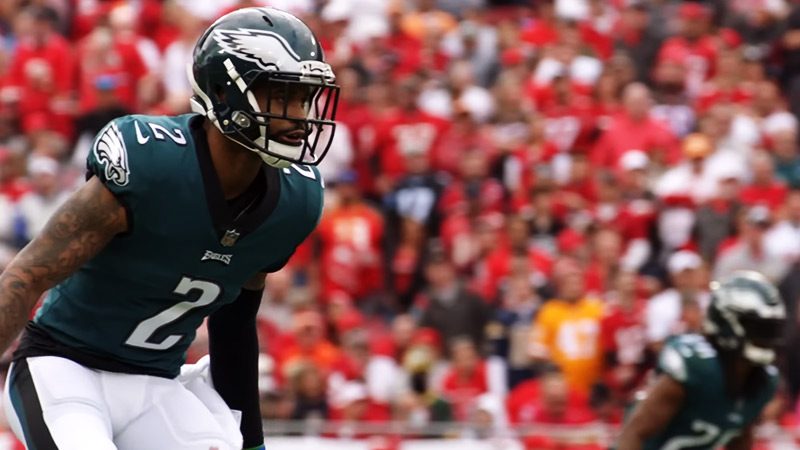
Slay’s move to Philadelphia in 2020 marked a new chapter in his career, one characterized by an even more refined approach to man coverage.
By 2022, Next Gen Stats revealed that Slay was being targeted at the second-lowest rate in man coverage among all outside cornerbacks (just 12.1%).
This is the ultimate compliment for a defender; quarterbacks simply stopped looking in his direction.
During this period, his “shadow” matchups became a point of intense interest for analysts. His recurring battles with Terry McLaurin serve as a perfect example of his veteran savvy:
- Week 12, 2019: 5 receptions for 72 yards on 12 targets.
- Week 17, 2021: 7 receptions for 61 yards on 8 targets.
- Week 3, 2022: 6 receptions for 102 yards on 9 targets.
Even when a receiver like McLaurin managed to cross the 100-yard threshold, Slay’s ability to make them work for every yard—often requiring a high volume of targets to achieve those totals—demonstrated his “bend but don’t break” efficiency.
Legacy and Retirement: A Career Perspective
Darius Slay’s journey concluded in 2026 after a final season in Pittsburgh, following a highly successful four-year stint in Philadelphia from 2020 to 2023.
His retirement marked the end of a career that saw him transition from an overlooked talent in Detroit to a six-time Pro Bowl selection.
His legacy is defined by more than just a single 348-yard stat. It is defined by an 82-yard return touchdown in 2021, a relentless work ethic that saw him develop from a college player who wasn’t even the best cornerback on his own team into an NFL superstar, and a professional attitude that allowed him to maintain high performance across three different organizations.
Conclusion
Darius Slay’s career represents the ideal marriage of statistical efficiency and “Big Play” impact. While the 348-yard total from 2017 remains a foundational piece of his legend, his true value lay in his longevity and his ability to adapt to the evolving demands of the cornerback position.
From his early days of being “underrated” to his final years as a respected elder statesman of the league, Slay proved that a shutdown corner is defined not just by the yards they allow, but by the confidence they provide their entire defensive unit.
As the NFL enters the 2026 season without him on the field, his statistical benchmarks will continue to serve as the target for the next generation of elite defenders.
For any aspiring cornerback, the blueprint is clear: minimize the yardage, maximize the takeaways, and always be ready for the “Big Play.”